Crème brûlée: Its History and How Chefs Have Reimagined It
A slightly crunchy caramelized top, a creamy vanilla center: crème brûlée has stood the test of time without losing any of its appeal. From the court of the Duke of Orléans to the kitchens of today’s chefs, Gault&Millau tells its story.
You can recognize it by the sound: the soft crack of the spoon breaking through the thin layer of caramelized sugar before diving into a rich, vanilla-scented cream. A dessert served in both bistros and fine dining restaurants, crème brûlée is one of those classics you never tire of ordering. Its history, however, spans France, Spain, and even England.
Between Catalonia and France
Its history lies between France and Spain, particularly in Catalonia, where traces of the famous crema catalana can be found as early as the14th century. But it seems that it was in France, in the17th century, that the caramelization technique was first developed. François Massialot, then chef to the Duke of Orléans, brother of Louis XIV, came up with the idea of running a hot iron over the surface of the cream, thereby caramelizing the sugar and giving birth to crème brûlée. The recipe appeared in 1691 in his book *Le Cuisinier roïal et bourgeois*.
Across the Channel, Trinity College, Cambridge, also claims its own version, “burnt cream,” which has been served there since the19th century, with the surface marked by an iron bearing the college’s coat of arms. Long somewhat forgotten in France, crème brûlée made a strong comeback on restaurant menus starting in the 1980s, eventually becoming one of the most famous French desserts in the world.
The Essentials of a Good Crème Brûlée
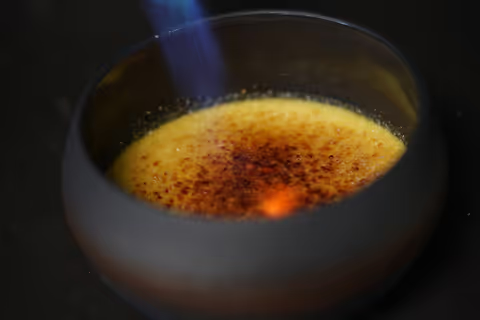
In terms of ingredients, the basics are egg yolks, sugar, heavy cream, milk, and vanilla. The mixture is then gently baked in the oven in a water bath to ensure it remains wobbly. Once cooled, the custard is sprinkled with brown sugar and caramelized at the last moment using a blowtorch or a kitchen torch. It’s all about the contrast: a cold, silky custard paired with a warm, crisp crust.
When Chefs Reinvent It
Traditionally made with vanilla, crème brûlée sometimes lends itself to creativity, and chefs have no shortage of imagination when it comes to reimagining it. Some remain faithful to tradition. At L’Auberge du Pont in Pont-du-Château, Rodolphe Regnauld recreates his grandmother’s version: “This dessert is simple, but it’s also an expression of my childhood memories. ” Free-range eggs, farm-fresh cream, and Tahitian vanilla come together for a classic, old-fashioned treat. At Belles Rives in Juan-les-Pins, Steve Moracchini also celebrates tradition with a caramelized Madagascar vanilla crème brûlée that takes you right back to your childhood.
Others take a more creative approach. In Nancy, Charles Coulombeau, chef at La Maison dans le Parc, pairs it with sweet potato and spices: “I wanted to offer a new experience while preserving the indulgent nature of crème brûlée. ” Cédric Perret, pastry chef at Clair de la Plume in Grignan, creates a version with hazelnuts and muscovado sugar, contrasted with a vinegar-marinated lamb’s lettuce. At Domaine des Andéols in Saint-Saturnin-lès-Apt, Vincenzo Regine retains only the essence of the classic, with a cheesecake-style version made with buffalo ricotta and a very crispy caramel opaline. Proof that this simple dessert continues to inspire.
Where can you find a good crème brûlée?
From neighborhood bistros to fine-dining restaurants, our reviewers have tasted the versions worth seeking out. Check out our selection of the best crèmes brûlées.