






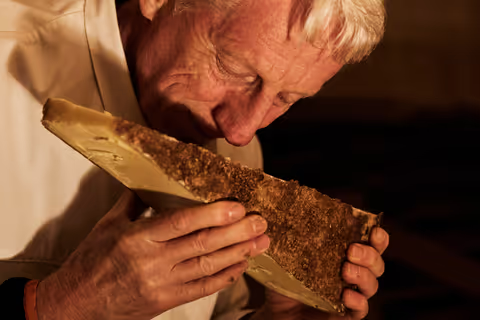
Jean-Charles Arnaud, the fort's janitor
Jean-Charles Arnaud is proud of his XIXᵉ century fort, where 180,000 wheels of exceptional Comté cheese are refined in cathedral silence.

In the commune of Les Moussières, in the Haut-Jura regional nature park, the Fromagerie du Haut-Jura was taken over just over eight years ago by Jean-Charles Arnaud. Without his intervention, this dairy would have closed, forcing dairy producers to give up the trade or move to another cheese dairy - there are 140 in the geographical area - within a mandatory 25-kilometre radius. With milk delivered daily by 16 producers, it produces around 250 tonnes of Comté per year, 120 tonnes of Bleu de Gex and a few tonnes of Raclette, Tomme de Montagne and Morbier.
The staggering figures for Comté
In addition to the 2,400 dairy producers, 140 fruitières and 14 maturing houses, the figures for Comté are staggering: 400, the number of liters of raw milk needed to produce a wheel of cheese; 45, the weight in kilos of a wheel of cheese at the time of manufacture, between 37 and 38 after 3 years of maturing; 60, its diameter in centimeters; between 9 and 13, the height in centimeters of its heel; 1.5 million, the number of wheels of cheese produced each year.these are dizzying figures, as is the depth of the copper vat used by the master cheesemaker to heat the 2,400 liters of raw milk that give rise to just 6 wheels of cheese.
Emprésuré, the milk is heated to 32°C for a curdling time of around 30 minutes. The curd is then sliced, and stirred faster and faster as the temperature rises to 53°C. The curds are then pressed for around ten hours, strapped for 18 hours, placed in a first acidification cellar and salted on the surface. After a few days in these cellars, each wheel - whose consistency at this stage is close to that of a marshmallow - is scrutinized by Jean-Charles Arnaud, who - by eye, ear, nose and touch - decides on its destination.
Some will go to the Poligny cellar (70,000 wheels) for a short maturing period, between 6 and 12 months. Others go to the Fort des Rousses for a longer maturing period (12 to 36 months). To understand the sheer size of this edifice, we need to go back to 1800, when Napoleon 1st realized that the Rousses valley - shallow and easily traversed - was the ideal location for an enemy quick to attack France, as the Austrians proved in 1815. Initially, a redoubt was built, and work on the fort began in 1841, finishing 70 years later.
The second-largest fort in France - after Mont-Valérien in Suresnes - Fort des Rousses could accommodate 3,500 men and 2,000 horses on a 21-hectare site featuring buildings built over 50,000 m of vaulted cellars and kilometers of tunnels. A training facility during the First World War, it was later transformed into a Red Cross center to take in broken bones and orphans. Taken by the Germans in 1940, liberated in 1944, it became a training center for elite troops and a barracks for conscripts, until it was demilitarized and put up for sale by the state. Jean-Charles Arnaud is familiar with the site - which at the time did not appear on any land registry - having been a military instructor there.
Like his grandfather and father, Jean-Charles Arnaud, a graduate of the École nationale d'industrie laitière in Poligny, went into Comté cheese production and took over the family business in 1990. He rethought the Fort des Rousses, which would be ideal for refining cheese wheels. But the transaction cost millions of euros, not including work. A banker believed in his project and, thanks to a 100% loan, Jean-Charles Arnaud undertook a titanic project to turn the site into an exceptional refining facility for his own cheese wheels, as well as those of 22 other fruitières.

@ Studio Dubois-Didcock
Cheese ripening
Today, 180,000 wheels of cheese wait in the various cellars - between 4 and 7 for a Comté, depending on its maturation period - including the 214-meter-long "Charles Arnaud" cellar.
here, 6,000 wheels are stored on their planks of Haut-Jura spruce. In this cellar, as in the others - whether for texturing, at 12°C, where the cheeses remain for 5 to 6 weeks, or for fermentation, at 18°C, for 3 to 4 months - each wheel is turned (at least 100 times), examined, brushed and salted with coarse salt. When they are 4 months old, they are tasted to determine their capacity to reveal themselves. But maturing, as Jean-Charles Arnaud points out, is not an exact science: " Take 3 wheels from the same vat, place them in 3 different cellars. You won't get the same result, because the air quality is not the same from one cellar to another, and because the microflora of the neighboring wheels will not impact the new one in the same way. "
You have to listen to each wheel by making it ring or vibrate, put your hand on it - or your ear - and feel it to decide on its future. Some will develop a lactic flavor, others more vegetal, dried fruit, citrus or animal. But none will be salty. The famous crystals that everyone can taste are not salt crystals at all, but little clusters of tyrosine, an amino acid that causes that salty sensation. Let's face it, it's good for everyone!
Fromageries Arnaud
- Avenue de la Gare, 39800 Poligny
- Tel: 03 84 37 14 23
Le Fort des Rousses
- Le Fort des Rousses, 39220 Les Rousses
- Tel: 03 84 60 02 55
- www.fort-des-rousses.com
- www.juraflore.com