






From the king's court to our jams: the incredible story of the mirabelle plum
The little golden plum with the taste of honey returns for its short season at an ever earlier date, due to climate change. From now on, this sweet and tart natural sweet is harvested from mid-July onwards in its native Lorraine, only to disappear before the end of summer... The mirabelle plum can only be found on the shelves for six or seven weeks.
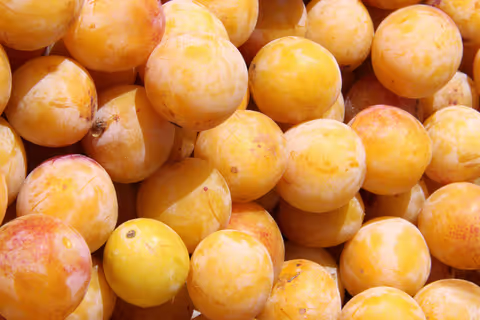
"The mirabelle plum is a small plum that is amber-colored when ripe, with an oval shape, fine, melting flesh and very sweet water (...). There are two kinds, the large and the small: both are equally good. "Almost four centuries after the publication of the confectionery dictionary Le Cannaméliste français, there's nothing to change in the descriptionthe description given by Joseph Gilliers from Lorraine, presented as " chef d'office et distillateur de sa majesté le roi de Pologne, duc de Lorraine et Bar ". Like the reine-claude before it, the mirabelle de Lorraine is a successful plum.
Among the forty or so existing varieties, these two headliners stand out for the royal interventions attributed to their destinies.according to Alexandre Dumas, the mirabelle plum was planted in Provence, then Lorraine, in the 15th century by the "good King René" - without a kingdom, but duke of Anjou, count of Provence, duke of Bar and Lorraine. Other fairy godfathers followed in his footsteps, and the Mirabelle plum successfully took root in the clay-limestone soils of Alsace-Lorraine. The " best plum of Lorraine " was recognized as a variety in its own right as early as 1628 in Pierre Lectier's historic Catalogue des arbres cultivés dans le verger. Entered in the Dictionnaire de l'Académie française in 1762, its name " probably from Mirabel, a toponym quite common in the south of France " is thus confirmed in the ninth edition of the Dictionary.
First PGI fruit
Although Mirabel grows almost everywhere in France, it took advantage of the phylloxera crisis at the end of the 19th century to spread widely in Lorraine, replacing the devastated vines. since 1974, a brotherhood has been working to preserve this crop, making the "mirabelle de Lorraine" the first fruit to be awarded a PGI. the first fruit to be awarded a PGI in 1996, followed by a Label Rouge in 1999, with guaranteed origin, traceability, 22 mm size and sugar content. As a result, with 250 growers and 5,000 to 9,000 tonnes of fruit a year, Lorraine now supplies 80% of the world's harvest. Joseph Gilliers' "grosse" and "petite" are still the two main varieties, named in the 19th century after rival towns in the region.
Gros Mirabelle from Nancy and Petite Mirabelle from Metz coexist, the former more suited to fresh eating and tarts, and the latter, sweeter and with red flecks, to jams, compotes and coulis. Since the late 18th century, and officially recognized since 1953, a fine, fragrant eau-de-vie has been distilled from the juicy Nancy variety. With a Mirabelle plum festival that has established itself as a popular event in Moselle - from August 22 to 31, 2025 - Metz takes center stage every summer.