






The tomato, fruit of the New World and the new world
"The most widely grown vegetable in the world, the tomato attracts covetousness and innovation. It shows just how far today's cultivation methods can go, traveling across every continent and in thousands of preparations. In France, we've become attached to them in every season. It's the most widely purchased fresh vegetable, and we can no longer cook without it, even if we almost lost its taste. But it's been making a comeback over the last twenty years, thanks to producers who are also bringing back its sublime colors!

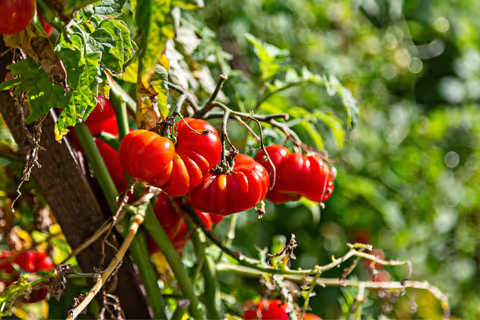
In botany, a fruit is the product of a flower and is intended to protect seeds, pits or seeds. The tomato, an annual plant in the Solanaceae family, is a fruit! Native to the Andes, tomatoes are yellow or red in the wild. The Incas are credited with first selecting it, then the Aztecs with cultivating it and naming it " Tomatl ". It was the size of a ping-pong ball when the conquistadors discovered it and brought it to Europe in the 16th century. As the Solanaceae family includes so-called witch plants (belladonna, mandrake), botanists were wary of it and classified it as toxic. In France, it is only cultivated in gardens for its ornamental qualities. The more daring Italians used it in sauces to garnish meats, giving it the name " pomodoro " (golden apple).
By the middle of the eighteenth century, the tomato had earned its title as a fruit, and was included in seed catalogs (1778). In the 19th century, Europeans migrating to the United States took some with them, opening up a new market. Meanwhile, tomatoes began to travel around Europe, as everyone wanted to eat them. In the 20th century, people finally "dared" to eat them, raw and in salads.
A dizzying market
Worldwide, tomatoes account for 190 million tonnes of annual production, including 70 million tonnes in China alone, the world's leading producer and exporter. A large proportion of this volume is destined for the processing industry - concentrate, purée, coulis.
Tomato paste has become a universal ingredient, used in thousands of culinary preparations. Worldwide tomato production has increased more than six-fold in sixty years, bringing with it agricultural and ecological upheavals. In 40th position, France produced 475,500 tonnes of tomatoes in 2024, of which 225,700 tonnes were exported, while 422,300 tonnes arrived on our soil from Morocco (75%), Spain (13%), Belgium and the Netherlands. In France, the main producing regions are Brittany, Provence-Alpes-Côte d'Azur and Pays de la Loire, and the surface area under glass is three times that of outdoor cultivation. There are many arguments in favor of the former: greenhouses protect plants from the cold and hail - tomatoes can be harvested in the spring - they help reduce the use of pesticides, and they regulate water, which tomatoes consume a great deal.
Last but not least, growing tomatoes in greenhouses means avoiding the dreaded mildew, a disease linked to humidity. As with many other fruits and vegetables, the greenhouse and soilless production methods - in which the plants' roots lie in a substrate, stained from the soil, the soil and the roots of the tomato - are ideal for growing tomatoes.the water supplied by drip irrigation can be enriched with nutrients. Specially-created varieties - tomatoes need to be resistant to disease and transport - hybrid seeds, nutrient inputs, heated facilities and sometimes very high energy bills....if this method of cultivation is far from eco-responsible, it meets the galloping needs of the agri-food industry and the desires of consumers who want tomatoes all year round.
Taste gone
In the 1990s, cases of "junk food" and health disasters broke out. The firm, round tomatoes flooding the market no longer had any taste, and people's consciences were awakened.louis-Albert de Broglie, who had started a collection of tomato varieties in his kitchen garden at the Château de la Bourdaisière in Montlouis-sur-Loire, attracted media attention.the "Prince Gardener", as he is known, is a great lover of diversity, history and poetry, and is keen to rediscover the taste of the lost tomatoes of his childhood. "The special thing about tomatoes is their unexpectedness. They can be as colorful as candy," he enthuses.

borja Mérino
Thanks to catalogs (including that of Terre de semences, now Kokopelli), magazines and his contacts with collectors around the world, he managed to build up a collection of almost 400 varieties. In 1998, the collection was accredited by the Conservatoire des collections végétales spécialisées (CCVS) and the kitchen garden officially became the Conservatoire national de la tomate! The fruits of this conservatory, like those of resistant growers, are what are known as field tomatoes. Planted in May, after the ice saints, they can be picked and eaten from July to the end of October. Neither before nor after. Cultivation that respects seasonality offers richer-tasting varieties and better-quality fruit. Their higher prices are justified by low yields and the artisanal cultivation of tomatoes picked at full ripeness, one by one, by hand.
Tomato paradise
The arrival of head gardener Nicolas Toutain at the Conservatoire de la Tomate in 2007 helped to further develop the collection and reorganize the kitchen garden. "A garden resembles its gardener ", he explains. That's how he reframes, refocuses and works on precise labeling to better showcase the collection, which now includes 780 varieties! All the seedlings are produced on site - a seedling is a young plant intended for transplanting - from seedlings sown between January and February. The greenhouses that house them date back to the 19th century, and were magnificently restored in the late 1990s. The seeds, sown by hand and sometimes with tweezers, are also home-grown, having been salvaged from damaged fruit. Some of the plants - 12,000, corresponding to 50 varieties - are sold at the annual Fête des plantes, held over the Easter weekend. Visitors are delighted to buy these rare varieties, which are also available as seeds from the boutique.
The other series of plants is reserved for the conservatory's kitchen garden: two or three plants of each variety are transplanted onto 9,000 m², for a total of 1,800 plants, producing around 3 tonnes of tomatoes. Surrounded by aromatic annual and perennial herbs and ornamental flowers, the fruit is destined for the Château de la Bourdaisière's restaurant and the Tomato Bar, located next to the greenhouses (open for lunch for visitors and dinner for hotel guests). But the standing fruits, on teepee-shaped stakes, are there first and foremost to show off their diversity, their fragrance (it's the stems and leaves that are charged with fragrant sap, not the fruit) and to arouse curiosity and wonder. Varieties are planted by color and alphabetical order.
The Festival de la tomate et des saveurs arrives at the height of the season (September 13 and 14, 2025, for the 27th edition), with tours of the conservatory, events, cooking demonstrations, conferences and the extraordinary tomato market.

© Conservatoire De La Tomate
The old, the new?
When he talks about the taste of the tomatoes in the garden, gardener Nicolas Toutain immediately breaks into a smile: " These are high-quality fruits, the flavors of a terroir. "For him, growing tomatoes in heated greenhouses is a disaster, " both ecologically and in terms of taste! Tomatoes are not like potatoes. As soon as it's harvested, it has to be eaten quickly. Mass-market tomatoes are harvested very firm and stored in cold rooms. To ripen them, ethylene gas is used, which has a major impact on taste. "It's best to use heirloom tomatoes, either in the field or in the ground. These are reproducible varieties, also known as "population varieties". In other words, tomato varieties whose seeds can be replanted. not to be confused with "F1 hybrids", which are intended for mass distribution - produced for the complementarity of their characteristics, their resistance to disease, the quality of the harvest, the earliness of the fruit and the quality of the fruit. these varieties have to be recreated for each generation, and the seeds purchased from seed companies every year.
According to Nicolas Toutain, " the real old varieties are tomatoes from the 18th, 19th and 20th centuries, like the Pomme Rouge de Montpellier from the 18th century, the Pineapple from the end of the 19th century, or the Green Zebra created in 1985 ". The largest tomatoes were created at the end of the 19th century - even larger ones would risk bursting. Until the 20th century, many varieties were created. But seeds contain water and therefore also die. " It's a living organism ," confirms the head gardener. Varieties are passed on because they are cultivated by gardeners. Louis-Albert de Broglie is already thinking about the new restaurant of 2026, which will offer a unique tomato experience.
This article is taken from Gault&Millau Magazine #10. This issue can be found in our online store.