






Petit Bouilleur will become great
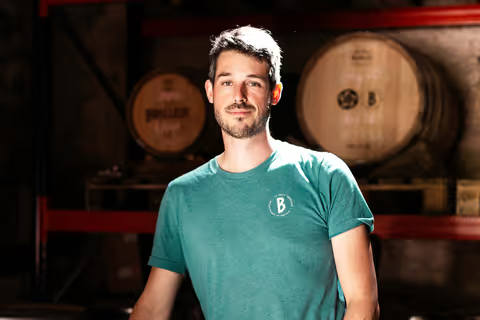
In a peaceful corner of the Jura, nestles Le Petit Bouilleur, a distillery like no other. No gleaming industrial machines or automated processes here, but one man, Baptiste Dayet, who has chosen to revive tradition while infusing it with his boundless creativity.
A native of Lons-le-Saunier, Baptiste launched his distillation adventure.after almost a decade in Alsace and four years in Germany, where he worked in Zalando's warehouses, it was an ecological trigger that prompted him to change course:" When you buy something on the site, it's free to return it.people know this and use it to excess. This waste showed me that this world sometimes makes no sense at all ", confides the distiller, his eyes shining with undiminished conviction.
Baptiste set up his distillery in a patiently restored 17th-century Jura coaching inn: " The planets aligned. Everything became crystal clear... or rather like a good spirit. When you're on the right track, everything becomes logical and fluid, and that's exactly what happened. "
Between tradition and modernity
At the heart of his workshop proudly sits a traditional bain-marie still, a veritable jewel inherited from Alsace: " The advantage of a bain-marie is that you can distill absolutely anything without the risk of it burning or catching," says Baptiste, affectionately caressing the patinated copper.he heats with wood, preferably reclaimed from the vineyard. next to him, a second, more modern, 500-liter, gas-fired, direct-fired still completes the installation: " Between tradition and modernity, both work perfectly. "
But don't think that technology has replaced ancestral know-how. Here, there's no need for sophisticated thermometers: the touch of copper is enough: " Distillation calls on all five senses. The eye observes the steam; the ear listens to the crackling of the wood; the hand feels the heat of the copper; the nose smells the aromas that escape, and of course, the mouth tastes the final result. "He applies this sensory, almost meditative approach religiously: " There's no music when I'm distilling, you have to pay attention to what's going on. You hear the bubbles, smell the copper heating up, see the steam appearing... It's this attention and the use of all my senses that make the quality of the work. "
A passion for plants
Baptiste turned to distillation first and foremost for his love of plants: " Their medicinal side, their olfactory and gustatory properties, their colors ...". To obtain this magnificently fragrant greenery, he sources as close to home as possible. Elderflower even comes from his own garden. His anisé, which he refuses to call pastis since he doesn't use tropical star anise, is inspired by Pontarlier traditions with caraway, fennel and aniseed, with no added sugar. An authentic, refreshing Jura version.
From this passion has grown a range of spirits as varied as they are original. He also produces gin, absinthe and arquebuse, which put the plant world on a throne. All three are crafted in such a way that the local plants find meaning and come to life. Gin, which one might be inclined to serve with tonic, is best enjoyed on its own, on the rocks, so complex is it: " A well-crafted spirit has substance, nobility: it must accompany the aromatics of the plants or fruits we're looking for. "But it is perhaps in his eaux-de-vie that Baptiste's talent expresses itself most freely. His savagnin marc, from Domaine Les Bottes Rouges, is worked like a fine, delicate grappa: " For 100 kilos of marc, we make 6 to 7 liters. "The result? Smooth, full-bodied and delicate, with the delightful freshness that characterizes our spirits.

claire Jachymiak
A druid's work
If distillation is an art, maturing spirits is no less crucial. Our Petit Bouilleur plays with different types of casks to refine his creations: oak for whisky, old straw wine casks for rum, acacia micro casks that leave their mark in just a few months, or chestnut casks for an absinthe aged in the Chartreuse VEP style: " The barrel is not an end in itself," he nuances. "A lot of work is done in stainless steel vats, especially for white spirits. "What counts for him is the intention. " Every time I create a new recipe, I imagine the finished product. Then I make sure I get there, by finding the plants and fruit I need and, after that, I think about whether it's worth going underwood. "A real Druid's job.
Baptiste also puts this boundless creativity to work for other brands. The creation of white-label spirits accounts for more than half of his sales: " I love this part, it allows me to bring my creativity, my novelty and my innocence. I don't have ten generations of distillers behind me putting pressure on me. "
An ethical and ecological commitment
As a member of the Gnôles naturelles collective, Baptiste's approach is respectful of the environment. Distillation waste is given a second life: the methanol is used for cleaning and disinfecting, while the vinasse (the molasses from which his rum is made) is used as fertilizer in the surrounding vineyards. Now a member of the Collège Culinaire de France, he hopes that his spirits, still highly confidential, will shine on gourmet tables. If you're going to make good products, you might as well make them known, tasted and appreciated. His life in the countryside reflects this commitment: a few plots of vines for his own consumption, three Ouessant sheep (including two rams), chickens, a dog, a cat, fruit trees and a vegetable garden complete this bucolic picture:" Enough to keep you busy when you've got five minutes left in an already busy day ," he jokes.
Baptiste Dayet is the perfect embodiment of this new generation of distillers who, far from industrial constraints, are reinventing the craft with passion and authenticity. In his small Jura workshop, he perpetuates ancestral know-how while infusing it with his creativity and personal vision. His remarkably fine and precise spirits bear witness to a certain talent and a sensitive approach to distillation. Le Petit Bouilleur is small in name only: it's a great tasting adventure that's only just begun.