






Niche honeys produced in the Sarthe region and prized by haute gastronomie
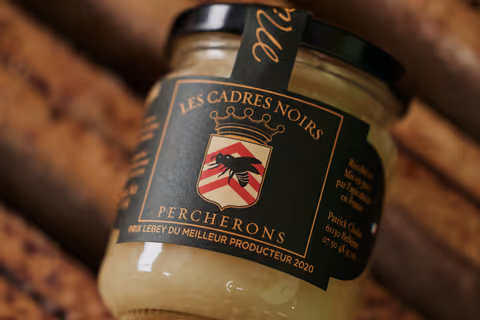
In Bonnétable, Sarthe, Patrick Cholet has found his vocation. Far from the offices of the oil group for which he worked for 15 years, it was with the bees that he undertook a reconversion. His exceptional honeys, reflecting the landscapes and terroirs of the Perche region, are now prized by connoisseurs and chefs alike, both in France and abroad.

When Patrick Cholet started beekeeping in Bellême, Perche, in 2015, he got off to a rocky start. Too few hives and market sales that weren't enough to ensure the viability of his business. In 2019, an idea came to him: to produce niche honeys, specific to his region and the crops that grow there - a practice not very widespread in the industry. He places his hives in specific locations, on crops that stand out, such as buckwheat, and, pooling what savings he has left, sets up a stand at the Chefs World Summit in Monaco, where his production can be tasted. A number of chefs showed an interest, and Patrick took his first orders. They include Christian Garcia, chef of the Palais de Monaco, Pascal Barbot of L'Astrance in Paris, and Arnaud Donckele of La Voile d'Or in Saint-Tropez. This positioning, this search for niche honeys, is bearing fruit. In six years, Patrick has gone from five chefs to 80, from local markets to exports, from around 30 hives to 300 or 400 depending on the year, for an annual production of five to six tons. To achieve this, he mapped out his region, its terroirs, production and honey-growing areas, and approached farmers to work hand in hand. The farmer makes part of his field available for the installation of beehives, the bees pollinate his crops, and the beekeeper harvests the honey. A win-win situation.

One crop, one honey
The possibilities are endless, depending on the location of the beehives in the countryside and its crops: hawthorn honey, alfalfa honey, carrot flower honey or meadowsweet honey. Depending on the year, Patrick offers between 12 and 14 rare honeys, not counting those made to order for certain chefs, bakers and pastry chefs, and vintage honeys. You have to be everywhere and cover a lot of ground, as with onion blossom honey, which is produced on 17 hectares, while apple blossom honey is obtained from the 70 hectares of renowned cider-maker Benoît Lesuffleur. Chestnut honey, meanwhile, requires special attention, as the deciduous tree only flowers for four days. Despite all these efforts, "niche" honey can be downgraded to "spring" or "summer" honey if the samples sent to the laboratory cannot guarantee that 80% of the advertised plant is actually present in the samples. added to this are the hazards of the trade, notably the mortality of bees exposed to pesticides or those lacking food as urban areas nibble away at the countryside. A bee forages "on average between 250 and 700 flowers per hour for 9 to 13 hours a day". Another concern for the beekeeper is competition from low-priced foreign honeys, or fraudulent honeys diluted with rice, sugar beet or wheat syrups.

A busy job
From May to August is the extraction period. Patrick takes only the honey from the frames at the top of the hive, the rest providing food for the thousands of beekeepers for the rest of the year. As soon as the honey is extracted, it is placed in jars to avoid the risk of oxidation and loss of some of its nutritional value. Within a few days, the honey crystallizes and a very thin protective layer of wax forms on the surface. So honey is never liquid? "Honey is only liquid when it is extracted. If beekeepers sell liquid honey, it means they've stirred or heated it for a long time. In itself, it's not bad and it's not forbidden, but it's not my idea of beekeeping." So there's no such thing as creamy honey either? "That's a marketing ploy. In reality, it's liquid honey that's been beaten for a long time and becomes unctuous or creamy by force of circumstance." Once the honey is in the jar, the year is far from over. We have to constantly check the health of the hives, the bees and their queen, whose life expectancy has dropped considerably over the last two decades, protect their habitat and replace some of the frames. Winter is also an opportunity to meet chefs to taste the dishes in which his honeys are incorporated, to meet farmers to discuss the crops planned for the following year, or to set up new projects. Most recently, Patrick Cholet planted almost 2000 trees and forgotten plants, where he and his chef customers organize discovery workshops punctuated by a meal made from locally harvested produce, including, of course, honey.