






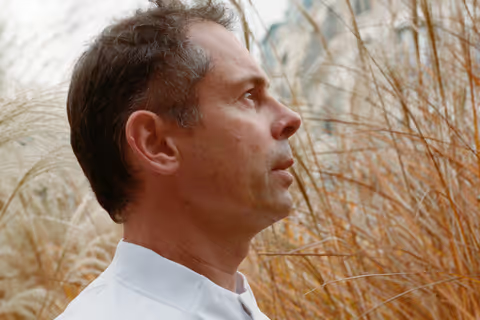
Pascal Barbot in 5 dishes
From burnt-bread soup to an absolutely demanding bowl of white rice, Pascal Barbot of Paris's L'Astrance looks back at five emblematic dishes that tell the story of his career, his influences and his vision of gastronomy on the move.

Opened in 2000 on rue Beethoven by Pascal Barbot and his partner Christophe Rohat, L'Astrance (4 toques) remains one of Paris's most legendary addresses. In the space of a quarter of a century, the chef has made his mark with pioneering cuisine, notably with the bold choice - at the time - of a single menu without a menu. Not out of strategy, but out of necessity. "The kitchen was tiny, so we had to adapt. And this constraint became an extraordinary source of creativity," recalls Pascal Barbot.
Since then, the restaurant has moved to rue de Longchamp, in the 16ᵉ arrondissement, in place of Joël Robuchon's former Jamin. While the address has changed, the spirit remains: a cuisine of micro-seasons, attentive to producers, textures and balance, nourished by the chef's many travels, from Auvergne to the Pacific, Japan to Australia. through five dishes, Pascal Barbot recounts this singular trajectory.
The foie gras and mushroom tart: an innovative interplay of textures
For years, this has been one of L'Astrance's signature dishes. A tart as radical as it was subtle, it has now been withdrawn from the menu, but is still firmly anchored in the memories of our customers. The foie gras was served raw, marinated in verjuice and combined with button mushrooms finely carved with a Japanese mandolin. "At the time, everything was quite innovative: foie gras was served raw, as a condiment, simply to add a note of fat and counterbalance the almost bland side of the mushroom," explains Pascal Barbot. A real interplay of textures, enhanced by the crispness of the brick pastry sheets, designed to be assembled for six to eight people and cut up at serving time, at the cost of a great deal of technical thought to ensure that nothing collapses.

The recipe has evolved over time, sometimes with beet and haddock, ceps and parmesan, zucchini and tomato, or truffle and potato, but has retained its essence, and has been a favorite with customers for many years.
The shellfish and seafood platter: a tribute to Asia
Served in the new Astrance décor, this platter is the most direct expression of the chef's Asian influences. "My partner is from Asia, I learned to cook with Japanese people, and I've been going to Japan almost every year for a long time," explains Pascal Barbot. Bulots, clams, mussels, razor clams, abalone... The products vary according to the season, served raw, cooked, warm, hot or cold. Associations sail between cultures: oyster, horseradish and green apple; prairie and almonds with citrus juice and chili; langoustine and shellfish consommé; scallop and kombu.

"During Covid, I did a lot of work in Japan, particularly on seafood cutting. I love this hyper-precise cuisine, in terms of gestures, tastes and textures", he emphasizes. It's a permanent playground where the chef has fun, without ever losing sight of the product.
Burnt bread soup: a comforting memory
This bread soup was born in Australia almost thirty years ago. "I used to work in that country, and I remember making this soup spontaneously during a service," recalls Pascal Barbot. The bread is burnt to bring out roasted notes, then blended into a soup and emulsified to bring out its lightness.

"We offer it as a welcome soup when it's very cold, but without telling customers what it is... They have to guess! Some think it's a croque-monsieur soup, others a coffee soup, but many hit the nail on the head. In any case, they bring back a lot of memories, with those comforting, reassuring tastes, without being too rich", enthuses the chef.
The white rice bowl: purity at its purest
At Pascal Barbot, a bowl of rice can become a major dish. Behind this apparent simplicity lies an extreme rigor. The rice must be of impeccable quality, freshly polished. The water must be highly mineralized and as pure as possible. Every detail counts: the rinsing to remove excess starch, the cooking temperature, the resting time.

"We cook a fresh rice for each table. No salt, no butter. Just rice and water, period. it sounds simple when you say it like that, but it's actually very complicated." Only then do the condiments come into play: marinière, shellfish bisque... They evolve over time, without ever altering the purity of this rice prepared to perfection.
Tulip peanut and sorrel: the perfect balance
Created a year ago, this dessert has established itself almost in spite of itself. "It'shard to get it off the menu," laughs Pascal Barbot. Conceived with the Astrance team, it illustrates the importance the chef places on collective creation. The starting point: the peanut, from a family of producers in the Landes region. "Peanuts aren't really part of our culinary culture, but I thought it would be interesting to work with this product," says the chef. The combination with sorrel came naturally, to the point where the dessert could almost pass for a starter.

Peanut ice cream, sorbet sorrel, caramel, shortbread, sorrel salad: the whole plays on the balance between freshness and indulgence. "You have to keep the sweetness in the dessert, but too much sugar isn't pleasant at the end of a meal," he comments. A finale of controlled tension, true to the spirit of L'Astrance.