






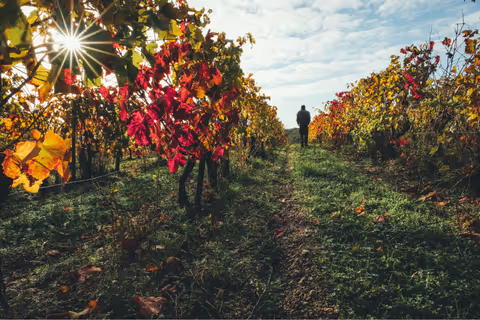
Softness, between resistance and extinction
With three main production areas: the South-West, Anjou and Alsace, some thirty appellations, and volumes that vary from vintage to vintage, the market for sweet and syrupy wines is experiencing varying fortunes in the face of changing consumer trends.
" No thanks, I don't like sweet wines. "Who hasn't heard this refrain in front of a golden bottle of sauternes or a coteaux-du-layon? Try an experiment: feign prejudice with a côtes-de-bordeaux-saint-macaire, a pacherenc-du-vic-bilh from the Pyrenees or a bonnezeaux from angevin, sweet wines that everyone has forgotten. Tasting often changes one's mind, not least because the high acidity offsets the dreaded sweetness.
Aromatic delight
Sweet wines, a heterogeneous production, have in common a residual sugar content - after fermentation - of over 12 grams per liter. Below 45 grams, they are said to be "semi-sweet", and sweet beyond that. The term "liquoreux" has no regulatory definition: it is used to designate the richest nectars, up to 250 grams per liter for certain Alsatian lords. These autumn "jams" conceal an intense aromatic voluptuousness, sculpted in a sheath of acidity. Moelleux" wines are softer, with fresh fruit and liveliness. Sweet wines are made from grapes harvested when slightly overripe or more pronounced - known as passerillage or vendanges tardives.they are often picked in several "passages" to select berries at different stages of dehydration, and therefore concentration. this is sometimes compounded by the presence of a noble fungus, Botrytis cinerea - in Sauternes, Quart-de-Chaume or in Alsace for the selection of noble grapes...
Monbazillac, the champion
South of Bergerac, the Monbazillac appellation covers 2,300 hectares and produces 7.5 million bottles (60,000 hectolitres) of this rich, golden-coloured wine, with aromas of candied fruit and gingerbread.sold 70% in supermarkets, it is the "popular" counterpart to the elitist Sauternes from Bordeaux." We're pulling up red wine vines all around us, but not the Semillon and Muscadelle varieties we use to make Monbazillac," says Annette Goulard, vice-president of the cooperative. The winegrowers manage their stocks by collectively setting a maximum yield each year: " In this way, we maintain a decent income at 3,500 euros per 900 liters, even if we'd always like a little more. "Sauternes had to grub up its vines, reducing them from 2,200 to 1,600 hectares ten years ago.
" Stock levels are at their lowest for twenty-five years. Our market is very small, but healthy," assures Jean-Jacques Dubourdieu of Château Doisy-Daëne, president of the Sauternes-Barsac appellation. There are 140 growers on the banks of the Ciron, a river whose mists provide the humidity needed for botrytis to develop on the skin of the Semillon grape. The limited yield of 25 hl/ha produces three to four million bottles, rich in a palette of fifty aromas. And an infinite range of hues, from light gold to amber to scarlet copper, depending on age. A great wine for laying down, almost eternal, it is the king of sweet wines. Forget Grandpa's pairing with foie gras and black forest, it's with Sunday roast chicken, fine fish, blue-veined cheese, tangy desserts or spicy dishes that it will reveal all its majesty.
To restore its tarnished reputation, Sauternes wants to rhyme with modernity and appeal to younger consumers by slipping into their cocktails. Sweet wines account for 3% of Bordeaux's surface area. In addition to Sauternes and Barsac, the Entre-deux-Mers region produces generic sweet Bordeaux and a few sweet nuggets such as Sainte-Croix-du-Mont (200 ha), Loupiac (150 ha), Cadillac (80 ha) and Côtes-de-Bordeaux-Saint-Macaire (just 18 ha!). These appellations are threatened by the age of the winegrowers, who are nearing retirement and often have no successors. But even though they're on borrowed time, all these appellations are defending their turf, " which doesn't make sense when it comes to exports", saysEmma Baudry, head of the Union des vins doux de Bordeaux, who regrets that Sweet Bordeaux, a common brand created in 2009, has fallen into disuse. "Producers are increasingly turning to Crémant," she observes. " It's our main competitor ", adds Annette Goulard, for Monbazillac: " Sweet and sparkling wines have the same consumption times: end-of-year celebrations, weddings, birthdays...".
Resistance from Pau
South of Pau, in Jurançon, wines based on petit and gros manseng, whose natural acidity whips sugar, are more than holding their own: releases of moelleux increased by 3% between 2014 and 2023, even if the expansion of this very dynamic vineyard (from 600 to 1,400 hectares in twenty-five years) has mainly benefited the "dry white" boom. however, sweet wines still represent 35,000 hl for 16,000 hl of dry wines ," points out Thomas Pissondes, president of the winegrowers' association at Clos Labrée: "On the other hand, their profile has evolved ", as has that of the Pacherenc du Vic-Bilh appellation (3,000 hl), in the Madiran sector, straddling the Gers and Hautes-Pyrénées departments. In these sister appellations, the mountain grape varieties, which burn but don't flinch, are more often picked in October for crisp, mellow wines with citrus notes. Exceptionally, at Christmas, for rare elixirs made from small, almost-frozen mansengs.

vincent Baldensperger
Anjou, the other major production area
With almost a dozen appellations and 43,000 hl of sweet wines, Anjou has lost a quarter of its production in fifteen years. According to Florian Cesbron, president of côteaux-du-layon, which remains the driving force (35,000 hl), ahead of coteaux-de-l'aubance (4,500 hl), but are adopting " tighter, lighter, less sweetprofiles, blending overripe chenins with just-golden berries for balance". Producers of chaume (100 hl) and quarts-de-chaume (50 hl), the only premiers and grands crus in Anjou, reserve their efforts for vintages that are worth their while. And a handful of confidential appellations - côteaux-de-saumur, bonnezeaux, jasnières and savennières doux - persevere in valiantly releasing a few stolen bottles in the off-season.
a few kilometers away, Vouvray from Touraine, which claims to be "demi-sec" but, diet and communication coquetry aside, often falls into the sweet category. " They represent half of all still wines, i.e. around 25,000 hectolitres, and are always dynamic on the export market," confides Denis Breussin, president of the union.
The Alsatian sweetness scale
Alsace is also a stronghold of sweet wines, and sometimes a trap, as its classifications do not allow - apart from the "VT" for vendanges tardive and "SGN" for sélection de grains nobles, which represent a very high proportion of sweet wines - any classification of sweet wines. for Sélection de Grains Nobles, which account for less than 1% of the wines on offer - you can't tell whether a long-necked bottle will be dry or tender until you uncork it. Some winegrowers have adopted a sweetness scale to avoid unpleasant surprises, but the subject has crystallized into a controversy, with some producers attempting to exclude Rieslings above four grams from the appellation. The Conseil interprofessionnel des vins d'Alsace (CIVA) carefully avoids the question: " This type of wine is becoming rarer and no longer corresponds to current expectations ", says a member of this promotional body.
Sugar, targeted by health and slimming campaigns, is also mistrusted. But, paradoxically, " the younger generation has been brought up on soda ", points out Annette Goulard. " It's a card to play for our sweet wines. "While they no longer have the aura of yesteryear, they have stopped the hemorrhage by controlling production, sometimesand adapting to consumer tastes at aperitif time. The challenge now is to convince them, in spite of tempting food and wine pairings, that sweet wines have their place at the table.