Panettone: Its History and How Artisans Have Reimagined It
Gault&Millau takes you on a journey to discover this fascinating hybrid of cake and yeast-raised pastry, a must-have for the holiday season in Italy. From the legend of “pan di Toni” to the French artisans who have embraced it, here is its story.
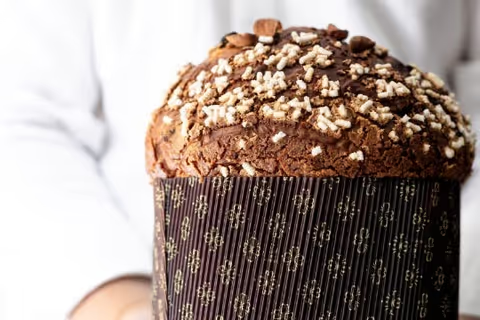
With its tall, golden dome, a soft, stringy crumb studded with candied fruit and raisins, and the aroma of butter and citrus, panettone is the sweet symbol of the holidays in Italy. A cousin of the moist brioche—though experts often prefer to classify it as a cake—it is currently riding a remarkable wave of popularity outside of Italy. It’s even starting to gain traction throughout France.
The Legend of “Pan di Toni”
In the world of gastronomy, there are many legends—always unverifiable—that attribute great creations to initial blunders, from tarte Tatin to Sauternes. Panettone, Milan’s sweet treasure, is part of this amusing tradition: the Duke of Milan’s cook is said to have once forgotten a dessert in the oven. The cake, charred to a crisp, was unpresentable, and Toni, a young kitchen boy, is said to have tried to salvage the situation by enriching the bread dough with eggs, fat, and dried fruit. This “Toni’s bread,” or pan di Toni—a true revelation—is said to have given rise to panettone.
What Historians Say
Serious historians trace its origins back to the early17th century, when it was a flat, yeast-free bread, while its modern form is said to have emerged in the 1920s, inspired by an Orthodox Easter cake.
A baker’s delicacy, renowned for its technical skill
Panettone requires real patience, and our artisans often train through long apprenticeships on the other side of the Alps. Its production takes at least 72 hours: “We aim to develop as many yeast cultures as possible, which should lean toward the sweet side,” explains Gauthier Denis, a master baker who teaches at the Lenôtre School. This allows the panettone to develop its unique aromas, its stringy texture, and, above all, to have a long shelf life—up to more than a month. ” It is the slow fermentation and the gentle kneading that perfect its texture and flavor, as well as, of course, the butter, eggs, and candied fruit that enrich its dough. The most indulgent versions are topped with a mixture of egg whites, sugar, and almonds—known here as “macaronade”—which forms a light crust and adds a touch of sweetness.
When French artisans took it on
In Paris, Christophe Louie is undeniably the king of panettone in France. Trained in Italy under maestro Mauro Morandin, he even brought back the sourdough starter—which he still cultivates today—and, naturally, nicknamed it “Mauro.” Keep an eye out for his collaborations: a coffee-flavored version with the venerable house of Verlet and even a savory version with green yuzu and nori seaweed in partnership with Petrossian. Near Place des Vosges, the two brothers Lucio and Thomas, at Brigat’, offer a classic example of the genre, with a crumb that’s both dense and airy, stringy, and above all, not dry.
In the South, Mauro Colagreco, chef at Mirazur, offers his own take on it at his Mitron Bakery locations, featuring Menton IGP lemon or chocolate chips. In Marseille, Guillaume Tetu and Mati Touis, at Ferments, have developed a signature version with roasted butternut squash, chocolate, and maple syrup. In Concarneau, baker Fabrice Richard has fallen “in love with this dough and its complexity.” And in Paris, Marion Goettlé, at Café Mirabelle, has even incorporated it into a Yule log, complete with a panettone-infused mousse!
Our selection of the best panettones
From Parisian bakeries to regional artisans, our tasters sampled the versions that are worth seeking out. Discover our selection of the best panettones in France.