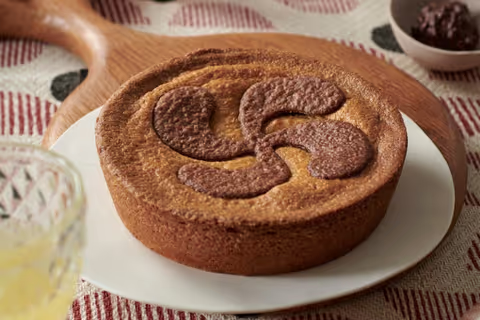
The Basque Cake: Its History and Variations
Etxeko biskotxa, the “house cake”: the Basque cake is, first and foremost, a family recipe. Popularized in the 19th century by a pastry chef from Cambo-les-Bains, it has become the culinary symbol of the Basque Country.
A crumbly shortcrust pastry—crispy on the outside and melt-in-your-mouth on the inside—filled with cream or black cherries: the Basque cake is instantly recognizable, often adorned with a Basque cross drawn on top. Before it became available in every pastry shop along the coast, it was a family cake, made at home. Its Basque name, etxeko biskotxa, actually means “home cake.”
Marianne Hirigoyen, the pastry chef from Cambo
The earliest records of the Basque cake’s predecessor date back to the 1830s. The recipe is attributed to Marianne Hirigoyen, a pastry chef in Cambo-les-Bains, who learned it from her mother. Whenever she visited the Bayonne market, she would offer this crispy yet moist biskotxa. This family cake, baked in a wood-fired oven, is made with eggs and almonds from Aragon. It was an instant hit, and the recipe was passed down to her daughters. Over time, it became the region’s emblem.
Cream or cherry?
That’s the big debate. The most traditional version remains the one with pastry cream, often flavored with rum or almonds. But since the early20th century, there has also been a version made with black cherry jam from Itxassou, a small village in Labourd renowned for its orchards. To preserve the artisanal recipe, the Eguzkia association, founded in 1994, awards a certification to artisans who adhere to specific guidelines and organizes an annual Basque cake festival in Cambo-les-Bains in early October.
When Pastry Chefs Reinvent It
Among generations of artisans in the Basque Country, everyone has their own recipe. In Biarritz, Maison Adam carries on the tradition of Grandfather Jean-Jacques, with its golden, lightly rum-infused dough, available in black cherry, vanilla cream, or chocolate varieties. Pare Gabea! (unparalleled, in Basque). Not far away, Thierry Bamas offers a version particularly rich in almonds, filled with a cream reminiscent of frangipane: the ultimate travel cake, which keeps for a week.
In Saint-Jean-de-Luz, at Pariès, the recipe has been passed down from generation to generation. While the almond cream remains the customers’ favorite, Céline Pariès has created variations with chocolate, citrus, and even hazelnuts. In Bidart, Patrice Ibarboure, of Frères Ibarboure, adds orange and lemon zest to his batter “to give the cake a subtle tang.” And in Paris, Anne Coruble at the Peninsula lets her creativity shine with a vanilla-chocolate version featuring a marbled batter. Let’s dig in right away!
Where can you find the best Basque cake?
From the Basque Country to Paris, we’ve tasted the versions that are worth the detour. Check out our selection of the best Basque cakes.