





The truth about paella
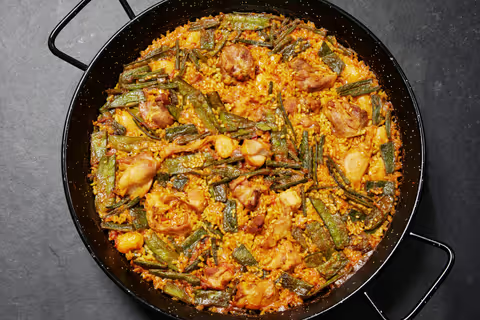
A mass of yellow rice studded with mussels, shrimp, red bell pepper and chicken: this is the paella of French markets and caterers. But paella, the real thing, is first and foremost a traditional dish, a cultural identity, a close link with festivity and strict rules for preparation.
The term paella refers both to a utensil - a large iron pan with two handles - and to the dish prepared in it. It's also a festive symbol, as the expression " ir de paella " - " to go paella " - means to celebrate. In Spain, however, we prefer to speak of " arroz en paella " ("rice in paella") or simply " arroz ", with paella referring to the classic Valencian paella, about which purists clash, as with all emblematic recipes.
Above all, paella is rice. It is the soul of the dish, its raison d'être, when the other ingredients are at its service. In the case of seafood paella(paella a banda) - " a banda" means "the side dishes" - the main function of the ingredients is to give the rice its full flavor. In fact, the banda is traditionally served before the rice, which is then enjoyed afterwards, as it has concentrated all the flavours.
The richness of wetlands
After Italy, Spain is Europe's second largest rice producer (between 800 and 900,000 tonnes per year). The cereal, acclimatized by the Arabs in the 8th century, has found its natural paradise in the coastal wetlands of the Iberian Peninsula: andalusia (Guadalquivir marshes), the Murcia region, the Albufera marshes south of Valencia, the Valencian Community and the Ebro delta in southern Catalonia.in the course of this long agrarian history, rice has become inseparable from Spanish life as an economic resource, a subsistence crop and a staple of local gastronomy.
The botanical species Oryza sativa - rice - is divided into two categories: Oryza indica, long-grain rice, and Oryza japonica, round-grain rice.spain has always preferred the latter, decisively influencing the way it prepares rice. Although japonica rice, with its short, pearly grains, has less flavour than indica rice, it is an excellent conductor of flavours, making it ideal for paella. The starch it releases during cooking binds preparations together harmoniously, giving them a creamy texture. Within this vast area of coastal cultivation, three PDOs (protected designations of origin) stand out: Calasparra (Murcia), Albufera (Valencia) and Delta de l'Èbre (southern Catalonia). Under this stamp is most often found rice of the bomba variety - the undisputed star of paella - but other local varieties such as sénia, bahía or hybrids may also be used.

© Sébastien Dubois
Arroz bomba, the super rice
Bomba rice, from a low-yielding plant, is around three times more expensive than the others. Why choose it? because it's easier to cook than senia or bahía rice," explains Alberto Herraiz, chef/owner of Fogón Ultramarinos in Paris. These other two rices are not inferior in quality, but bomba is the most appreciated for its exceptional absorption capacity: a little more than twice its volume of water. What' s more, it swells lengthwise, making it easy to cook. "And as Jorge Luis Borges so aptly wrote, "In a well-made paella, each grain of rice retains its individuality. "Bomba rice is capable of achieving a perfect osmosis between broth, ingredients, herbs and itself. A spoonful restores the identifiable flavor of each ingredient, plus another taste derived from the combination of these flavors. Thanks to the rice, the whole becomes greater than the sum of its parts: therein lies the secret of paella.
Round rice is also used to control the consistency of a paella: it can be moist and fluffy, or dry with a socarrat, a layer of toasted rice at the bottom of the container, much appreciated by connoisseurs.this is achieved by resting the paella on the fire after cooking, but the socarrat should only be the thickness of a grain of rice and must not burn. Those who like that crispy layer can also enjoy an ultra-thin paella, where the socarrat dominates.anyone who has tasted the crunchy base of a fine paella prepared according to the rules of the art will never go back to the yellow rice tubs sold in the markets. In any case, you can't reheat paella!
Paella: do's and don'ts
- If you don't have bomba rice, use round Camargue rice, Italian risotto rice or Japanese rice.
- Don't mix different types of rice.
- Allow 100 g of rice per person.
- Never wash rice.
- To find out if your paella is well cooked, bite into a grain of rice: it should burst and give way under the tooth, with no firm "core" in the center. If the grain is still hard, leave the paella on a low heat for a few moments. The "al dente" rule doesn't apply in Spain.
- Once you've washed and dried your paella (the container), oil it until you're ready to use it again.
- Apart from a wood or charcoal fire, the best source of heat for a paella is a gas stove with a wide hearth.
- The slightly concave bottom of a traditional paella makes it unsuitable for ceramic hobs, but there are flat-bottomed paellas (in stainless steel or enamelled metal).
- French paellas come in all shapes and sizes, but the recipe for true Valencian paella does not include seafood.