






Anne Vitchen, flowers are life
In the room of a palace or in the lobby of a hotel - be it simple or luxurious - on the tables or at the reception of restaurants, flowers are part of the décor. Everyone sees them and admires the craftsmanship, but who wonders how they got there? At what time of day? Who worked on staging them? This is the art of the floral designer: to be invisible while making his work visible.

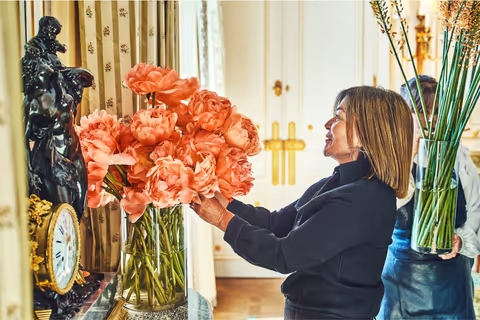
Place Vendôme, dominated by the 44-metre column dedicated to the victorious soldiers of Austerlitz, inaugurated by Napoleon in 1810. Around it, world-famous jewellers, the Ministry of Justice and the emblematic Ritz Paris, founded in 1898 by César Ritz. A handful of steps to climb, a revolving door to push, and the eye hesitates between the receptionist and the bouquet of blue hydrangeas that seem to be waving in a huge vase of the same color on a period cabinet. Who cares he's there? Who notices it? If this bouquet weren't there, would the image that guests have of the Ritz be tarnished? For Anne Vitchen, floral designer nicknamed the "Flower Lady" by Christian Boyens, the former general manager of the Ritz: " It's not just a bouquet that you put in a vase, it's flowers that you stage so that they blend into the decor, like a work of art. "
Ten years ago, the management of the Place Vendôme luxury hotel chose Anne Vitchen to design its floral decor for a renewable three-year period. Her scope? The Ritz in its entirety, from the 142 rooms to the main entrance, as well as every nook and cranny where a vase could be adapted to its shape, events or special requests. Only plants and flowers in the ground are out of her hands.
Saved by flowers
There are insurmountable trials that prompt you to change your life in the hope of a brighter, less melancholy path. Before flowers, Anne Vitchen was a keyboardist at Le Quotidien de Paris. Her job was to copy texts onto a computer keyboard in preparation for printing, without actually having the right to touch the content. From keyboardist, she became layout artist, before sinking into immeasurable grief, " but flowers saved my life ". After the press, she imagined herself moving into the decorative arts or photography. In the end, it was sweet peas, violets, peonies, azaleas, begonias and roses that won her over. With no real floral culture and no diploma, she opened her florist store in 1998 in the capital's 8ᵉ arrondissement.
With timeless creations and bouquets, often with little or no foliage, and in which no more than two colors coexist, Anne Vitchen seduces a public touched by her sensitivity. She is approached by fashion houses, prestigious event agencies, future brides and grooms, and national and international magazines for photo shoots. "What I like to do is create floral scenarios, find the right containers and materials. Flowers aren't just a bouquet in a vase. In the end, it's all about comforting and soothing the place that receives them, as well as the people who live or work there."Month after month, year after year, she establishes herself as one of the most sought-after floral designers, who is difficult to catch unprepared, unless the flowers requested are out of season. In this case, she tries to impose an alternative through education. Among the craziest requests, she remembers the customer who ordered 1,000 roses to declare his love, or another lover who wanted her to write "Marry me" in pink and white floral letters, visible and legible from his sweetheart's bedroom.

guillaume Czerw
In the basement of the Ritz
Seven days a week, from 6 a.m. to 6 p.m., Anne's teams - led by Manon, three years with the company and first in the workshop - take turns in the premises allocated to them in the basement of the Ritz. Flowering the palace and maintaining the bouquets is an almost military task. Around 4 a.m. from Tuesday to Saturday, when the whole of Paris is asleep, the flowers - some 1,500 a day - arrive from France, Italy, the Netherlands, and sometimes from Ile Saint-Denis, near Paris,where the designer has formed a partnership with Fleurs d'Halage, an accredited training center, shared garden and social integration center, substrate manufacturer and urban flower farm. at 6 a.m., the flowers were deployed throughout the hotel's public spaces (the main entrance, the Salon Proust, the gallery, the reception lounges, the bar, the corridors, the reception area, even the smallest pedestal table).reception, every single pedestal table...) to put flowers in bloom, remove petals that have fallen during the night, straighten a branch, replace a faded flower with another. by 8 a.m., this first stage has to be completed, by which time the majority of guests have taken possession of the palace and are on their way to breakfast.
Do customers realize what has happened while they were asleep or daydreaming? History doesn't tell us, because these florists, in addition to discretion, don't play on the opulence and glitz that would draw the eye: "Here, in this classic place, you have to know how to remain sober, classic and blend into the decor. "It's for this reason that orange flowers are forbidden, as they don't fit in with the decor like yellow ones do - except for special events, and then only if requested by the customer. While the Ritz is busy, the teams get in touch with room service. Objective: check out. As soon as a room becomes available, the florists go there - they travel between 5 and 10 kilometers a day - and line up bouquets or arrangements, taking into account the decor of each room and its luminosity. Here, eremurus (or steppe lilies), there peonies, and further afield mini-orchids or hydrangeas, like those placed early in the morning on each table in the dining room.Éric Merlet, Maître d'hôtel at the Ritz for the past ten years, in charge of the Salon Proust, explains: " It's simple but it's chic. "
Room after room, the morning stretches on, but the teams don't forget the palace's event side, a reception room to be decorated, a special request to be honored. Only the gourmet restaurant, l'Espadon, is not concerned. This is one of the few areas where flowers are not allowed. Most of the work has been done, although some of the staff will remain on standby. In the meantime, it's time to recover the old flowers, which, thanks to their daily freshness, are far from faded. Stems, foliage and some flowers will be recovered by the Moulinot company, which collects and recycles food and plant waste, while other flowers will be given to an association that gives them a second life in partnership with retirement homes.

guillaume Czerw
Mother and daughter united by a passion
Emma Sosa, Anne's daughter, was born into the world of flowers, but she could have chosen a different career. Not so, and although they work together, they are, in principle, competitors, since each heads her own company: " When I set up Jardins de Matisse nearly twenty-eight years ago, I was working for both private individuals and professionals in all sectors. That lasted eighteen years, but when I was awarded the floral design contract for the Ritz, I realized that I was going to have to devote 100% of my time and my teams to it. So Emma took over my business and developed it, while I managed my main client."
With the same sensibility, but not the same style or the same teams, Emma works for Yachts de Paris, the Hopscotch agency, Le Jules Verne restaurant, numerous hotels, luxury boutiques and museums. Today, mother and daughter have decided to join forces geographically and have created La Maison Vitchen in a former garage and convenience store on Boulevard Pereire in Paris. Anne's 450m2 basement space houses thousands of vases, plates, lanterns... all those famous containers that we sometimes examine before even looking at or smelling the flowers.
On the first floor, around a square courtyard reminiscent of the Place Vendôme, everyone prepares their own arrangements. on Emma's right, campanulas, foxgloves and roses.on Anne's left, flowers she likes to associate with moments in life: violets for a weekend; daisies for a first date; garden roses for events, even if they are fragile; and sweet peas to pass on the torch.the message is out!
Maison Vitchen
- Where? 14, boulevard Pereire, 75017 Paris
- www.annevitchen.com