






Flanders' green gold
In French Flanders, just a stone's throw from Mont des Cats, Mont Noir and Mont Kokereel, strange plantations catch the eye of those unaccustomed to vertical vines that seem to reach for the sky. Welcome to another hop-growing region.

With 95% of France's surface area, i.e. around 500 hectares, Alsace stands head and shoulders above the rest in the hop production market. The remaining 5%? Spread across Auvergne, Normandy, Brittany, Berry and the North, particularly Flanders, which is doing well thanks to the growth of microbreweries that want French hops - Humulus lupulus. At the Pruvost family home in Boeschepe, grandfather Roger planted 11 hectares of hop fields in the 1950s. But by 1985, the world was experiencing a hop crisis. There were too many of them, and French growers, small players on the world stage, were asked to grub up in return for a premium payment. Yvon Pruvost, Roger's successor at the height of the hop crisis, grubbed up and started growing wheat and potatoes, but kept in mind that Flanders would always be a hop-growing region. He ended up replanting little by little in 2008, before handing over to his son, Paul, who today has almost 10 hectares under his belt.
A story hanging by a thread
The tractor pulls into the rows. The puller on the side of the tractor grabs each vine one by one above the root and cuts it off, then pulls it until the end is detached from the upper cable.the end of the vine is detached from the upper cable, 6 metres above the ground, and falls flat onto the cart behind the tractor. At the end of the row, the load is such that we have to go back to the shed to unload and "feed" a machine that looks vaguely like a combine harvester but without wheels, which will swallow, shake, crush and sort the vines one by one (around 280 per per hour) to separate the leaves, wood and hop flowers, which join a conveyor belt while the wood is dragged away. The wood is crushed and mixed with the leaf compost to be spread on the hop fields, which have the particularity of not requiring crop rotation. Harvesting is the result of six months' work, starting in mid-March with the formation of the mounds. The following month, the stalks emerge and quickly grow to around 15 cm. They then have to be "wired", otherwise they would naturally grow horizontally. They must be forced to coil up on the wire attached to a post installed every 10 meters. Once coiled, the plant will continue to grow along the support to the top wire.
Storage and drying
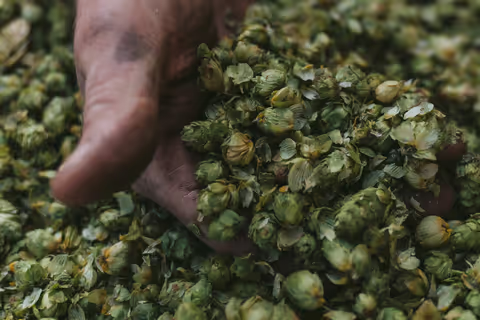
After the conveyor belt, the hop flowers move to the storage and drying area.stacked to a height of around 70 centimetres, they are first ventilated to prevent fermentation, then dried overnight in hot air at 60°C. A crucial stage for flower quality. In the early hours of the morning, the dryers are emptied and the flowers packed into 65-70 kilo bales. Some are then crushed and ground into pellets for easier storage. Of around 2.5 tonnes of ventilated flowers, only 600 kilos of raw material remain at the end of the drying process, i.e. a cumulative dry tonnage of between 16 and 17 tonnes on 10 hectares, which do not remain on the market. Today, in fact, demand outstrips supply, starting with the major regional breweries who buy tonnes from the Coophounord cooperative, to which must be added requests from micro-breweries in search of French hops. Flanders hops therefore have a bright future ahead of them. It won't regain its former glory tomorrow - when local production accounted for a third of French output. The region's farmers should take a greater interest in it, because it's rare in the agricultural world to find men who are happy to say that they make a very decent living from their trade.
This article is taken from the Hauts-de-France 2026 guide. It is available in bookshops and on the Gault&Millau e-shop.