






Agroforestry to reenchant the Château de Javernand
Total grassing, 240 trees planted per hectare in the heart of the vines, pulling out vines to make room for them... At Château de Javernand in the Chiroubles appellation, Pierre Prost and Arthur Fourneau are rethinking everything to revive their soil and produce fresh, silky wines.
A highly prized cru at the turn of the 1990s, it has gradually fallen into disuse. Located less than five kilometers from the famous village of Villié-Morgon (Rhône), the chiroubles appellation has fallen asleep, embalmed in the discreet nostalgia of a bygone glory, the fleeting renown of an outdated taste, incapable of resisting the passing of time.a past glory, the fleeting fame of an outdated taste, unable to resist the age of "glouglou" wines and star-studded winemakers on Instagram. From the Mâcon-Loché train station, however, you're struck by the beauty of this undulating terroir.and then, at the bend in a valley, at the end of an avenue of lime trees, stands a pink winegrower's house, dominated by a walnut tree several hundred years old, and a terrace overlooking a large part of the estate below.
Here, at Château de Javernand, a hint of Italy can be found in the landscape as well as in the glass, when the Indigène cuvée is as much a taste of Friuli as it is of Beaujolais. Crispness, length, fine tannins, freshness... How is it that, in the midst of chemically-scorched hillsides, granite and hectares of Gamay Noir, so much aromatic richness can be found?
Producing less, but better
Until then, the family estate had lived its life without stepping out of line. Since 1917, to be precise, and through five generations, the road seemed to be all mapped out.then, in 2017, a complete change of course, a real leap into the void: Pierre Prost and Arthur Fourneau, aged 44 and 45, who run the estate together after studying engineering, wanted to do less, but better. To achieve this, they cut back from 12 hectares to 8. Why this radical turnaround in an estate that had been producing wine for over a century? we became fathers," explains Pierre Prost, " and we began to wonder what we ourselves were leaving behind. Erosion, soil impoverishment and climate disruption were all here, and the fight for life appeared to us as a priority for the future. "
While it has so far smoothed out the years and brought a certain regularity to the Beaujolais crus, global warming is now "too much", says the winemaker. Some years, it doesn't rain from mid-May to the end of August. How do you retain water on hillsides damaged by decades of vineyard work? In 2017, Pierre and Arthur are betting everything on agroforestry. Not the cosmetic kind that consists of planting short hedges at the edge of the estate to protect against the neighbor's inputs.
But total agroforestry, right in the middle of the rows of vines, which have to be widened and sometimes uprooted to make way for the trees. It's a mammoth task, even though studies are lacking to measure the future virtues, and potential drawbacks, of the presence of trees in vineyards. Why this gamble to change everything? pierre Prost continues: " The starting point for this awareness was the soil, which was becoming poorer and poorer after two hundred years of viticulture. In our vineyards, organic matter levels were below 1%, and even grass was struggling to grow! If we continued to impoverish the soil, we'd be heading for the desert. "
Gone were the bare soil methods of the old winegrowers, who needed to reflect the sun for the grapes to ripen. it was more sustainable when winegrowers had less surface area, and contributed organic matter through mixed farming and their cows," recalls Pierre Prost. Humus is at the heart of our thinking, and everything flows from it: humus is carbon, soil life, fertility, water retention, food for the earthworms that decompact the soil. Even the nitrogen cycle depends on the carbon cycle, which we capture in the process. "
Global reflection on the ecosystem
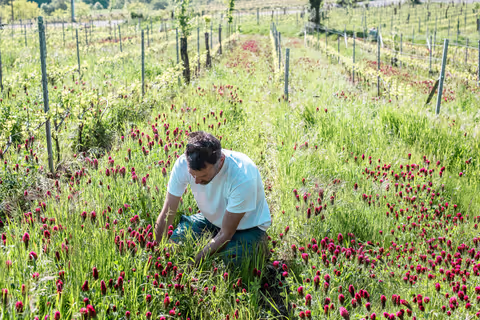
in late spring, the estate's soils appear covered with the red flowers of clover, and legumes sown to nourish the soil. It's a very different landscape from the one Château de Javernand presented ten years earlier. How did Pierre Prost and Arthur Fourneau get started back then? Why did they choose not fruit trees, but country trees, planted very young with bare roots, and pruned into "trogne" as soon as they reached 2.50 meters? In 2017, the winegrowers received training through Ver de terre production, an organization dedicated to helping farmers in France with everything they need to make their agroecological transition. " It gave us our foot in the door, and reinforced our awareness that technical solutions also existed," says Pierre Prost.
following this training, Pierre and Arthur set up a collective, VVB for Vigneron.ne.s du vivant en Beaujolais, bringing together 24 estates, including Julien Bertrand, from Domaine Bertrand, and Pierre Cotton and Marine Bonnet, from Domaine Bonnet-Cotton. Side by side, these men and women are working and learning all they can about agroforestry, as well as vine physiology with Marceau Bourdarias, an expert at Ver de terre production.the collective is also in contact with the Auvergne-Rhône-Alpes mission, which advises them on hedges and their role as natural air-conditioners.as the estate is in a single block, the planting of multiple hedges intended to reach 5 to 6 meters in height meets the need for both cooling and ventilation.the hedges were planted to cool the vines by deflecting the wind, and also to create an ecological corridor for the local fauna. This global reflection on the ecosystem led Pierre and Arthur to recreate a ripisylve - a forest around the watercourse, which can be seen below the terrace.a green corridor that provides a pocket of coolness and retains water to prevent evaporation.
Once a month, the collective meets for half a day to discuss practices, results and difficulties. Uprooting, planting, tending... the winegrowers take care of everything, sometimes making radical choices. To be able to work with plant cover and trees, they need to widen the rows. But old vines planted at 10,000 vines per hectare on very steep slopes don't lend themselves to this. The two winegrowers therefore preferred to grub up the vines and leave several hectares fallow, the better to concentrate on converting to organic farming, which will be completed in 2023, and working on the rest of the estate.

claire Jachymiak
A competitive edge
Spectacular between the vines, the results are also visible underground. Right from the first spadeful of soil, Pierre Prost unearths two beautiful earthworms nestling under the plant canopy, in a richer soil than the sandy surface would suggest. The increase in earthworms due to vitiforestry (or agroforestry) is a point attested to by the Vitiforest study published in 2021 "Evaluation of the impact of agroforestry trees in a viticultural context". And the downside? Won't trees and legumes hinder the development of the vines? Well, no: none of the young vines observed near the trees seem to show any particular fragility or stunted growth.
The competition between plants feared by some critics of the presence of trees in the heart of vineyards was also refuted by the study. from an agronomic point of view," write the agronomy researchers, "the presence of trees for eight or nine years near the vine has no direct effect on its vigour or the composition of the grapes. "Pierre Prost, for his part, denies the resurgence of diseases such as downy mildew, pointing to the presence of a fungus under the plant cover that protects the vines. Given the surface area cultivated, the volume obtained suffers little from the choices made by the winemakers: the maximum yields of the chiroubles appellation, set at 58 hl/ha, are achieved by a first parcel planted in 2016 in agroforestry. The estate's overall target is around 45 to 50 hectoliters per hectare, which offers, according to Pierre Prost, " a good balance between concentration and terroir typicity ".
And in the glass?
The winegrowers' hope is to better connect the wines to the terroir, on a living soil, filled with mycorrhizae - a symbiosis between a fungus and a plant - which allows plants to better explore the soil. We do this above all for the vines and the soil," explains Pierre Prost. Ultimately, the aim is for the vine to be less stressed and more resilient, with more organic matter and water retention. The low-angled western sun sometimes scorches the grapes. We hope to improve and smooth out the quality of the grapes from one year to the next. In a non-rainy year, the plant cover pumps out the water. In a rainy year, the mulch conserves it. The idea is to cushion the climate, so as to continue producing healthy, natural wines. "
Among the 2023 cuvées tasted at the estate, the four Chiroubles reveal a remarkable aromatic quality and freshness that sets them apart from the rest of the small (320-hectare) vineyard. The Climax cuvée, in particular, has a roundness not expected from a chirouble.add to this a sober, crisp Rose de Gamay rosé from the Beaujolais Villages appellation, and Java, an almost metallic natural sparkling brut. These crus speak volumes about the potential of this pilot estate, at the forefront of a practice that should win over many winemakers in the years to come.
Château de Javernand
- Where? 421, impasse de Javernand, 69115 Chiroubles
- www.javernand.com