






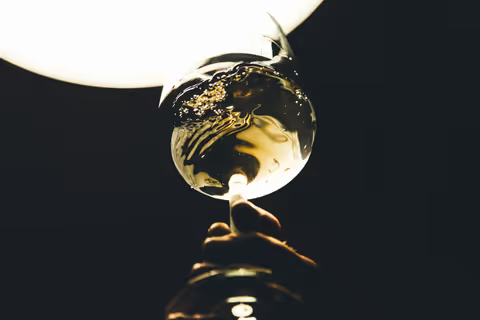
With white, red goes out the window
Buoyed by French consumers' new expectations for fresh, light wines, white wines are experiencing an unprecedented craze. By 2023, white wines will have overtaken reds in terms of volume, and are reshaping part of the French winegrowing landscape.
Gone are the days when powerful, full-bodied, tannic red wines were the order of the day in restaurants and bistros. Laure, a restaurateur in Levallois-Perret [Hauts-de-Seine], has been hearing a different tone of voice over the past few years. Her customers, who tend to be young, now want fresh, light wines. It has to be said that with global warming, alcohol levels have soared in some vineyards. In the past, people would chase after it: " It had to be colorful, it had to have substance ", recalls Ewen Le Moigne of Cave des Papilles in Paris.
Today, almost everyone is on the hunt for alcohol content: " Thanks to earlier harvests, slower fermentation and gentler vinification, winemakers are able to extract less substance, tannin and color," continues the wine merchant. This is a response to new consumer expectations, particularly among the younger generations, who have a more relaxed relationship with wine: " They no longer have the benefit of their family's culinary heritage. They want to drink light wines, at a variety of moments of consumption - as an aperitif, on a café terrace - and no longer just at the table and with the family to accompany red meat ", observes Marie Mascré, director of the Sowine agency. A sign of the times, the main outlet for the Centre-Loire wine interprofession (sancerre, menetou-salon, pouilly-fumé, quincy...) is cafés-restaurants and wine shops (38%).
White wines attract
It's clear that white wines have benefited greatly from these new aspirations, winning over more and more consumers and, against a backdrop of a general decline in wine consumption, doing very well indeed. In 2023, white wine production in France exceeded that of reds for the first time: 13.5 million hectolitres (40% of total production) versus 12.8 million (39%). Smoothed over five years, between 2018 and 2022, FranceAgriMer's figures are even more spectacular: +17% for whites; -14% for reds; -5% for rosés. And there's more to come. In 2024, white wine is by far " the color that has driven the category ", confirms Marie Mascré. In fact, 90% of French people say they drink white wine most frequently (versus 82% for red wine)." White wines provide a sensation of lightness and freshness that is highly prized by today's wine lovers ," notes Corinne Richard, President of the Inter Caves network. " They're also easier to access. You take fewer risks than with a red," notes one restaurateur. What's more, the codes for wine tasting have changed: " Consumers have realized that white wine goes very well with charcuterie or cheese," explains Cyril Laudet, a wine and armagnac producer between the Landes and Gers regions.
White wines offer a particularly wide range of food and wine pairings: " You can even imagine pairings that are firmly rooted in the region. A Jura wine goes wonderfully with a Comté cheese, while a Sauvignon goes perfectly with a fresh goat's cheese," suggests wine merchant Ewen Le Moigne.
Bubbles benefit
The craze for sparkling white wines, synonymous with freshness, is part of this renewed interest: " Prosecco has opened up the world of bubbles to new consumers," notes Emmanuelle Gallis, Sales Director of Cave de Turckheim in Alsace. According to the Wine Intelligence consultancy (owned by International Wine and Spirit Research IWSR), in five years, where 750 million bottles of still wine have been lost, 10 million have been gained by sparkling wines: " They have the capacity to embrace current consumer expectations. They offer a style, a price, but also creativity and a unique experience ", boasts Jean-Philippe Perrouty, France Director of IWSR. Such is the case with crémants, whose sales continue to rise year after year (+19% in five years), with a clear advantage: " We can produce white crémants with red grapes. There ' s no need to uproot vines in order to replant," stresses the Conseil interprofessionnel des vins de Bordeaux (CIVB).
Fewer inputs, more naturalness
Gone is the image of the little white wine that gave you a headache. Vineyard practices have changed, as Christophe Riou, Director of the Institut français de la vigne et du vin, points out: " For a long time, winegrowers used sulfites to stabilize their white wines, which are more prone to oxidation than reds, which are naturally protected by the presence of tannins. "The president of a white wine appellation agrees: " In the old days, we didn't ask ourselves any questions. We just opened the parachute and pumped in sulfur. "
Now, however, we have to respond to the societal expectations of consumers, who demand fewer inputs and more naturalness. Thanks to new winemaking and preservation practices, sulfite levels are now lower: " There's a real desire to let nature express itself and provide just the right dose of sulfites. This will depend on the character of the vintage and the pH level of the wine ", assures Arnaud Bourgeois, co-president of the Centre-Loire wine interprofession.

vincent Baldensperger
Reds take root, whites take root
The appeal of white wines is reshuffling the cards in the French wine landscape. In some regions, whites are regaining the upper hand, as Jean-Marie Fabre, winemaker in Fitou and president of the Vignerons indépendants de France, explains: " In Languedoc-Roussillon, where reds once accounted for 80% of volumes, they now account for only 50%, to the benefit of whites and rosés. "A few hundred kilometers away, wine professionals in the Côtes-de-Provence region are encouraging the planting of white grape varieties, while further north, the Beaujolais interprofession, with its traditionally red wines, is aiming to triple its white production over the next five to ten years. In the Bordeaux region, Michel Reybier, owner of Cos d'Estournel in the Saint-Estephe appellation (second grand cru classé in the 1855 classification), has been producing a white wine in a land of great reds since 2005: " At first, we were taken for sweet dreamers. It took us five years to find the right terroir to bring freshness and minerality to our wines ," says Michel Reybier.
In some vineyards, we had to adapt, reorient grape varieties or even create new ones from scratch: "For example, Inrae has developed a new variety, floreal blanc, which produces an aromatic wine with real freshness and aromas reminiscent of sauvignon blanc," says Christophe Riou of IFV. The wine world no longer hesitates to shake up the codes. Even if it means reviving old recipes, such as vin orange, made from white wine macerated but vinified as a red wine. The fruit of an ancestral method originating in Georgia, it combines freshness and strength of character. Appreciated by young consumers and in great demand on the export market, orange wines, or vins de macération, even found their place in the Alsace AOC in 2024, after lengthy debates between winegrowers. And what about "blouge", a light-colored wine that combines white and red grapes in co-fermentation? Cyril Laudet, a winegrower from Les Landes, produces one: " Traditional wines are no longer consumed in the same way, and I have vines, so I have to deal with that. I'd rather blend my syrah with a chenin than produce 14° wines that nobody wants. "A fad for some, a viticultural revolution for others. In any case, these new trends are proof that the world of wine is not standing still.