






Why Chefs Are Clamoring for These Rare and Little-Known Breton Butters
A new generation of producers is turning butter into a true culinary gem in the region. With their use of heritage breeds, pasture-based farming, and proven expertise, they are winning over chefs and food connoisseurs with unique flavors that reflect a vibrant local terroir.

In Brittany, butter is always on the table. But behind this everyday product, a small revolution is underway. From Plœuc-L’Hermitage to the hills of Bubry, all the way to the pastures of Ille-et-Vilaine, producers are reinventing the industry by getting back to basics: hardy cows, a grass-based diet, and milk processing that stays as close to nature as possible.
For Le Vieux-Bourg butter, the story dates back to 1956. At the time, on farms around Quintin in the Côtes-d’Armor, everyone churned their own butter. Mr. and Mrs. Raoult then had an idea: to collect this butter, churn it a second time, and sell it. Seventy years later, the business has evolved without straying from its roots. Taken over in 2015 by Éric de Sonis, it relies on a network of six local dairy farmers. “There’s a wide variety of cow breeds, but we favor those that produce milk rich in fat , ” he explains, citing the Normande and Montbéliarde breeds in particular. Here, there are no industrial-scale herds: a maximum of about fifty cows per farm, raised primarily on pasture.

The butter, always packaged by hand, retains its signature quality: a double churning process that gives it a particularly creamy texture. Its color and flavor vary with the seasons, from the intense yellow of spring to the richer notes of winter. With two metric tons produced each week, Le Vieux-Bourg supplies both large retailers and gourmet restaurants, such as Aux Pesked (15.5/20 – 3 toques) in Saint-Brieuc. Some recipes even result from collaborations with chefs, such as a coffee butter created with Anthony Avoine at the Manoir de Lan Kerellec(14/20 – 2 toques) in Trébeurden.

Farmers and Producers
Further south, in Bubry, the Kerbastard farm embodies a radical approach. Linda Seyve and Jean-Marie Bourgès, former landscape architects, established an organic farm in 2016 on previously fallow land. Their choice: to work exclusively with heritage breeds—Pie Noir, Froment du Léon, and Jersiaise. “They produce less, but their milk is exceptionally rich,” explains the farmer. Here, the cows eat only grass and hay from the farm. The result: butter with a robust flavor, whose color and taste vary depending on the cows’ diet. In the spring, carotene-rich grass gives the butter a vibrant yellow hue; in the winter, hay and silage impart more pronounced flavors.

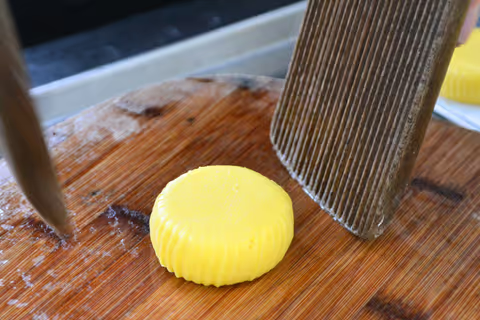
Their production remains limited (between 50 and 90 kilos per week) but is highly sought after. Chefs—from Yannick Alléno to Alain Ducasse and Christian Le Squer—rave about this butter, which is often served as is to preserve its full complexity. Hand-molded and seasoned with fleur de sel from Nathalie Krone, a salt worker in Saint-Armel, it becomes a gourmet treat, served at the table as a dish in its own right.
In Pacé, Thierry Lemarchand continues this quest with a single iconic breed: the Froment du Léon. “In the 1980s, there were only a handful left,” he recalls. Long neglected in favor of more productive cows, it owes its survival to a few passionate breeders. What makes it special? Larger fat globules, which give the butter a smooth texture and a unique flavor. Once entrusted to women while the men went to sea, the Froment du Léon earned the nickname “madame’s cow.” It is distinguished by its warm, golden wheat-colored coat and its docile temperament.
Thierry Lemarchand, who has been farming here since 2010, now works with nearly 700 cows on 126 hectares. His “Beurre de Madame,” primarily intended for the restaurant industry, first won over father and sons Olivier and Hugo Roellinger at Le Coquillage (17.5/20 – 4 toques) in Saint-Méloir-des-Ondes, near Cancale. “Thanks to word of mouth, my butter found its way onto the tables of their chef friends, such as Pierre Gagnaire, Michel Troisgros, and Michel Bras.”

Behind these stories lies a shared conviction: the flavor of butter begins in the pastures. Heritage breeds, feed, seasonality… each factor shapes a unique flavor profile. By giving these variables their rightful place, these Breton producers do more than just make butter: they tell the story of a region in all its vibrancy.
- Le Vieux-Bourg, 14, chemin des Loges – Chantepie industrial park. 22150 Plœuc-L'Hermitage / @beurre-le-vieux-bourg
- Ferme de Kerbastard, Kerbastard. 56310 Bubry / @fermedekerbastard
- Beurre de Madame, 11 Allory Street. 35740 Pacé / @beurredemadame