






Solar salt workers
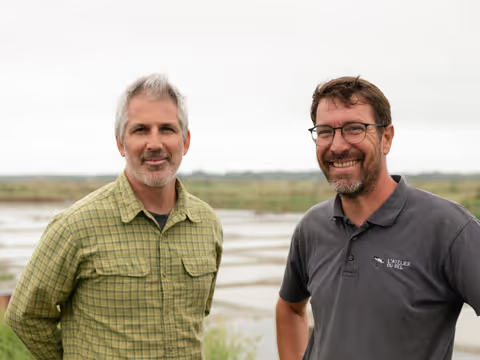
For nearly a decade, Matthieu Le Chantoux has been producing and harvesting salt in the Mès basin, in the picturesque setting of the Guérande salt marshes. An independent salt worker and producer-harvester, he launched L'Atelier du Sel in 2013 with his uncle, then continued the business with Hughes Martineau, his cousin. In keeping with the tradition of salt workers, ancestral gestures and know-how are perpetuated, as is the pride of offering a natural product harvested by hand, using artisanal methods.
Gault&Millau: What motivated you to launch Atelier du Sel?
Matthieu le Chantoux: For me, it was a career change. After working a lot abroad, I wanted a project that would anchor me somewhere. With my uncle, who was a mussel farmer, we wanted to take over a business and develop it. The opportunity presented itself in the salt marshes. Even though I wasn't the son of a salt marsh worker, I became one. I took the training course at La Turballe in 2013. While all salt workers are salt producers, not all of them are storekeepers or traders. Here, we wear three hats. We operate our own salt marshes, and we also work with other salt growers as traders. We undertake to buy from them the quantity of salt present on a defined number of "œillets" (compartments where salt crystallizes, editor's note). My uncle retired in 2020 and I now work with my cousin, who handles the commercial side of the business. We are two partners, we have two employees and we work with two ESATs - establishments employing disabled people, an important value for us - to whom we entrust, for example, the packaging of small products. Our farm comprises 46 carnations and we have an average annual production of between 70 and 90 tonnes.

This article is taken from Gault&Millau, le magazine #7. Find the latest issue on newsstands or in our online store.