





Contact

37-39 rue Boissière
75016 Paris
France

Phone : 01 41 40 99 80

GaultMillau © 2025 All rights reserved

Do you know the story behind this champagne tradition?

Do you know the story behind this champagne tradition?

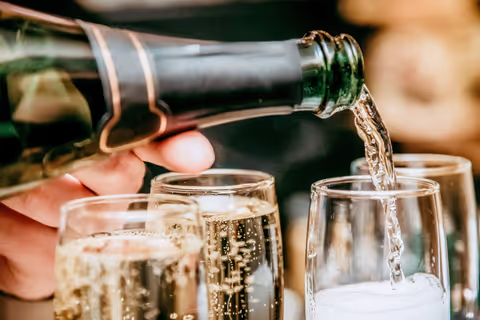
If this alcohol, symbol of festive moments, is well known, a tradition surrounding the tasting of champagne still persists today. But do you know the origins of this tradition?

Yuna Lamarque

A true marker of the festive season, we take a look back at the origins of an emblematic ritual. With a history stretching back centuries, this gesture continues to sparkle on special occasions. But what's the story behind this tradition?

The military origins of champagne sabré

Over the centuries, champagne has established itself as a drink made to celebrate important moments. In Napoleon's time, champagne was also used to celebrate his many battles and victories.

The practice of sabering a bottle of champagne comes from this era. On the battlefield, soldiers celebrating a victory would open bottles of champagne. With only their sabres at their disposal, they used them to open the bottles.

Even today, the tradition has survived, and champagne bottles can still be opened at happy moments. While long swords are no longer the order of the day, other tools, such as the smaller, curved "sabre briquet", can be used for practice.

The difference between "sabler" and "sabrer" champagne

We sometimes hear two similar expressions that have very different meanings. The term "sabler" is used colloquially to describe the act of drinking champagne quickly, rather like "whistling" a glass, while "sabrage" is the technique of opening a bottle in the Napoleonic style, by popping the neck with a sharp blow.

To successfully saber champagne, make sure the bottle is kept cool until opening. Then remove the metal cage, tilt the bottle between 30° and 45°, and locate the weld line, which is the most fragile part of the bottle. Holding firmly, the last step is to give the neck a sharp blow to remove it. Take precautions to avoid accidents.

"From public service to the service of taste": the story of a former railway worker turned pastry chef
Craftsmen & Know-How
"From public service to the service of taste": the story of a former railway worker turned pastry chef
In his book "Des trains au vacherin", Pascal Guglielmi shares the story of his conversion. Leaving the rails behind, he now runs La Pâtisserie des Marseillais, a must-visit address in the Old Port.
Nos adresses Gault&Millau pour un Noël à emporter
News & Events
Nos adresses Gault&Millau pour un Noël à emporter
Pour un repas de fête sans stress mais avec tout le raffinement des grandes tables, découvrez les restaurants Gault&Millau qui proposent menus, plats et créations à emporter pour Noël.
Polish cuisine: a sensitive journey to the heart of traditions and flavors
News & Events
Polish cuisine: a sensitive journey to the heart of traditions and flavors
Woven from ancient gestures, seasons and multiple influences, Polish cuisine offers a vibrant universe where each dish reveals a living heritage and a unique gourmet poetry.
Yann Brys in 5 desserts
Craftsmen & Know-How
Yann Brys in 5 desserts
Essonne-based pastry chef Yann Brys reveals five creations that perfectly represent his world. Among other things, the Meilleur Ouvrier de France talks about his now-famous tourbillon.
Agroforestry to reenchant the Château de Javernand
News & Events
Agroforestry to reenchant the Château de Javernand
Total grassing, 240 trees planted per hectare in the heart of the vines, pulling out vines to make room for them... At Château de Javernand in the Chiroubles appellation, Pierre Prost and Arthur Fourneau are rethinking everything to revive their soil and produce fresh, silky wines.
Flanders' green gold
Craftsmen & Know-How
Flanders' green gold
In French Flanders, just a stone's throw from Mont des Cats, Mont Noir and Mont Kokereel, strange plantations catch the eye of those unaccustomed to vertical vines that seem to reach for the sky. Welcome to another hop-growing region.
Become Partners