






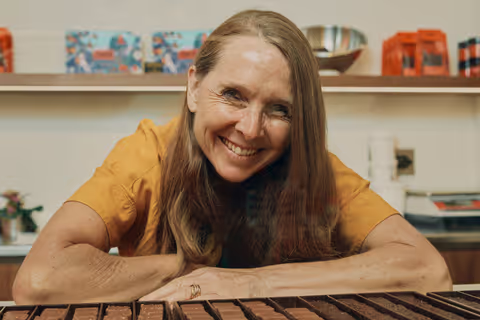
Chloé Doutre-Roussel, the bean in the body
Her name is on everyone's lips in the world of chocolate. One day in Venezuela, another in Budapest, then in Chelles, Seine-et-Marne, and Japan, Chloé Doutre-Roussel travels in search of the best beans and the best processes. A knowledge she passes on with passion and rigor to beginners and advanced alike.

How did your story with chocolate begin?
Chloé Doutre-Roussel: Chocolate is part of my roots: I was born in Mexico and lived in South America until I was 14. My father's professional situation meant that we moved every three or four years, to Chile, Bolivia... Ever since I was a little girl, I've been called "Chloé Chocolat". I've always loved tasting, with the curiosity to compare and take notes. But I hadn't planned to work in chocolate. I studied agricultural engineering, then went to London to train in film and photography, which I loved. However, I felt that I would never be more than a good assistant, and that wasn't enough for me. I'm always questioning everything. When it's no longer my place, I organize my departure.
When I arrived in Paris, I wrote to chocolate houses to be a sales assistant. I had a Baccalaureate + 8. Pierre Hermé, who was working for Ladurée at the time , interviewed me on a Saturday and asked me how I felt about tasting Pralus chocolate bars. in the end, he told me to come back on Monday morning. I was an intern, then a secretary. It was an excellent school, I tasted a lot and asked a lot of questions. Then I managed the chocolate boutique on the Champs-Élysées avenue. Later, I was lucky enough to join Fortnum & Mason as a chocolate buyer, a highly coveted position in a London department store. I took the opportunity to learn more and travel around the plantations. I was already interested in the bean-to-bar movement, and this interest grew as I met pioneers in the United States and Europe like Steve DeVries in Denver and Naive Chocolates in Lithuania.
So you decided to set up your own company...
C. D.-R.: To throw myself over the cliff, yes! For someone who had been a salaried employee all his life, it wasn't easy. But I'd been running wine-tasting courses for a long time and was increasingly invited to give talks at festivals abroad. I was approached by a cooperative in Bolivia, which was making chocolate from its cocoa and wanted to launch a range for export, embellished with typical local products (salt, quinoa). We presented it at the Salon du Chocolat in 2008.the packaging read "Chloé Chocolat".it was a very important experience.it was the first quality chocolate range at the time to be developed 100% by cocoa producers and distributed worldwide. They've become a family, and I'm going back to see them this year. One mission follows another, for a culinary school in Japan where I've been teaching since 2010, another in Brazil... I never spend six months in the same place.

sébastien Dubois
Who are your customers today?
C. D.-R.: Above all, I seek to work with people whose values I share. In France, with the new management of the Chapon chocolate factory, the aim is to optimize production and grow without compromising quality. We're working to diversify sources and get closer to cocoa producers, and of course to train our staff. I'm convinced of the need for a little sparkle in the eye when you talk about a product in a store. And that requires knowledge and the tools to find pleasure in one's work. We've just returned from a trip to Venezuela, where we met producers and buyers of fresh cocoa. We saw how cocoa is fermented and dried, and talked to the source about how it is transported...
Exports, imports, paperwork, everything counts to get the cocoa to the Chapon workshops in Chelles [Seine-et-Marne] in the best possible conditions. The aim is to learn from each other. The cocoa chain is complex, and we need the work and expertise of all the players in the field. This can only be achieved through meetings, tastings and training. My mission is to constantly strive for consistent quality production in sufficient volumes, i.e. between 600 and 1,000 kilos per year for a bar. I'm also a year-round consultant for Green Bean to Bar Chocolate in Japan. We're developing new products, and I help them with roasting; there's a production challenge for me, depending on the machines, the cocoas... how best to express all that.
And then there's the "bean to bar and specialty chocolate" training I give in Paris and in the field, which is my bean to bar lobbyist side. I'm thinking of Plaq, in Paris, Ōme, in Montpellier, Hervé and Mathieu Robin, in Périgueux. For those who have the courage to come to Venezuela, for example, the plantation experience is incredible. Putting my energy into education is what I want to do today, through the transmission of knowledge and writing, and perhaps other tools for younger generations who no longer read.
What is your vision of chocolate in France?
C. D.-R. : Traditionally, the majority of chocolate confectioners don't make their own chocolate, and buy from Valrhona, Barry... Those who do tend to roast the beans very hard, and add lecithin, salt... roast the beans, add lecithin and salt... Is it because they prefer a more uniform, more consensual chocolate? Other chocolatiers turn to professionals like Nicolas Berger, roaster and cover-maker, or Xoco Gourmet, producer and cover-maker, who work differently.
In the bean-to-bar philosophy, we look for cocoa with exceptional aromatic potential to create spectacular bars. So that people can say to themselves: "What is this? I've never tasted anything like it! "On the other hand, 80% of the bean-to-bar on the market worldwide is bad, and that's bad for the profession. Rather than making bars that aren't up to scratch, the best thing would be to diversify, with mousses, hot chocolates, ice creams, so as to express the product in a different way. Because it's a huge and admirable job to work with beans, and on a low income at that. We're influential in France, that's for sure. We're at a turning point. A lot of professionals are coming to train, learn and discover. But it would be good to put names to professions that are different, to put words to what we taste, to guide consumers, so that everyone speaks the same language!