






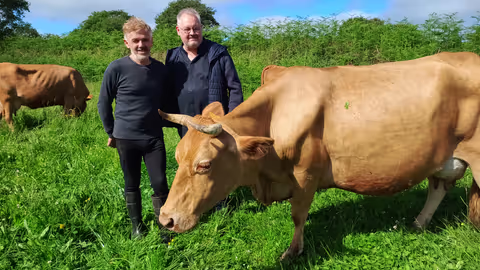
Nicolas Adam, Stéphane Terlet and the "best butter in the world
In Maël-Pestivien, in the Côtes-d'Armor region, a breeder of Froment du Léon cows and a doubly-tastic chef have been weaving a story of taste, loyalty and commitment for several years. The butter that unites them is like no other.

He carried a bucket, a stool and all his faith in his hands. Every day, Stéphane Terlet milked his cows the old-fashioned way, in the middle of the Breton meadows, to produce a rare, sun-kissed, inimitable butter. But with no suitable premises, no lab and no bank backing, his project was faltering. Until the day Nicolas Adam, chef at La Vieille Tour (2 toques) in Plérin, decided not to let him down.
A butter like no other
In Brittany, there's a corner of rolling countryside where cows graze in silence. There, in the heart of the Côtes-d'Armor region, the Couleur Froment farm stretches over twenty hectares of short grass, punctuated by woods, hedges and sky. Here, Stéphane Terlet passionately raises a herd of Froment du Léon cows, an elegant, endemic breed with big dark eyes and a blond coat that turns almost golden at sunset. "There'ssomething very gentle in their eyes," he confides. "They used to be called 'Madame's cows'. I fell in love with them."
These cows, fed exclusively on grass and hay, give a rich, fragrant milk, whose cream offers a butter of a naturally yellow, almost saffron color. Stéphane works this butter with a rare meticulousness: gentle milking, slow churning, patient gestures. "When you hear the grass crunch under their feet, you know it's crunchy. And it's that grass that gives it that taste."
The cow, the chef and the bank
When the first blocks of butter arrived in the kitchen of La Vieille Tour, the agreement was immediate. "It's the best butter in the world", Nicolas Adam assures us without wavering. But behind the delicacy of the product, reality is harsh. Stéphane milks his cows by hand, sitting on a stool with his metal bucket between his legs, right in the middle of the field. Then he transports the milk to a neighbor for processing.i used to do everything the old-fashioned way," he says, "but by the time I got to it, I was rinsed out. I needed to be able to turn a corner, to get some equipment."
But the banks weren't interested. The project was too small, too rural, too atypical. Stéphane thought about quitting. And that's when Nicolas Adam stepped in. "It wasn't possible to let him down when he had gold in his hands," recalls the chef, who predicts that thisone-of-a-kind butter would be a great success.cises that this intense yellow butter was one of the first delicacies placed on the table of his restaurant on the Port du Légué. He picks up the phone, calls the bank, tells Stéphane's story, and... buys a cow, Henriette. "It wasn't me who chose her, but the other way around. She was the first one to come up to me and give me big licks," the chef of La Vieille Tour still laughs. "But it was a symbolic purchase. The cow of course stayed with Stéphane, along with the rest of the herd."

© DR
A rare bond, consistent quality
This gesture changed everything. The bank called back immediately. The loan was released. A milking parlour was built, and a laboratory opened. The workload remained intense, but it became sustainable. As for the butter, it keeps its soul. Salted to chefs' specifications, it is taken out of the fridge a few minutes before serving to express its full aroma. "I never wanted him to pay me back for that cow," says Nicolas Adam. "I did it to keep it going. So that we'll still have this product tomorrow."
Today, Stéphane Terlet's herd includes sixteen cows, and the breeder supplies nine gourmet restaurants - Asten in Binic, Nicolas Carro in Carantec, Allium in Quimper Quimper, La Tête en L'Air and Empreinte in Vannes, Domaine du Limonay in Saint-Méloir-des-Ondes and L'Hostellerie de la Pointe Saint-Mathieu in Plougonvelin. Alain Ducasse himself has fallen for this exceptional butter, which he offers at Ducasse Baccarat in Paris. "He also keeps some for his personal consumption," Stéphane Terlet tells us, with a mischievous air. "But Nicolas is still the one I supply first," he adds, as a token of eternal gratitude.
As for Henriette, she had a calf. And as a nod to their story, it was Nicolas who chose his name: Roméo.