






Pierre Duplantier: the farmer who swapped milk for exceptional poultry
Breaking away from a productivist agricultural system is never easy. Pierre Duplantier, a former dairy farmer, dared to change the course of his life. He freed himself from an unprofitable production system to start breeding top-of-the-range poultry for chefs and gourmets.

Pierre Duplantier remembers a study trip to the Netherlands in 1998. There he discovered 200-hectare farms with 200 dairy cows milked by robots. Science fiction for the time. When he returned to the family farm in Méracq (Pyrénées-Atlantiques, France) - with its 35 cows, 40 hectares, red tape and hectic schedules to earn two francs six cents - he decided it was time for a change.
A successful change of life
at the time, Pierre Duplantier was working in a GAEC (groupement agricole d'exploitation en commun) with his parents. Their Prim'holstein herd produced 230,000 liters of milk a year. Blocked by quotas, the whole operation was struggling to survive. To diversify and add some extra cash, his parents began producing Label Rouge chicken, while Pierre raised his first poulard chickens. breeding is a big word, as he has little experience in the field and, above all, he does it mainly for family and friends.
Nevertheless, he takes an interest in water quality, different feed grinds, soil quality and ventilation. ventilation and, in the early 2000s, not a little proud of his few poulardes, he headed off to present them to chef Arnaud Daguin, then based in Biarritz. Seduced, the latter told him to do little but do it well, aiming for the top end of the market. But above all, he invited him to start raising quail, as what was on the market at the time was not very interesting.
Back in Méracq, Pierre Duplantier concentrated on his poulardes, which he received at 1 day old and raised for between 17 and 22 weeks - 5 of which in pens they shared with guinea fowl, as these two species cohabit well together. Convinced that he does little but well, with poultry fed partly on corn and dry extract milk, the breeder travels to Paris to let chefs taste the fruits of his labor. Many were won over. so much so that he registered the Poulardes Duplantier brand and decided to transform the entire farm.
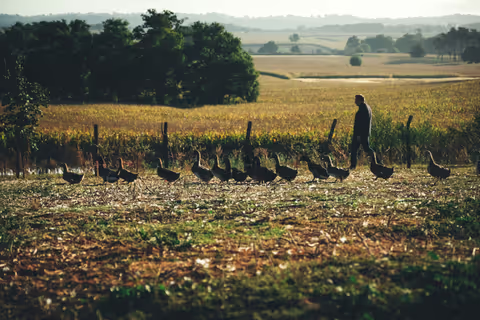
A large part of the land that had been used as pasture for the cows was turned over and planted with corn, the rest was laid out as grassy parks, particularly for the ducks, and the barn was transformed into a slaughterhouse, cold room and order preparation area. With his production facilities in place, the farmer has developed a range of poultry, poulardes, pullets, guinea fowl and crossbred ducks, all of which are raised for long periods in small numbers, without ever becoming intensive. And since Arnaud Daguin's suggestion never fell on deaf ears, Pierre Duplantier eventually began raising quail.
Today, some of the world's top chefs buy from him, both in France and abroad (Spain, Belgium, Switzerland and even Thailand), and quality product sales platforms enable the general public to order the poultry of their choice. It remains to be seen why Pierre Duplantier's poultry is so high-flying. For the breeder, success depends on attention to detail, stress management, quality water and feed, and calm. In a setting like that of the Méracq countryside, with the Pyrenees, the Pic d'Ossau and the Pic d'Annie, rising to 2,884 and 2,507 meters respectively, in the distance, how can you expect the poultry to be stressed?
Exemplary breeding
Whether common or Japanese, Pierre Duplantier's quails are raised only in the dark, ortolan-style. When they arrive on the farm, they are 3 weeks old. Many coturniculturists are content to fatten them at around 5 to 6 weeks. For Pierre Duplantier, this is not enough. He pushes on to 10 weeks, and sometimes 15, for each quail to reach 280 grams. at the end, they are not bled, but smothered and then dry-plucked so that the skin is not damaged, which also enables the quail to be kept longer.
- Volailles Duplantier
- Route départementale 944, 64410 Méracq
- 06 84 59 16 29