Mafé, wasabi, 48 spices: the secrets of Mory Sacko's cuisine
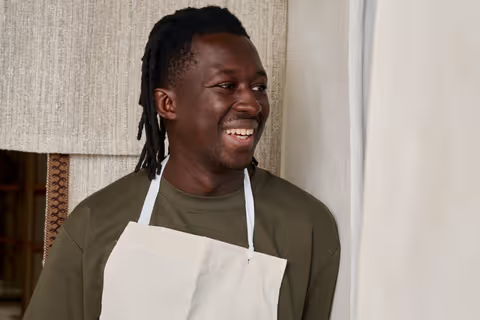
Drawing on French, Japanese, and African influences, Mory Sacko introduces us to his culinary world through five standout dishes from his restaurant, MoSuke.

At MoSuke (3 toques), Mory Sacko creates cuisine inspired by multiple cultures, where childhood memories blend with French ingredients and Japanese techniques. Some dishes stem from family history, others from a chance encounter or an ingredient discovered during his travels. From his mother’s mafé to sake kasu, and including a fish soup with 48 spices, the chef highlights five creations that reflect his culinary world.
Beef Mafé: The Family Dish
If there’s one dish that never leaves the MoSuke menu, it’s this one. Beef served with mafé sauce is also one of Mory Sacko’s most personal dishes. He’s been eating mafé for as long as he can remember. A family dish, deeply rooted in his history, that he wanted to feature on the restaurant’s menu from the very beginning. To create his sauce, the chef first asked his mother to share her recipe with him. He kept the basic recipe intact, without trying to alter it, with one exception: “I replaced the salt with miso, ” he tells us. A detail that profoundly alters the result, as the miso adds more length on the palate and an umami dimension to the sauce. The beef itself is a cut of Aubrac aged in shea butter. This combination sums up MoSuke’s approach quite well: preserving the identity of a familiar dish while transporting it into a whole new world.

Pépé Soup: Three Cultures in One Broth
Pépé soup is a fish soup widely enjoyed in West Africa. Its base is generally the same: fish cooked in a broth made from tomatoes, tomato paste, herbs, pépé nuts, chili peppers, and black pepper. Its character varies by country. In Côte d’Ivoire, it is traditionally very spicy; in Cameroon, it is distinguished by a particularly peppery seasoning. Mory Sacko offers his own interpretation using rockfish typically used for bouillabaisse. He adds fennel and saffron, then transforms the broth profoundly toward the end of cooking. Once strained, it is infused with kombu and katsuobushi, much like Japanese dashi.
Three culinary worlds thus come together on a single plate: West Africa, France, and Japan. It’s a combination the chef fully embraces, going so far as to include no fewer than 48 spices in the soup. Yet the result remains clearly recognizable. The broth retains the comforting character of the original soup, while gaining complexity thanks to ingredients and techniques from other cultures. It’s a dish that’s particularly popular with MoSuke’s guests and illustrates the chef’s ability to create a dialogue between different cultures without trying to homogenize them.

Chocolate and Wasabi: A Surprising Pairing
In pastry-making as well, Mory Sacko enjoys experimenting with unexpected pairings. Among those he particularly favors, chocolate and wasabi hold a special place. On paper, the combination may seem surprising. And yet: “When you mix these two flavors, they enhance each other without one overpowering the other,” explains the chef. The pairing has already inspired several desserts over the seasons: first a soufflé, then a ganache, and then a tart. The form changes, but the duo remains. It’s Mory Sacko’s way of holding onto an idea that works while allowing the creation to evolve.

Thiakry: Reinventing a Memory
The pre-dessert is also inspired by a traditional West African dish: thiakry, a dessert made with millet and fermented milk. Traditionally, small millet dumplings are steamed or cooked in hot water, then served with fermented milk. Mory Sacko has always enjoyed the flavor, but is less fond of the original dessert’s very dense texture. He therefore chooses to reinterpret these same elements in a different way. The millet becomes a crumble, accompanied by a date-and-lemon sauce. For the fermented milk, the chef uses Breton ribot milk and cream, finishing the dish with a thin sugar wafer. The idea is not to reproduce the dessert exactly, but to offer a fresh encounter with it. A creation designed so that everyone can find something familiar in it, even when discovering thiakry for the first time.

Sake kasu: transforming a neglected ingredient
Every winter, sake kasu makes a regular appearance in Mory Sacko’s creations. These residues from sake production are the solids that remain after pressing. They form a sort of moist paste, similar in principle to grape pomace, but with very different aromatic characteristics.
The chef discovered this ingredient during a visit to sake breweries. Originally, it is often considered waste by manufacturers. He immediately saw its culinary potential. “I tasted it and thought it was amazing! Its flavor is reminiscent of cheese—even Parmesan—with a moist texture and a strong umami dimension, ” he says. He then began incorporating it into various dishes. Sake kasu gave rise, in particular, to gnocchi inspired by cassava dango, served with a sake kasu sauce enhanced with a dash of vin jaune. Upon tasting, the chef almost felt as if he were eating Parmesan gnocchi, even though there were no Italian ingredients on the plate. He also uses it in mashed potatoes, melting it into the mixture and then combining it with infused butter and milk. The same principle works with cassava, whose mildness pairs particularly well with the bold flavor of sake kasu.