






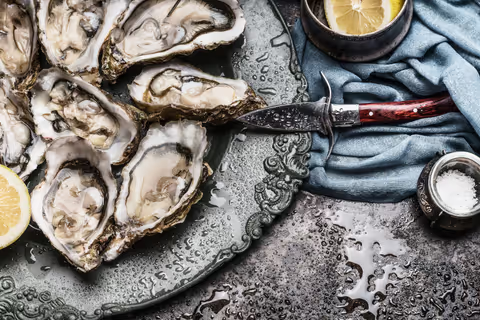
The oyster knife, the fatal weapon
The knife is the linchpin of the kitchen, the soul and weapon of the chef. Choosing the right oyster knife means taking your cooking to the next level. It's the only knife that can give you access to the umami of the iodized taste: shiny, plump, fragrant flesh. But you have to know how to use it.
The oyster is the checkpoint of taste: you either agree with it or you don't, you either love it or you hate it. When you do, it's love at first sight. You'll recognize the aficionados, standing in the cold on Sunday mornings outside the halles, fervently gobbling up their breakfast with a glass of white wine, or landing in Cancale on a Saturday on a whim.
To avoid dialing 18
The fact remains that, once unwrapped at home in their double-locked shells, the fiercest oysters can't be eaten raw without resistance. A little, sometimes a lot. How do you open oysters as well as a shucker? Tackling this delicate operation without ending up in the emergency room requires common sense, a basic technique and, above all, the right tools. The tools: a plate to wedge the animal (holding it securely is crucial), a cloth and, of course, the right utensil. This is where the oyster knife comes in. It's absolutely exclusive. Try opening an oyster with an ordinary knife and you're likely to end up on the fire truck.
A stainless blade
How do you choose between all the knives available on the market, from the most basic to the most designer? To spot a good mollusc knife, there are two elements to consider: the blade and the handle. The blade must be sharp, rigid and corrosion-proof. The handle must be solid and easy to grip, preferably riveted, to ensure its rigidity and the certainty that it won't change trajectory.
All you have to do is choose between the traditional model, the Lyonnais, and the lancet-type knife. Practical and elegant, the traditional knife features a thick, stainless blade. One side is very sharp, while the other is broad and non-cutting. The lyonnais blade is tapered and measures around 7 cm: the two edges are identical and slightly thick. Perfect for opening medium-sized mollusks. Finally, the lancet, with its short, stiff, thick blade, is renowned for attacking the shell with great ease.
The right method
All set? All that's left to do is cut the adductor muscle which allows the animal to open, close and protect itself from predators. The right way? Insert the knife two-thirds of the way down the hinge, slide the blade under the upper shell to cut the adductor muscleadductor muscle, rotate the blade a little like operating the gas pedal on a motorcycle, lever gently, lift upwards : you've got it. Be careful not to break the shell - nothing is more irritating than those fragments cracking under the tooth. The secret: gentleness and diplomacy. The art of war is to subdue the enemy without a fight. All that remains is to choose sides: to empty or not to empty the water in which the mollusc is swimming? That's the (good) question. On the other hand, you'll have no choice: rinse your knife thoroughly, without putting it in the dishwasher. It's well worth it.
The Gault&Millau selection
To avoid accidents, choose safety with our selection of oyster knives and tongs.

- Handcrafted. Oyster tongs for easy, effortless opening, Ostra di Giulio, 50 €.
- The safety combo. Oyster clamp and oyster knife in beech, Jean Dubost, €10.90.
- Eco-responsible. Oyster knife with recycled scallop handle, Charles Canon, 52 €.
- Personalized. Knife with customizable wooden handle, "Little Robert", l'Atelier d'Affûtage, 45 € (customization included).
- The design. Oyster knife with oak handle, "Le 1920", Jean Dubost, €19.90.
- The professional. Oyster knife with curved blade and non-slip handle, Victorinox, €25.
- The precaution. Silicone oyster mitt, de Buyer, €23.40.