






How a Prominent Wine Family Turned Its Fortunes Around Thanks to Asparagus
Less well-known than their château in Fargues, the Uza farm in the sandy plains of the Landes region is to white asparagus what a grand cru is to Sauternes: a must-have on gourmet tables. It also marks a new chapter in a family saga that has spanned 500 years.
The name Lur Saluces is almost synonymous with Sauternes, where this famous noble lineage was—and remains—a major producer, first at Yquem and later at Fargues. This barony, which became part of the family estate in 1472 through the lavishly endowed marriage of Isabeau de Montferrand and Pierre de Lur, included the viscountcy of Uza and its pond, in the heart of the Landes wilderness. This fiefdom of former marshes and peat bogs is now enjoying its fourth lease on life under the stewardship of Charlotte and Philippe de Lur Saluces, winemakers in Bordeaux and producers of organic white asparagus in Uza.

© Yohan Espiaube
A Thousand and One Lives
Before gracing the tables of Jean-François Piège andAlain Passard, Uza had long allowed a few families of resin collectors to eke out a living from the forest’s resources, several centuries ago. In 1759, Henry de Lur Saluces decided to establish forges there, which survived the French Revolution and thrived throughout the 19th century thanks to local resources of water, wood, and iron ore. They employed 162 workers in 1851, successively producing agricultural tools, pots and pans, ammunition during World War I, and parts for the SNCF, before declining like most rural factories: they closed their doors in 1981.
Prior to that, the rise of a true industrial town led the Marquis Romain-Bertrand de Lur Saluces to cede part of his land to establish the town of Uza in 1872, preceded by the construction of a church. Then came the town hall, the school, the train station, the community center, the post office… buildings most of which still belong to the family, along with half a dozen old Landes-style farmhouses converted into charming vacation rentals. A few houses in the village now house seasonal workers from the asparagus farm and two restaurants that opened in 2016 and 2018: La Table du Marensin, located in what was once the home of the forge’s director, and a bistro and tea room in the former “food store,” the hamlet’s grocery store. This transformation of industrial heritage into green tourism has helped create about fifty jobs in this village of two hundred residents.

© Yohan Espiaube
Eternal Spring
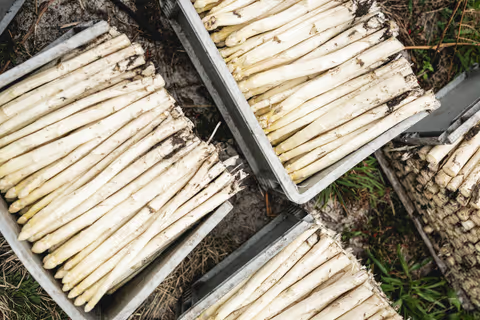
The revival came out of devastation: in December 1999 and January 2009, Storms Martin and Klaus ravaged the Landes mountains, jeopardizing the Lur Saluces’ forestry income for several decades. The family then turned to white asparagus, “after experimenting with carrots, kiwis, and physalis , ” Charlotte notes. The sandy soil of the Landes—which drains well and retains heat—makes the region the leading producer of this spring delicacy. They grow there“vigorously and straight,” explains Matthieu Costarramone, who manages the 23-hectare organic farm. They grow underground in a mound of sand, white as mother-of-pearl, sheltered from the light. The mother root produces its first asparagus after three years. These are small buds that push their way up toward the surface. They are harvested from March through June as soon as they peek out into the open air, using a “gouge,” a sort of large, sharp shoehorn. The asparagus must be harvested before the bud blooms and its delicate white color—now exposed—turns purple due to photosynthesis… and becomes bitter.

@ Yohan Espiaube
Two-colored plastic tunnels are used to heat the rows at the start of the season (black side) or to insulate them from the intense summer heat (white side). Barring any accidents, they are reused throughout the seven years of production on a given plot. Strange, spider-like machines precede the pickers, lifting the tarps as they pass and replacing them behind them.

© Yohan Espiaube
At the station set up near the old blacksmith’s shop, the freshly harvested asparagus is immersed for eight hours in water at 7 °C to preserve its pale color. They are washed and brushed on a conveyor belt, then sorted by an optical camera to remove twisted, discolored, damaged, or broken stalks, as well as tips that are too open. Uza’s organic production—one hundred metric tons of vegetables as fleeting as they are flavorful, melt-in-your-mouth, and exceptionally tender—is certified by the Collège Culinaire de France and distributed to gourmet restaurants in France and Japan.

© Yohan Espiaube
Until the end of the season, La Table du Marensin serves an“all-asparagus” menu from appetizer to dessert: raw, in a soufflé, in risotto, roasted with foaming butter, and even poached in vanilla syrup. The “queen of the sands” has a reputation for being difficult to pair with wine, but—surprise!—it pairs beautifully with the golden nectar from Château de Fargue.
▶ This article is excerpted from the Nouvelle-Aquitaine 2026 guide. Find this guide in bookstores or on our online store.



 12,5
12,5