






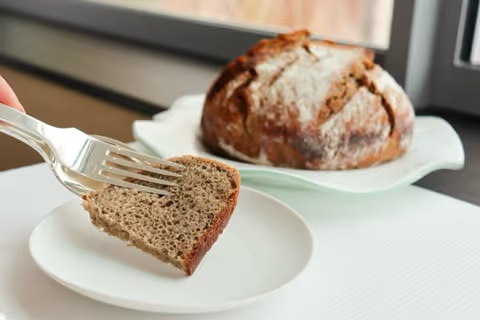
These restaurants bake their own bread, and that makes all the difference!
Buckwheat bread, beet bread, gluten-free bread or even charcoal-smoked bread... Far from being trivial, these creations tell a real story, and are offered in different restaurants as a genuine extension of the kitchen.

Long relegated to the simple role of accompaniment, bread is now back at the center of the gastronomic stage. In exceptional restaurants, it is no longer an accessory placed casually on the table: it becomes a culinary manifesto, a signature, a field of expression. Some establishments go so far as to devote a veritable goldsmith's art to it - ancient flours, natural sourdoughs, tailor-made cooking, gluten-free variations, or even food and bread pairings conceived in the same way as wine pairings.
Because a great meal often begins with a great loaf of bread. Bread that's broken while still warm, spread with exceptional butter, dipped in fruity olive oil, or which collects, without losing a drop, the sauce of a long-simmered dish. Texture, crust, crumb, acidity, roasted seeds or smoky notes: every detail counts.
In this selection, we reveal gourmet restaurants where bread is conceived as a coherent extension of the cuisine, presenting itself in turn as a creation in its own right, a tribute, a regressive memory or even a manifesto in favor of local products.
L'Oustau de Baumanière, Les Baux-de-Provence, France
Glenn Viel doesn't do anything like everyone else. The chef at l'Oustau de Baumanière (5 toques) has in turn installed tomato dryers on the restaurant's terraces, devised "seasoning pebbles" to finish his plates in style and even works closely with his ceramist Cécile Cayrol, who has her own workshop on the premises, to create plates that are ever more in keeping with her imagination. In addition to these unusual ideas, Glenn Viel has also devised a bread-and-dinner pairing with the restaurant's baker, and proposed a different variation for each dish.
- Where? 500 route de Baumanière, 13520 Les Baux-de-Provence
- See Gault&Millau's review of L'Oustau de Baumanière

AM by Alexandre Mazzia, Marseille
At AM par Alexandre Mazzia (5 toques), bread becomes a creation in its own right, conceived as a direct extension of chef Alexandre Mazzia's cuisine. Born from an initial focaccia with vegetable charcoal, this bread has evolved into a lighter version: "Today, it's a Viennese bread, smoked and still with vegetable charcoal.this ingredient is far from anecdotal, since "charcoal absorbs moisture, which amplifies the lightness", while at the same time "enhancing theflavour".this ingredient is far from anecdotal, since "charcoal absorbs moisture,amplifying the lightness", while adding a smoky note that's "not too pronounced, rather evanescent". The result is a texture that's almost unexpected, "a bit like a really light meringue", and a strong visual signature, with a black color that, as early as 2014, stood out on gourmet tables.
Conceived as a structuring element of the meal, this bread accompanies the first sequences, "saucing an eggnog, or bringing freshness after a marine sequence without ever crushing". It is served with a semi-salted kombava butter, whose peel and zest are infused for over 72 hours before being dried and then incorporated, adding a subtle aromatic dimension. "I wanted a delicacy that was easy to master at the table", confides the chef, capable of integrating into the rhythm of the service while maintaining precision and regularity. A legacy of his past in pastry-making, this bread boasts "the gourmet side of Viennese bread, without the opulence".
Behind this creation also lies an intimate memory: "the smokiness reminds me of Africa", says Alexandre Mazzia, referring to Pointe-Noire where he grew up. Made according to the season with a variety of flours - manioc, coconut, spelt or rice - it adapts to dishes as "a real element of construction and tasting". A more generous version even exists for his foodtruck, with almond and hazelnut flours, smoked vegetable milk and dried chili skins, designed to accompany more robust preparations.
- Where? 9 rue François Rocca, 13008 Marseille
- See the Gault&Millau review of Restaurant AM by Alexandre Mazzia

Gluten-free bread at the Auberge de la Fenière, Cadenet
at the Auberge de la Fenière (3 toques), Nadia Sammut offers a 100% gluten-free and lactose-free menu. The chef, who suffers from celiac disease, has turned this struggle into a creative force for committed, inclusive gastronomy. This includes, of course, gluten-free bread, which she bakes with her teams. "What we're looking for above all is gourmandise. A fine crust that sings under the blade of the knife. A supple crumb, almost buttery to the touch, that retains moisture and warmth. A chewy texture that envelops the palate without ever drying it out. We use buckwheat flour, brown rice flour, chestnut flour and, of course, my chickpea bread, a legume chosen for its aromatic depth. It brings notes of toast, lightly toasted, almost cocoa-like at times, with that hint of hazelnut that makes you want to come back for more," explains Nadia Sammut. "This bread is designed to be broken, shared and sautéed. It accompanies a new olive oil, it collects the juice of roasted vegetables, it prolongs a broth. It's not a substitute: it's a partner to the dish. Its deliciousness is also due to its sincerity. No additives, no tricks to "imitate" gluten. We take on the personality of the flours, their character, their rusticity sometimes. That's what gives bread its strength, its identity."
- Where? 1680 Route de Lourmarin, 84160 Cadenet
- See the Gault&Millau review on
L'Auberge de la Fenière
La Butte, in Plouider
at La Butte (3 toques), bread is one of the pillars of the culinary project led by chef Nicolas Conraux and his wife Solène. Although the house has been making bread for a long time, a new step was taken in 2016 with the purchase of the village bakery. The business then took on a whole new dimension, until the move to a vast 350 m² bakery in 2021, now open seven days a week. "We work on our bread like we work on our plates, with a great deal of sourcing and the desire to be as committed as possible to the environment and the preservation of local trades", explains the chef. Local wheat, rye and oat flours form the basis of these lively breads, to which the team adds a unique character: some are flavored with miso made from Paimpol coconut, while unsold buckwheat bread is used to produce this homemade miso, creating "a virtuous, zero-waste circle". In keeping with this local ecosystem approach, some breads are enriched with honey from the in-house beehives or beer from a neighboring brewer - who also brews a cuvée from their unsold bread. In the restaurant, three breads accompany the meal: the traditional baguette served as a welcome with the butter cart, a more rustic bread with oat bran miso, and a fennel and honey bread activated to accompany local cheeses. An approach nourished by fermentation and "living food", which echoes the family history: Solène Conraux is the granddaughter of a baker. A discreet heritage, but deeply rooted in the DNA of the house.
- Where? 12 rue de la Mer, 29260 Plouider
- See Gault&Millau's review of La Butte

Le Manoir de la Régate, Nantes
At the Manoir de la Régate (3 toques), the welcome bread is a real tribute. Chef Mathieu Pérou claims it'sa"nod" to a great name from Nantes, now somewhat forgotten: Édouard Nignon. This early-20ᵉ century chef, who passed through Claridge's in London and was a figure at Restaurant Larue in Paris, had even created the first French bakery in Moscow for the Russian aristocracy. at the time, he imagined a nourishing bread, fashioned "from whatever he could find: beet, walnut kernels and coriander seeds. You had to imagine what bread was like before the First World War in Russia, it had to be nourishing," recalls Mathieu Pérou.
The recipe was passed on to him by retired chef Yvon Garnier. Faithful to the original spirit, but with an eye to elegance, Mathieu Pérou has come up with a contemporary version: a flaky loaf to "lighten itup, without detracting from the taste". Now presented in the shape of a cube, this bread roll requires "a lot of work", but it opens the meal as a welcome gesture. Tasty and light, it offers "the right compromise" between memory and modernity.
- Where? 155 route de Gachet, 44300 Nantes
- See Gault&Millau's review of Le Manoir de la Régate

Honey-buckwheat bread from Domaine du Liziec, Vannes
At Domaine du Liziec (3 toques), Olivier Samson can count on the sensitivity and curiosity of his pastry chef Nathan Megret. While Megret imagines enveloping desserts, he also creates a veritable collection of homemade breads, conceived as a natural extension of the kitchen. The meal opens with a flaky bread, perfectly crusty and generously buttered, served while still lukewarm.themeal opens with a flaky bread, perfectly crusty and generously buttered, served warm to match the first courses (lemon, squid ink, seaweed)... A delicate appetizer, before "rising to a crescendo in the meal".
But the centerpiece remains the buckwheat and honey bread. "When I arrived in Morbihan, Olivier Samson was already making buckwheat and honey bread in his former restaurant, La Gourmandière", explains Nathan Megret. It all started with the discovery of Lanvaux honey: "one of the best honeys I've ever tasted", says the young pastry chef. He met the producers in Saint-Jean-de-Prévelay, decided to work with their entire range, and then discovered Épi Breizh flour in Colpo. With these products, he revisits Olivier Samson's original recipe.
Nathan Megret's bread is based on "a blend of four flours: rye, T65, T80 and buckwheat flour", enriched with a percentage of buckwheat honey, very dark, almost brown, with a "powerful buckwheat taste". Fermentation lasts 24 hours, followed by a further 24 hours of slow fermentation "to develop maximum flavor". On the palate, we find the character of buckwheat sourdough, a toasty depth, a "sweet, gourmand side", without ever falling into excessive density: the bread remains supple and balanced. Versatile, it goes equally well with fish, meat and cheese. But, according to Olivier Samson, it goes perfectly with his dish of oysters and pig's head. A bread with character, rooted in the Breton terroir, born of demanding teamwork, and now one of the hallmarks of Domaine du Liziec.
- Where? 20 route de Rennes, 56000 Vannes
- See the Gault&Millau review of
Domaine du Liziec

La Passagère, Antibes
At La Passagère, a three-star restaurant nestled in the legendary Hôtel Belles Rives, Aurélien Véquaud creates a bread that tells an intimate story around his Proust's madeleine: "Prefou is a local specialty," confides the chef, a native of the Vendée region. For a long time, this bread remained "the secret recipe of the Pays de la Loire", before being more widely distributed - often industrialized - but for him, it remains above all a childhood memory.
"Originally, the real name was pré-four", he explains: a piece of dough that bakers would slip into the oven to gauge its temperature, at a time "whenthere were no thermostats". At the end of the service, these pieces became an aperitif treasure: "we opened them, added butter, pepper and garlic", pressed them, lightly pressed them again in the oven, and shared them around eleven or twelve o'clock. A simple gesture, terribly convivial.
in Antibes, the chef has completely revisited the recipe. The dough, worked "like croissant dough", is rolled into disks for sharing. inside, a puree of garlic confit mixed with butter; then, as soon as it comes out of the oven, a melted butter infused then, once out of the oven, melted butter infused with raw pink garlic is added, seasoned with Kampot pepper, smoked Penja pepper or white pepper. The result? "A very gourmet, very addictive bread, dripping with butter", he smiles. This flaky prefou is a nod to his roots, as are the langoustine, oysters and pine-needle-smoked mussel éclade that punctuate his cuisine.
- Where to eat? Belles Rives, 33 boulevard Edouard Baudoin, 06160 Antibes
- See Gualt&Millau's review of La Passagère
Maison Saint-Crescent - La Table Lionel Giraud, Narbonne
At Maison Saint-Crescent - La Table Lionel Giraud (4 toques), a gourmet restaurant deeply rooted in the Narbonne region and acclaimed for its elegant, inventive style, homemade bread takes on a singular form under the impetus of chef Lionel Giraud. Where many establishments serve classic breads at the opening, here the choice is for a "petit pain vapeur", a light, airy and delicate creation that resonates with the finesse of the cuisine on offer.
This bread is not a simple accompaniment, but an appetizer in its own right. It resembles a bread "a little Viennese", shaped with "a honey-based fermentation part for a natural leaven", which gives it a subtle sweetness and a very delicate aromatic depth. The sprouting remains traditional, then comes the singularity: "very light steaming, between 60 and 80°C, for around ten minutes", confides the chef. The result is a crumb of almost ethereal softness, supple, melting and restrained.
Served immediately, it instinctively calls for a drizzle of olive oil. It's a simple, almost Mediterranean gesture, but one that's not trivial for the chef: dipping the bread in oil reminds him of a ritual his great-grandmother used to do. An intimate memory, transmitted through this vaporous mouthful.

- Where to eat? Rond Point de la Liberté, 68 avenue du Général Leclerc, 11100 Narbonne
- See Gault&Millau's review of Maison Saint-Crescent - La Table de Lionel Giraud