






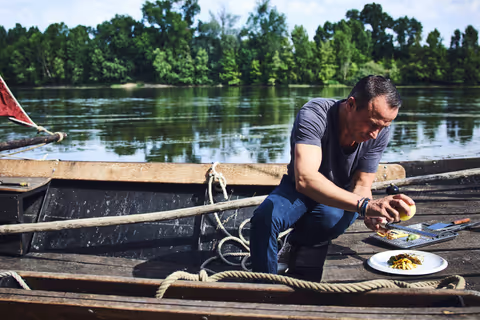
No frying on the line between Christophe Hay and Sylvain Arnoult
Long the preserve of riverside or lakeside inns and guinguettes, and neglected in the kitchen - often due to a lack of know-how - freshwater fish are now regaining their rightful place on gourmet tables. Depending on the season, bream, asp, shad and carp are making a comeback on restaurant menus.

Gault&Millau: When did you first meet and what do you remember about it?
Christophe Hay: In January 2013, to be precise. I was about to open my restaurant in Montlivaut and I was looking for a professional fisherman. On flowers and lakes, the principle is that fishermen rent concessions. The one closest to the restaurant was Sylvain's, stretching from the Saint-Laurent-des-Eaux power station to the Château de Ménars. I went to meet him, but he was very closed to the idea of collaborating with chefs, as those he'd worked with in the past only asked him for pike-perch and pike. I, on the other hand, was ready to cook anything he could catch in his nets. In fact, all we talked about was fishing, nets, meshes, species and very little about cooking.
Sylvain Arnoult: Perhaps I wasn't very kind when we first met, because I didn't want to hear any more about chefs who think that the Loire is Rungis, that there's everything all year round, day and night, and that all you have to do is place an order. But I quickly realized that Christophe knew the seasons and the species. When he confessed to me that he'd been a champion rod-fisherman when he was young, I said to myself that there was a way we could get along. He came to see me, he listened to me, and I think that's what convinced me.
How do you see each other and your respective professions?
C. H.: I really admire his work. I'm not saying I couldn't do it, but it's a lot more complicated than it looks. I've spent a lot of time with Sylvain, and I've often been out on the Loire with him. Behind his somewhat boorish character, there's a lot of benevolence, and when he tells me he doesn't want me on his boat, it's because he knows it's dangerous that day, and he doesn't want to take any risks. I also admire his knowledge of the river, his sense of observation of its biotope and the species that live there, fish and birds alike. And often, when I'm behind the stove, I think of him as I cook, and it saddens me to know that sometimes his nets are empty. it saddens me, but I know it's part of his job.
S. A.: You too can make zero customers. [ Joking aside, I admire the chef because he's been able to ennoble all the species I've caught.he doesn't order by the unit, he takes what I bring up in my nets, and then he manages. But when I see the titles on his menu, I tell myself I didn't get up in the middle of the night for nothing! We need more and more chefs like him to promote my profession and freshwater fish. He's even started cooking carp. It took him a while; at first, he didn't want any, but in the end, it's his carp "à la Chambord" that all his customers want to taste. It's my pride and joy, along with the catfish, which he offers marinated in citrus fruits before pan-roasting.

guillaume Czerw
Twelve years after you met, and one move later, you're still working together. How do things work on a day-to-day basis?
C. H.: When I first opened my restaurant, the menu included a little fish from the Loire and a little from the different oceans. Gradually, I stopped offering fish from the sea to refocus on Sylvain's catch. when I arrived in Blois, I didn't change a thing. I don't order him to do anything - by which I mean I don't give him orders. Since he's diligent, doesn't count the hours and has an incredible sense of the river, I know he'll always have something to provide. At first, it's stressful because we're thinking about the customers who are going to ask for this or that fish dish, but in reality, in the dining room, we explain the seasons, the migrations and Sylvain's work, and they understand. The nicest compliment is when customers come in, discover there's no asp or bream, and ask when the fishing season will start again.
S. A.: What I like about Christophe is that he knows my trade as well as the river. He knows that asp are caught from January to March, that catfish are caught from June to November, that carnivorous fish are mainly caught between September and November, and that there are no pike-perch in March because fishing is closed. After that, for a special meal or a group meal, if he has a particular request, I'll find what he needs, unless it's out of season, because I know where the fish are at a given time of day. All right, sometimes I come home empty-handed, but that's part of the job.
What has changed in recent years on the Loire?
C. H.: I have the feeling that the Loire has never been as beautiful as it is right now. In 2000, it was classified as a World Heritage Site by UNESCO, and thanks to this, in certain places, it has put an end to the decline of the river. in some places, it has put an end to architectural projects that would not have been good for the environment. The water is clear, there's no sewage, no pollution.
S. A.: The Loire is my work tool. I'm not going to answer on an environmental level, but on the core of my business. I've noticed that water temperatures have risen and that migratory fish are less numerous than before, except that this isn't linked to the Loire, but to what's happening in the oceans.i've noticed that asp and catfish are becoming more numerous, that certain species have been introduced, often by mistake, and that this is upsetting everything, but I think we should let it be.nature doesn't need man to evolve, it adapts. That's the way it's been since the dawn of time, and it's not the role of any particular administration or association to decide which species to protect. They live together, like each other or hate each other, rub shoulders or kill each other. Why should human beings get involved? In five years' time, a decision taken ten years ago for or against a particular species will be totally obsolete.
You use two verbs, appreciate and detest. This also applies to the general public. What image do they have of freshwater fish?
C. H.: It's not that they like or dislike them, it's that they have persistent preconceptions. For some members of the public, freshwater fish are full of bones, taste like mud and aren't all edible. Yet - and even more so on the Loire - fish live on pebbles. The Loire, like other rivers, is not silted up. What's more, the word "douce" in freshwater fish means "soft", which underlines the fact that we're not dealing with powerful flesh.
S. A.: I don't have much to add, that's exactly what I hear all the time. There are really two camps: those who are convinced and those who are not. And you'll never get them to switch to the other camp. It's crazy because, when you ask them, you realize they haven't eaten freshwater fish for decades sometimes. They're just peddling what they've heard. If I come back to the bone thing, it's a shame to stick to that idea, because in the case of the unloved catfish, for example, its flesh has no bones. And, last but not least, most fishermen and chefs don't leave the bones in. No, all the work is done upstream.

guillaume Czerw
Which fish species do you look forward to every year?
C. H.: It's complicated, because I think I've learned to appreciate them all by now. If I have to make a choice, I'd say I have a particular affection for carp, which I find definitely sensual. On the one hand, because I didn't want to work with it until Sylvain explained to me that there was an abundance of it, and on the other, because it's a difficult fish to understand morphologically. I think it took me between three and six months to master its bones, which are located on its back and not on its belly. Today, I owe part of my table's reputation to carp "à la Chambord".as far as I can remember, this is the fifth or sixth version, and they've all helped to make my cuisine a household name.
S. A.: Some catfish, because they give me a hard time. But I'm particularly fond of shad, a migratory fish that swims up the Loire in early spring. The fishing time is short and, in my geographical area, they're not there to spawn, but simply to pass through. In the same family of migratory fish, I also like lamprey and eel. As with shad, I thought I'd never be able to fish lamprey again, because some associations were opposed to it, but in the end a court rejected the request for suspension.
On the culinary front, which freshwater fish dishes have stood out for you?
C. H.: In the family, my grandmother Lucienne's pike-perch with beurre blanc is undoubtedly one of my favorite dishes. Today, there are plenty of inns and guinguettes along the Loire that serve it, but when I was younger, it was a real festive dish. Lucienne would poach the pike-perch in a turbotière, then peel it before removing the bones. Professionally, I think I was impressed by the Lyonnaise-style pike quenelles at Paul Bocuse's restaurant.
S. A.: There's a family tradition of setting aside the first shad of the season and cooking it at home. It has a particular taste that's linked to the moment, a bit like a celebration. I also like eel on the barbecue and fried.
This article is taken from Gault&Millau Magazine #10. You can find this issue on our eshop.