






He left everything behind to create a Breton whiskey that’s already winning over chefs
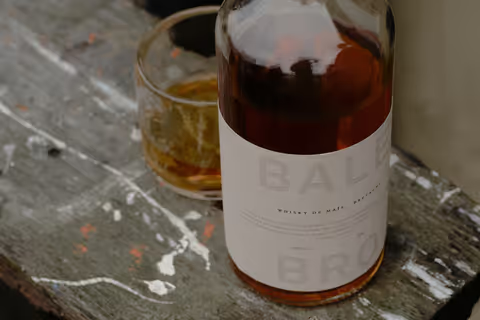
In a region already renowned for its whiskey, Bertrand Jestin crafts a line of organic spirits that are entirely sourced from Finistère. From corn grown in Loctudy to barley from northern Finistère, Bale Bro embodies a new generation of spirits deeply rooted in their terroir.

You have to step inside a quiet workshop in Gouesnou, just a stone’s throw from Brest, to understand what it really means to “make whiskey with your own two hands.” Here, the stills heat gently, the barrels wait patiently in the dim light, and time seems to stretch on. It takes at least three years before a single drop can be tasted. Three years of silence, watchful care, and unwavering conviction.
The story begins far from here, in Santiago, Chile. That’s where Bertrand Jestin met Waldo Brown, his future business partner. The two men shared four years as roommates and forged a strong friendship. Twenty years later, determined not to let distance erode that bond, they decided to start a business together. It’s 2019: Bale Bro is born. Waldo still lives in Chile; Bertrand, a native of northern Finistère, returns to his roots, between Lesneven and Plouider. That’s where he wants to build his business.

© DR
A former wine sales manager for over twenty years, Bertrand Jestin spent much of his time traveling the roads and flying through airports. “I’d often get home on Friday nights at 10 p.m. The house was quiet. I’d take a shower, then settle in to savor a glass of whiskey. That was my moment to myself. ” This almost intimate ritual has become a goal: to offer others this moment of respite. Not a showy, overly oaky whiskey, but a balanced, approachable spirit with a beautiful attack and a rich, lingering finish.
Breton corn in the still
Although he describes himself as a bourbon lover, it is in Brittany that he has rooted his project. From the outset, Bale Bro chose the path of organic and local production—a demanding commitment. Corn—a grain still rare in the French whiskey landscape—became his signature ingredient: dent corn, raw, and 100% organic.

Some of it comes from Loctudy, from Florence Ollivier and Marc Sparfel, who raise Angus cattle. They initially grew the corn for their own livestock; their partnership with Bale Bro opened up a new market. Little by little, the goal became clearer: to use only Breton grains.
Barley and rye also come from Finistère, while malting takes place in Scaër and distillation in Gouesnou, using two Scottish Forsyths stills—a 900-liter still for the first run and a 300-liter still for the second. Bertrand Jestin trained for several months before launching his venture: at the Brasserie du Baril under Benoît Corre in Brest, at the Kinkiz distillery in Quimper, in Charente, and then all the way to Denver, Colorado—a city twinned with Brest.
Balance Rather Than Potency
The first corn whiskey, released in October 2023, sets the tone. With a golden color, a pastry-like nose of vanilla and milk caramel, and a supple, silky mouthfeel, the natural creaminess of the corn delivers an enveloping richness without any heaviness. Some of the whisky is aged in American oak barrels to develop notes of coconut and vanilla; other batches are aged in French oak, which is more delicate, to preserve the desired balance. “I didn’t want a whisky that was too oaky, but something easy to drink, with plenty of aromas and a truly long finish.”
In May 2024, a barley whiskey will round out the lineup. More grain-forward and highly aromatic, it develops a lovely roundness and a subtle salty note on the finish—almost iodine-like—a discreet nod to the Breton terroir. In 2025, a third release, blending rye and barley, asserts a spicier, slightly peppery character, with a dry and clean finish—the signature of rye. Three expressions, three distinct personalities, but a common thread: aromatic precision, structure, and length.
Certified organic since 2023 and part of the Breton Whisky PGI, the distillery guarantees full traceability, from field to bottle. Choosing organic isn’t just a marketing pitch: it means contributing to a virtuous ecosystem, restoring biodiversity to the fields, and encouraging agricultural practices that are more respectful of the soil.

© Nomades
Production currently stands at around 30,000 bottles per year, distributed to nearly 150 retail locations, including wine shops and restaurants such as La Butte in Plouider (16/20 – 3 toques), the Nicolas Carro restaurant in Carantec (15.5 – 3 toques), and La Pomme d’Api in Saint-Pol-de-Léon (17/20 – 4 toques).
At its core, Bale Bro tells a simple story: that of a man who, after spending many years selling other people’s products, wanted to create his own. A whiskey born from a Friday-night memory, a long-distance friendship, and a region. A special moment… just as promised!
List of retailers at www.balebro.com
▶ This article is excerpted from the Bretagne 2026 guide. Find this guide in bookstores or on our online store.