Gilles Goujon: “Nature will do its job, but we need to help it”
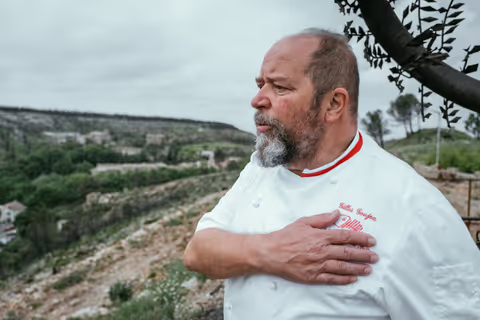
Between August 5 and 28, 2025, nearly 18,000 hectares of the Corbières mountain range went up in smoke, including part of the heart of Fontjoncouse, where Gilles Goujon (5 toques) opened his restaurant in 1992. A year later, he takes stock of the situation and looks to the future as he gazes at the mountains, still blackened by fire, where, here and there, nature is reclaiming its place.

GAULT&MILLAU We’re on the hills above Fontjoncouse (Aude), where you live; the Auberge du Vieux Puits is located below us. All around us is a panoramic view of the Corbières, but it’s no longer the one you once knew.
Gilles Goujon: Everything was green before the fire. Right there, down the hill, there were little oak trees, arbutus trees, junipers… It was magnificent—so dense you couldn’t even walk through it—and the wild boars feasted on it! Up there, it was full of rosemary, thyme, and lavender that I used to go pick. It all burned down… Here, I have a little savory [sarriette], which we’re going to replant. That’s all we have left.
Let’s go back to August 5, 2025, the day the fire started…
G.J.: I was away at the time, and circumstances forced me to organize the evacuation remotely a few hours before the order was given. The fire was forty kilometers away, but we couldn’t afford to wait. There were seventy people on the premises, including guests, and more than fifty cars. The firefighters were arriving just as the guests were leaving in the middle of the afternoon. It was the right moment—otherwise, everyone would have been trapped.
What was your state of mind at the time?
G.J.: On the phone, I was reassuring everyone by saying, “No, it’s not going to burn…,” and I was truly convinced of it! I’d always considered the place to be protected, and it seemed impossible to me that it could catch fire. Some areas burn regularly every fifteen to thirty years. Here, never. This is the first time in Fontjoncouse.
You were given permission to return two days later…
G.J.: When I arrived at the Auberge, my hunch was confirmed: just a little ash on the mattresses! But Christophe Téna, the mayor of Fontjoncouse, prepared me by saying that it wasn’t the same up there… It turned out that a TV crew was waiting for me, and naturally, with the shock of it all, I couldn’t help but break down. Everything was black, burned, melted. The firefighters had done an extraordinary job saving the homes. It was 5,000 degrees; the fire was raging; they had to pump water from the pool. Hats off to them! These young people are admirable—they’re risking their lives.
Another striking feature of this landscape is that bronze olive tree on your terrace. With its dark patina, it now seems to symbolize the fire.
G.J.: At the Auberge, I have many sculptures by Robert Cros. This one was a gift from some chef friends for my 50th birthday. It did indeed survive, just like that little square section of the terrace—even though it’s made of wood. Do you know why? Because a Virginia creeper was growing over it, and the fire went right around it. It’s funny, isn’t it? A friend from a nearby farm, who has a very large Virginia creeper, told me the same thing.
In April 2026, you began planting. How many trees did you order?
G.J.: About three hundred, including 130 laurel trees, 96 olive trees, and 20 large ones—bigger than the ones we already had… Among them is a “pruned” olive tree that we’ll plant in front of the house. There are also pomegranate trees, holm oaks, arbutus trees, hackberry trees, almond trees, and junipers—and the birds, which we can hear in the distance, will finally return to perch on the branches.
Has this fire changed your perspective on things?
G.J.: I’m a contemplative person, so I’ve always spent time observing a tree, a flower… Since then, I’ve perhaps been doing it even more. Last summer, I noticed there were more cicadas than in previous years. They were on the tree trunks—really big ones. I don’t know how long it will take for them to come back. It might be a “silly” question, but it bothers me. The same goes for squirrels, turtles, wild boars, deer, rabbits… Those that haven’t died can no longer hide or find food… They’ve gone elsewhere.
And what about your perspective—but in your kitchen this time?
G.J.: I created a dish that’s particularly close to my heart. When I called my team to present it, I couldn’t even finish the announcement because I was so moved—it’s through this dish that I tell that story. This “Occitan bourride with a Corbières twist” is made with monkfish, eel, and pikeperch. The ashes from the fire fell on our villages and our vegetable gardens, so the vegetables in this dish are browned. But spring will return, and everything will turn green again, just like the wild garlic and parsley emulsion that binds the dish together. Despite this, there will always be a few charred trees on our hills. I’ve represented them with small croutons made with squid ink.
Has your restaurant suffered financially?
G.J.: I closed for ten days, so there was an operating loss, but it wasn’t catastrophic. I chose to reopen on August 15, Saint Mary’s Day—a symbol of rebirth for me. It’s also my wife Marie-Christine’s name day—she’s my good-luck charm. I’m a believer, and I saw all of this as a good omen. And it turns out we made the right decision to reopen that day!
Did any acts of solidarity emerge?
G.J.: People supported us by coming to the Auberge—both regulars and people who’d never been before—which helped make up for some of the lost revenue. And then some customers gave us olive trees. I received 78 in all. That was really nice.
And what about your peers?
G.J.: On November 25, 2025, I organized a dinner called “Renaissance” at the Château de Boutenac with chefs from the Aude region—Jean-Marc Boyer, Lionel Giraud, Erwan Houssin, and Franck Putelat. The proceeds were donated to the affected winemakers. That same day, there was also a concert and reception at Narbonne City Hall, again in support of the winemakers, since they’re the ones who’ve suffered the most. Some have lost everything—two or three generations’ worth. I have a friend who’s facing five million in damages! Fortunately, he’s insured, but others aren’t… And then there are all the small grocery stores, hotels, bed-and-breakfasts, and small restaurants that rely on the natural beauty and environment of the Corbières to attract customers… How will things go for them this summer?
Are you worried about a decline in tourism in the Corbières?
G.J.: Yes, but the economic situation is taking its toll everywhere. We should be okay here at the Auberge, because people don’t just come for the scenery—they come for my cooking. I hope that those drawn to the hikes and the sea just 20 kilometers away—in other words, all the people who keep the local businesses going—will come this summer! Otherwise, all these establishments in the area will disappear. So I do fear that, yes—even though I’m usually a positive person…
Is that positive outlook your Sagittarius side—known for being an eternal optimist?
G.J.: Actually, you could say that a Sagittarius falls apart and puts themselves back together right away! I’m very emotional, and sometimes I go to bed feeling completely crushed… Then my mind races through the night, and by morning, I’ve found the solution. What was stressing me out the night before was the battle I’d face the next day… My wife tells me, “You sleep with your hand on your forehead, just like Rodin’s The Thinker!” (laughs)
It took a lot of resilience, because you’ve been through so many trials…
G.J.: My wifeand I met when we were 17. I told her right away: “Honey, we love each other—it’s wonderful—but there’s one thing that matters above all else to me: cooking. I want to become a Meilleur Ouvrier de France, reach the highest level, save up some money, and buy our own restaurant…” Maybe that was a little rude of me, but I was a handsome guy back then! (laughs) She said yes… We arrived in Fontjoncouse when I was 30. We were short on cash and looking for a business that had gone bankrupt. Three owners had come and gone here, and since I’m superstitious, I thought, “Three bankruptcies have already happened—there won’t be a fourth!” ” I negotiated for three months to work out a deal and become the owner of the property, and that’s how we got started. It was tough the first few years, while we were building a reputation. And then some people started slashing customers’ cars… Everything changed when, at city hall, another political slate—one I was involved with—won the municipal elections [in 2008, ed.]. Those who wanted to cause trouble didn’t push as hard…
You juggled it all at once: building a clientele, the MOF competition—which you first entered in 1993 and won in 1996—those local squabbles, all while settling into the kitchen and running your business…
G.J.: And then the stroke that struck me in 2024, the heart surgery, the fire in August 2025, the heavy rains in December that softened the ground, and then the storm in February… The trees that had survived the fire ended up falling in the wind, like that magnificent fir tree that we managed to prop back up… It was my brother-in-law who had planted the kids’ Christmas tree: it took root and grew to six meters tall. We were able to save it… Well, that’s a lot to take in in such a short time! Now that I’ve gotten that off my chest, let’s move on! (laughs)
What are your plans for the future?
G.J.: As for the Auberge, since late May, we’ve opened “Axel et la Chocolaterie” [named after one of his two sons, a pastry chef—Ed.], which offers chocolates, travel cakes, and pastries. In early July, we’re also opening a shop featuring regional products, and right after that, we’ll hold a grand opening to celebrate both new ventures. Just like in the movie, we’ll be hiding gold and silver tickets that will win the holders two meals at the Auberge and at L’Alter/Native in Béziers [Gilles Goujon’s second restaurant, ed.]. And as for our region, which is so beautiful, I hope that from now on we’ll talk about rebirth, hope, and life rather than the fire. Nature will do its work, but we must help it.
This article is excerpted from Gault&Millau magazine, issue no. 15. It is available at the Gault&Millau online store.