






Gilles Cresno, pralines under a lucky star
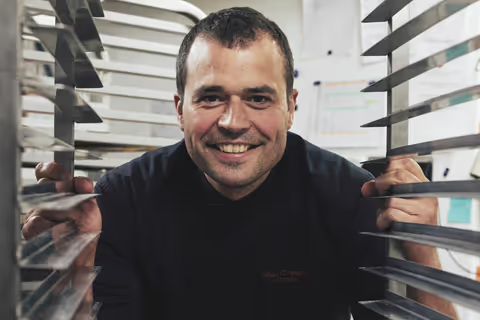
With its taste of roasted fruit and caramel, praliné is one of the favorite ingredients of chocolate lovers. Not so many professionals make it, however, as it requires a mastery of baking. Gilles Cresno produces it according to the rules of the art, and goes even further... Passionate about technique, he creates an enchanting palette of textures and tastes.

A native of the Vendée region, Gilles Cresno started out as a pastry chef before taking his chocolate CAP and joining La Maison du Chocolat, where he trained alongside Pascal Le Gac. he trained alongside Pascal Le Gac, who worked in this famous chocolate factory for twenty-five years before moving to Saint-Germain-en-Laye.later, at Hervé Robin's, now in Périgueux and Bergerac, Gilles continued his training and learned the art of standards, accuracy and precision. The young man had no shortage of ambition when, at the age of 24, he set up his own small chocolate factory on Mont Valérien in the Hauts-de-Seine. On a garden level, in a street that doesn't see many people pass by, business is almost non-existent. But his passion for handling tools and transforming materials keeps him going.
Until the day he opened a store in Rueil-Malmaison. The location, the footfall and all the energy he had put into it brought him recognition. Sales take off! The praliné was already there, but the chocolatier knew he needed know-how and equipment. He's going to remedy that. He learns again and again, and invests in the right machines and larger premises in Nanterre.
Smooth and creamy
Gilles Cresno tastes a lot, tests a lot (all kinds of tests, smoky, fruity, floral...) and relies on what he likes. "It' s often the simplest things that are successful. "Loyal customers know they're in for a treat with Gilles Cresno's signature chocolates, which offer incredible value for money. listening to them, the chocolatier understands that pralines are very, very popular. Among all the dried fruits, almonds come from Spain (Valencia variety), pistachios from Sicily and Iran, but hazelnuts are undoubtedly among the favorites. He chooses them from Piedmont, although he is also interested in French production.
His spread, made with 50% hazelnuts, is a great success. Gilles is also interested in gianduja, a Piedmontese paste made from a mixture of roasted and ground hazelnuts, sugar and milk chocolate. It takes two hours in the grinder to achieve the desired smoothness and creaminess: "There are a lot of gianduja fans out there ", he enthuses. Its smooth texture is very appealing, while other customers appreciate a chewy texture.
from an identical composition, depending on whether the praline is smooth or crunchy, the perception is different and the taste can change completely. This fascinates Gilles Cresno, who can't stop talking about technique, granulometry, stabilization, crystallization...

© Sébastien Dubois
The art of precision
Praliné is a mixture of sugar and dried fruit (50-70%), cooked and ground to a paste.almonds, hazelnuts, pistachios, walnuts, cashew nuts, peanuts - any dried fruit can be transformed into praliné, provided it is sufficiently fatty.
There are two main schools of praline-making. The first - which can also be made at home - involves preparing caramel, roasting dried fruit and mixing the two together before grinding. This is a simple method, but it doesn't allow perfect control of caramelization and roasting. At Gilles Cresno, praliné is made by sandblasting. In a large copper pot, 30 kilos of dried fruit and 20 kilos of sugar are cooked. The sugar is transformed into a syrup that coats the dried fruit with its skin, adding character. Over the course of several minutes, the sugar crystallizes, creating a sandblasted effect. It then melts and caramelizes, while the dried fruit gradually loses its moisture and roasts to a core. Constant care is needed to ensure that the dried fruit and caramel reach the peak of flavor without burning. The preparation is then poured onto a table equipped with a water-cooling system that stops the cooking process. The large slabs of caramel topped with dried fruit are then ground in a blender to the desired praline.
Gilles Cresno makes a number of pralines that serve as "bases": almond, smooth almond, hazelnut almond, smooth hazelnut almond, hazelnut, smooth hazelnut, old-fashioned praline, spread, gianduja. at this stage, praliné is an oily, runny paste, as the fat of the dried fruit stands out. To hold in a chocolate bonbon, you need to "glue" the praline, i.e. add dark or milk chocolate and/or cocoa butter. The praline will then set and hold in the chocolate coating. And it's from these bases that the chocolatier creates his other recipes, adding dried fruits, seeds, cookies, spices, etc. for different textures and tastes.
At Gilles Cresno's, there's no shortage of choice, with some twenty pralines available: gianduja, smooth, old-fashioned (coarsely ground almonds and hazelnuts), feuilletine (slivers of crêpes dentelle), topped with pistachios or caramelized hazelnutses, corn, coconut, peanuts, walnuts, buckwheat flour cookie, coffee, vanilla... And you can't get enough!
Pralines, but not only
Although praliné is the star recipe in the stores of this discreet but talented chocolatier, people also come to him for his ganaches (a ganache is a mixture of chocolate and plain or cream-infused cream).me plain or infused with herbs, spices or other ingredients, the fat of the cream fixing the aromas particularly well) varied and original. Among the most famous are those with pepper, ginger or orange blossom. But his expertise doesn't stop there. It is also renowned for its ice creams, fruit jellies and tablets. Something for every taste.