






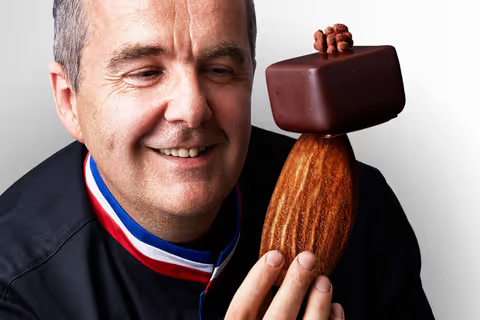
Fabrice Gillotte, art and matter
The man nicknamed "l'Ours" by the profession because he's allergic to the mundane, was the first, in 1991, to win the title of Meilleur Ouvrier de France chocolatier confiseur. Curious and inventive, he entered the competition with a machine that revolutionized the profession.
From his Grand Atelier near Dijon, Fabrice Gillotte continues to work in haute couture style, inspiring younger generations and entertaining peers curious to understand his high-tech methods.
How did you get into chocolate?
Fabrice Gillotte: I grew up surrounded by the smells of Le Parrain Généreux, my father's patisserie. His workshop was my playground. But I couldn't see myself taking over from him - I dreamed of being a graphic designer - until the day he suffered a stroke at the age of 42. I came to help my mother for six months... And I'm still here. back then, chocolate was only eaten at Christmas and Easter, and the same Lenôtre range was everywhere. You have to see how ganaches were worked in the 1980s. It wasn't very nice! When I met chocolatier Robert Linxe, who had a different sensibility, I realized that we could do things differently, and I started to explore the cocoa bean.
How did you come up with the idea of taking the Meilleur Ouvrier de France competition?
F. G. : I'd been fantasizing about the Meilleur Ouvrier de France pastry competition for a long time, admiring chefs like Lucien Peltier in Paris 7ᵉ and Pascal Niau at Dalloyau. When my father, who saw me constantly experimenting, read about the creation of a chocolate and confectionery title, he challenged me. just as well, I'm a bit of a stickler and I wanted to prove that I was one of the best. I was 25 years old. I took the plunge, but I had to brush up on my confectionery skills. I was lucky enough to work with Monsieur Sender. He had been a royal court confectioner and called me "the kid". It was thanks to him that I was able to impress the jury with a fruit puff pastry.
What memories do you have of these three days?
F. G.: Insomnia! Facing these juries of fastidious experts (MOF pastry chefs, renowned professionals) who judge your work, your artistic presentation, and who taste, is crazy intense. The timing is merciless, down to the minute. Since then, when I prepare candidates, I make them work with a stopwatch in hand.
What made you different from the other candidates?
F. G. : Back then, chocolate bonbons were made with alcohol to improve their shelf life. It was while observing my wife's cream in our bathroom - without air bubbles! - that I began to wonder. After all, chocolate is the same thing: emulsified fat. So I turned to the cosmetics industry to find out, and began by ordering a vacuum grinder from Germany. It was with this tool, which went on to revolutionize our profession, that I arrived at the final of the competition. It produced better textures while releasing more aromas and flavors. In fact, I arrived with my own fruit concentrations. For the buffet and the artistic piece, I remember choosing a 1930s theme.
How did it feel to put on your blue-white-red collared jacket for the first time?
F. G. : Pride, of course, but I quickly realized that with the title came a duty: to pass on the message. And, above all, to be wise. A lot of doors opened up, and the day after the competition results, the phone started ringing non-stop.the phone call that made me the happiest was from Gaston Lenôtre, who invited me to set up a preparation program for the competition. I did so for three years. But the title was never an end in itself for me. I wanted to get back to my research.

jérémie Blancféné
Did you subsequently perfect this technique?
F. G. : Today, every chocolate maker worth his salt works with this vacuum grinder. But I continued to play the little chemist. An INRA researcher helped me to understand the role of water activity in preparations. I ended up investing in yet another Aw-meter, an instrument for measuring water activity - a big budget and quite a risk at the time, but one that paid off. Whereas my colleagues' chocolates went mouldy quite quickly, ours were more stable. They are now set for two months with no loss of taste. Today, our workshop in Norges-la-Ville (Côte-d'Or) is like an F1 racing team! A highly specialized, highly mechanized facility. Not only is it exceptionally clean, but we can also work on more complex products. Ganache is not one layer, but two or three! Technology brings sophistication of texture and intensification of taste.
What would you like to do today?
F. G. : To keep innovating, to come up with playful products, like these new "clouds", marshmallow cupcakes, as light as the wind, with a tangy heart. Continuing to find the best origins for our classics and pralines. Imagining beautiful packaging with my son Julien. Eighteen months ago, we also opened Beurre Noisette, a boutique where we revisit classic viennoiserie and patisserie with exceptional products. It punctuates a journey. It's a return to my roots. It doesn't fill my hyperactivity, but offers what I prefer, a new challenge. at 60, I'm back at work!
Fabrice Gillotte
- 21, rue du Bourg, 21000 Dijon
- www.fabricegillotte.com