






This exceptional cognac has been immersed in the Atlantic Ocean
Les ateliers Camus unveil a new creation, sold in a limited edition of just five: an eau-de-vie blended from exceptional cognacs, inspired by Jules Verne's "Twenty Thousand Leagues Under the Sea".

It is on the basis of this work that Julie Landreau has imagined an exceptional cognac. Cellar master at the Camus workshops since 2020, she joined this family-run house in 2011 as a laboratory technician.
Four initial cognacs
Her creation, "Sous les mers", is a blend of four initial cognacs. One, aged 12 years, underwent a technique known as "chauffe crocodile", which softens the eau-de-vie. Another, 13 years old, was aged at Fort La Prée on the Ile de Ré. " It's been cradled by the sea spray," explains Julie Landreau.
Another stone in the edifice: a 14-year-old cognac, " born during the storm of the century, when the ocean passed over the island of Ré. The vines had their feet in the ocean. "The last cognac to be added is a 17-year-old eau-de-vie, " from plots very close to the sea, which causes a fine film of salt on the grapes. "
With this experiment, " we wanted to innovate: to blend the tradition of cognac with innovation ", explains Julie Landreau. For the novelty aspect, the cellar master went back to her chemistry classes. " We put the 35-liter barrel of this blend in the ocean off the Ile de Ré. With the tide, it was sometimes submerged, other times not. "
Normally, cognac is kept in a room without light, at a constant temperature. " In this case, we had parameters that were neither controlled nor controllable ", says the specialist.

dR
From the usual 15 degrees to 7 or 40 degrees at sea
The barrel was placed in a corrosion-resistant stainless steel cage, " weighing 90 kilos all in all, so that it wouldn't move off the seabed. "The first six-week immersion took place on August 2, 2024. The temperature varied between 7 and 40 degrees. " The variation is normally between 15 and 25°C. At these temperatures, alcohol evaporation was higher, and the brandy dropped by 5 degrees of alcohol. " Usually, water is added. Here, we reached 48% without water. "
The 35 liters were then put into a dame-jeanne. " We added Fine Champagne 1972. The wink is that it comes from a harvest during which the weather was exceptional. "Then a new immersion was carried out in early February, this time with temperatures fluctuating between zero and 17 degrees depending on the tide. In the dame-jeanne, a century-old Borderies eau-de-vie was added. " It's one of the most sought-after cognacs, it has a certain aromatic intensity. "
The result: a unique product, a rounder, more iodized, fresh and rich cognac. " It was magical, I really enjoyed creating this cognac ," smiles Julie Landreau.
" The idea now is to adapt this practice for large-scale use. "For the moment, the cellar master is trying to explain the effects of these immersions: " In any case, we know that the salt and tannin acted. "
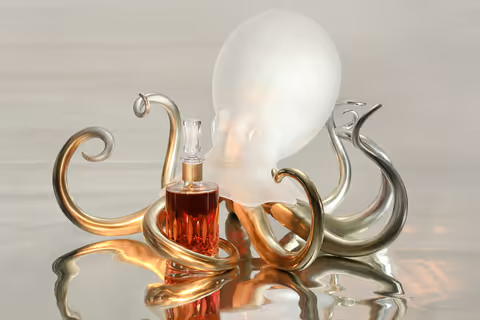
at each stage, a sample was taken to be tasted. Potential buyers present at the presentation in Hong Kong were also able to taste these samples. But no one has yet discovered the final product: only five lucky people will have that privilege. To enhance this creation, Maison Camus teamed up with master glassmaker Daum. An octopus, sculpted in bronze and crystal, surrounds the decanter, each detail paying homage to Jules Verne's underwater world. Price per piece: 200,000 euros.