






Songes et Cacao, cocoa know-how
If you're hoping to savor the bars of chocolatier Yann Maritaud, based in Lamastre, Ardèche, you first have to find him. Wedged between a yoga room and a cookie factory, his workshop is well hidden. However, enlightened chocolate lovers know their way around the doors of Songes et Cacao to satisfy their bean-to-bar chocolate cravings.

Yann Maritaud is certainly one of the most committed and innovative artisans in the world of bean-to-bar chocolate. This movement, which first appeared in the United States in the early 2000s, then in France from 2010 onwards, consists of taking back control of the transformation of beans into chocolate, a quasi-monopoly long held by industrialists. These chocolatiers - of which there are around 150 in France - import cocoa beans into their factories, and control all the stages involved in transforming them into chocolate. A titanic task requiring specific equipment and time.
The call of taste
Initially, nothing predestined Yann Maritaud to convert to chocolate making. After fifteen years working as a cinematographer, he found himself on forced leave when the lockdown came. No more shoots. No more films. Time to spare and moments to think about. In particular, he remembers tasting a chocolate made from raw beans, which made a particular impression on him, and tries to reproduce it in his kitchen. The taste is there. Working with raw cocoa beans, without roasting, keeps the cocoa aromas intact and preserves the nutritional properties of the bean. Filming resumes, but Yann now devotes part of his time to experimenting and perfecting the elaboration of his raw chocolate. He trained at Chocobio in Anduze, Gard, with a bean-to-bar artisan, and, after two years of a life divided between chocolate and cinema, opened his Songes et Cacao workshop in 2022.

Excellence driven by exacting standards
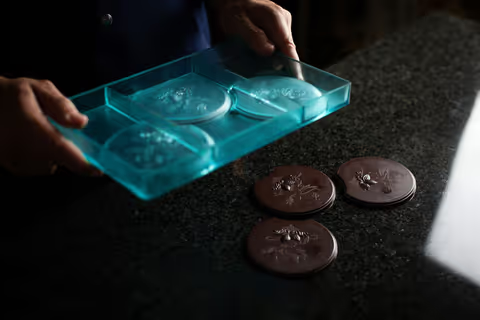
Four years later, Songes et Cacao produces one tonne of chocolate a year, the equivalent of 15,000 bars. A quantity that would put a smile on the faces of the cocoa behemoths, but it's enough work for Yann, alone in his workshop. Making raw bean-to-bar chocolate demands the utmost attention. It all starts with the sorting of beans from Peru, Côte d'Ivoire, Uganda or Nicaragua, to produce "pure origin" bars. In the absence of roasting, these beans are directly crushed and then winnowed, to separate them from the shells that envelop them. The latter are not thrown away. They are reused to mulch the herbs grown by a neighboring farmer. The cocoa nibs obtained are then ground in a stone mill for 24 hours until they become a smooth, liquid paste. halfway through the process, sugar is added and, if required, spices, coffee or dried fruit for special creations. Cast in blocks of 4 to 5 kilos, the chocolate matures in the workshop for several weeks. like a fine wine being matured, the maturing process smoothes, homogenizes and balances the taste. When it's ready to be sold, Yann melts it, tempers it, then ladles it into his molds. Then comes the last and most tedious stage, hand-packing.

Committed to eating well
After production, it's time to market the products via the online boutique, local retailers and trade shows all over France. This is an opportunity for Yann to promote his different products: pure origin" tablets made from a unique variety of beans, spiced chocolates (ginger, Timut pepper, salt and turmeric or coffee), but also gourmet creations such as praline chocolate with pumpkin seeds, not forgetting spreads, truffles and mendiants. Innovative recipes reflect a commitment to the taste and nutritional quality of our products, such as this chestnut flour bar, a lactose-free alternative to milk chocolate.

A know-how that is also committed to a more virtuous cocoa economy, both in terms of producers' income and the sustainability of their farming practices. Certified organic and Nature et Progrès, Yann Maritaud is keen to promote the craftsmanship of his practices, and will soon be giving himself a better showcase with the opening of a store in Lamastre.
This article is taken from the Auvergne-Rhône-Alpes 2026 guide and is available in bookshops and on theGault&Millau e-shop.