






Sébastien Bras in 5 dishes
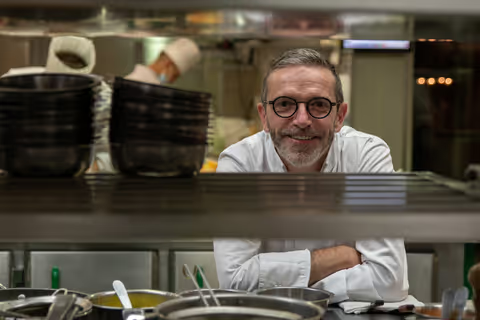
Sébastien Bras, chef at Le Suquet restaurant in Laguiole, tells us the story of five dishes that have marked his career and his cuisine, rooted in the Aubrac region.

Son of Michel Bras, heir to a unique culinary heritage rooted in Laguiole, Sébastien Bras has carved out his own path with sensitivity and inventiveness. Between family traditions, vegetable experimentation and gentle audacity, he tells us about five dishes that have shaped him at Le Suquet restaurant (4 toques).
The indestructible dish: the coulant imagined by his father
"Born in the early 80s, Michel Bras' signaturedessert has been with Sébastien since childhood: "I was about ten when my father perfected it. I took part in tastings, I ate a lot of them ...", he laughs. While the technique wasn't quite perfected at the time, the pleasure was immediate. As an adult, Sébastien has turned the coulant into a living product, an infinite playground: "We've created around 150 different versions (sweet and savory), with varied textures, temperatures and combinations." A dessert in perpetual evolution, never set in stone.

anne-Claire Héraud
The daring dessert: the potato wafer
The fruit of a failure transformed into a delicacy, this potato wafer is an emblematic dessert of the house. "During a trip to South America, we discovered many varieties of potato. We brought some back to try growing them in Laguiole, but most of them rotted: bad temperature, bad soil... A resounding failure!" But the idea stuck. Sébastien Bras then imagined a slow confisage of potato ribbons, which become a crispy tuile with a subtle taste. "My grandfather, a blacksmith, made the steel baking tray to measure to get the perfect texture," recalls the chef. Topped with a hazelnut butter cream, this wafer blends tradition, inventiveness and family tenderness.

anne-Claire Héraud
Souvenir dish: his grandmother's lamb shoulder confit
"For a long time, it was my grandmother who prepared the staff and family meals. Her favorite dish was lamb shoulder, preserved in salt the day before and cooked the day after", says Sébastien Bras. "But she had a flaw: she was often late for everything! So, to save time, she would put the meat in a very hot oven to speed up the cooking process, resulting in a very pronounced crust and a juicy, soft interior."The memory is still vivid: "I used to shred the top with my hands, I loved it."Served with potatoes cooked in broth, garlic and bacon, this lamb shoulder still embodies his work with meat: contrasting textures, the right taste, raw emotion.
The dish born of a challenge: croque moelleux from La Halle aux grains
Born of a conversation between hotel school friends, this dish is a contemporary challenge: "We wanted to create a product for fast-food restaurants that was at once gourmet, balanced and practical to eat."The result is a fluffy croque served today at La Halle aux Grains in Paris. The base? A crêpe batter made from whole or semi-complete organic cereals, rehydrated with plant-based milk, poured into a made-to-measure mould. In the center, a steamed vegetable filling. "A healthy, structured croque-sandwich that illustrates the chef's commitment to modern, sustainable food.

anne-Claire Héraud
Reflecting origins: pastre (or bag of bones)
A rustic dish from the heart of the Aubrac region, pastre (or "bag of bones") is a local cured dish made from pig bones, stuffed with pieces of lean flesh, encased in a large gut and dried for months. "Sébastien Bras turned it into anephemeral gastronomic dish: cooked for a long time in a broth, this salted meat was served with a fresh saffron pastry.

anne-Claire Héraud
Planned to remain on the menu for just one month, the dish made quite an impression: "One food critic was very moved. He almost had tears in his eyes. I was proud, because from a very simple dish, I had succeeded in turning it into something beautiful." A sincere ode to roots, between finesse and fidelity.