






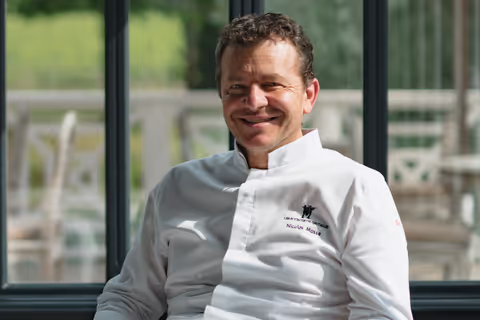
Nicolas Masse: “You don’t need a decoder to understand my cuisine”
From the Sources de Caudalie vegetable garden to celtuce, Nicolas Masse, chef at La Grand'Vigne in Martillac, showcases his culinary world through five dishes.

At La Grand'Vigne (4 toques), at Les Sources de Caudalie, Nicolas Masse has created a culinary style where plant-based ingredients take center stage and where every ingredient seems to have a story to tell. Through five dishes, the chef revisits the creations that have shaped his career, from his earliest dishes to those that today embody his pursuit of simplicity.
A Stroll Through the Vegetable Garden: The Founding Dish
It all begins with a stroll through the vegetable garden. That day, Nicolas Masse found artichokes, Swiss chard, and tarragon. The idea took shape around a stuffed Poivrade artichoke, served with a Swiss chard fricassee and tarragon butter. Originally, the dish was simply meant to serve as a side dish for meat. But the chef gradually chose to reverse the proportions and make it the true star of the plate. “I made it my mission to elevate the ingredient,” he says. This evolution also marked one of the first steps in his culinary journey toward greater simplicity: fewer elements, but greater precision in their combination. “Getting to the essence, removing the unnecessary, focusing on the harmony of flavors, the single ingredient,” the chef summarizes. Since then, the dish has continued to evolve, eventually being served with a caviar stuffing and a lovage-infused barigoule sauce. “ I like to assemble my dishes like a fine wine, combining flavors, textures, and tastes to create a truly lingering finish.”

© Agence Pancake
Vegetable caviar: the sweetness of spring
In the spring, Nicolas Masse eagerly awaits the arrival of the peas. He likes to pick them very young and taste them raw, when they offer that vegetal sweetness and distinctive sugary flavor. From this harvest comes a dish as simple as it is precious, named “Vegetable Caviar.” At the bottom, a tartlet holds fresh goat cheese. A few grains of oscietra caviar then add a touch of saltiness, before the whole creation is almost completely hidden beneath a blanket of garden peas. “All you see are the peas—it’s magnificent,” the chef describes. Here, there’s no cooking involved: just a few ingredients and careful assembly. A deliberately ephemeral dish, dependent on the day’s harvest, which can sometimes be served to only a few tables. The sweetness of the peas then becomes the central theme of a composition where plant-based flavors meet the briny notes of caviar and the freshness of goat cheese.

© Marie-Pierre Morel
Land and Sea: Getting to the Essence
With eggplant and bluefin tuna from Saint-Jean-de-Luz, Nicolas Masse continues this same pursuit of simplicity. The eggplant is first cooked and candied, then melds with a piece of tuna during cooking. Beneath, an eggplant caviar mixed with capers and candied lemon adds another dimension to the dish. Three sauces round out the plate: an anchovy sauce, an eggplant milk, and an eggplant jus whipped with butter and seasoned with a hint of lemon. They blend together to add depth, while nasturtium oil can be used to enliven the whole dish. Here, the chef focuses as much on flavor as on visual composition, paying particular attention to proportions and cooking techniques. It’s a dish in which the ingredients remain immediately recognizable, without resorting to excessive artifice.

© Agence Pancake
The Angry Egg: A Memory from the Early Days
Some dishes eventually leave the menu without truly disappearing. Such is the case with “L’œuf en colère,” a creation that Nicolas Masse prepared frequently during his early days at Les Sources de Caudalie and that the restaurant can still prepare upon request from certain guests. The soft-boiled egg is wrapped in phyllo dough and then fried, creating a contrast between a crispy shell and a runny center. It is served with a spinach chlorophyll whipped with garlic. Its name comes directly from its appearance: with the phyllo dough arranged around it, “it looks as though the egg has its hair standing on end.” The dish reflects an important period in the evolution of the chef’s cuisine, even though he now acknowledges having moved away from it. Over time, this creation has become a memory that regulars can still enjoy.

© DR
Aromatic celtuce and eel: today’s cuisine
With celtuce, Nicolas Masse returns to a plant-based cuisine that suits him particularly well. The vegetable is cut into long strands, like spaghetti, then coated in a slightly thickened arugula oil to add creaminess.

© Agence Pancake
Surrounding it, a smoked eel cream adds depth and character. The dish relies less on a multitude of ingredients than on how they complement each other. The vegetable remains front and center, while the eel adds a smoky and more intense note. “It’s a dish I really like—one that gets to the heart of the matter and surprises with its simplicity,” says Nicolas Masse. This philosophy sums up his current approach quite well: “ You don’t need a decoder to understand my cuisine—it’s straightforward.”