






France's most traceable chocolate? Matéo's incredible bet
From the cacao tree root to the chocolate square, Matéo Cosnefroy, an agricultural engineer by training and now a bean-to-bar chocolatier in Saint-Jeannet, transforms his Peruvian cocoa beans to create chocolates that are the true reflection of a terroir and know-how.

going against the grain of a chocolate industry whose traceability is sometimes uncertain, Matéo Cosnefroy has taken up the challenge of being totally transparent. By transforming his own cocoa beans into chocolate, he has committed himself to the bean-to-bar philosophy, a movement that brings together some 150 chocolatiers in France and promotes the diversity of cocoa tastes from around the world by taking back control of every stage of processing, from bean to bar. In his workshop, Matéo goes even further. His beans are imported exclusively from the San Martin region of Peru and, like single-crop cuvées in wine, are fermented and processed individually.
Chocolate engineer
Having fallen in love with Peru while taking part in agroforestry projects as part of his studies, Matéo is a man of the field. He joined Choba Choba - a Swiss chocolate brand co-owned by cocoa farmers - to specialize in the genetics of native cocoa. While there, he made friends with Jimy Isminio Gonzalès, a Peruvian colleague involved in the same project. Having just graduated, Matéo continued his research into the fermentation and drying of beans, the first steps towards their transformation into chocolate. He ferments by variety, transforming micro-lots of beans into chocolate and exploring the aromatic potential of each one. Confined to France during the Covid period, Matéo has nothing to do but make chocolate with the 30 or so kilos of beans repatriated from past trips. He took advantage of the situation to enroll in a CAP Chocolaterie (vocational training certificate in chocolate-making), and completed a work-study program at Hasnaâ Chocolats Grand Crus, a bean-to-bar factory in Bordeaux.

In April 2021, Jimy inherits a cocoa plantation in Peru, Alto Miro. Naturally, the two friends teamed up to create a fermentation center, while Matéo opened his Racine Carrée chocolate factory in Saint-Jeannet. Eager to explore a wider range of cocoa varieties, the duo set out to find other plantations in the region: "In the first few years, we visited around a hundred ". In the end, Matéo and Jimy chose just four, with whom they established a relationship of trust. Jimy oversees everything in Peru, Matéo manufactures in France.
Harvesting, fermenting, drying and processing
The pod harvest peaks between April and June. After a summer break, a smaller harvest takes place in October and November. Every year, Matéo takes a two-month leave of absence to take part in the harvest and make sure the fermentation process runs smoothly, plantation by plantation.

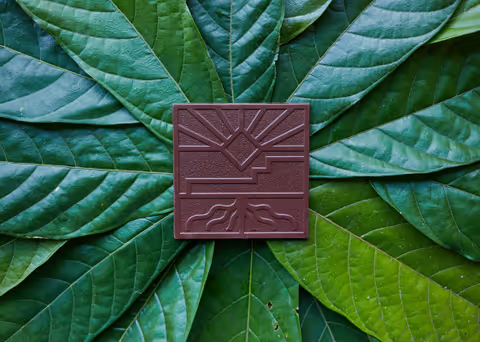
on arrival in France, the beans are roasted, separated from their skins, then ground in a stone conche with sugar to a smooth paste. Moulded into blocks, the chocolate matures for several weeks before being melted and poured into bars. The result is five bars of local dark chocolate made with just two ingredients - whereas industrial chocolate may also contain cocoa butter, soy lecithin and sometimes salt and vanilla. To take things a step further, Matéo omits the roasting stage on certain batches to obtain a raw chocolate, leaving enthusiasts the pleasure of tasting two identical bars, except that one of them is produced without roasting the beans.
Tasting and distribution
In addition to the tasting squares, for which the back labels indicate the name of the producer, the cocoa genetics, the type of soil, the surface area of the plot and the fermentation time, there are a number of other delicacies. Peanuts from Arcachon, almonds from the Drôme, saffron from the hills of Saint-Jeannet and lemon from Menton enhance the precious chocolate in flavored or filled bars, spreads and cocoa powders. Available to consumers in Saint-Jeannet, as well as from retailers in Nice and Paris (Galeries Lafayette Gourmet, La Grande Épicerie), Matéo's chocolates have also won over professional restaurateurs. These include Le Canon (13/20, 2T) in Nice, La Table des Baous (11.5/20, 1T) in Saint-Jeannet, and La Flibuste (14.5/20, 2T) in Villeneuve-Loubet. Today, joined by Camille Buisson, his fiancée, their projects are multiplying. In particular, the couple are organizing 8 to 14-day trips to Peru to introduce cocoa culture to amateurs and professionals alike, and will soon be opening a new laboratory-boutique in Nice. Racine Carrée is growing, but its essence remains the same: to promote cocoa from exceptional varieties and unique terroirs.

- Racine Carrée
- 45 rue du Château, 06640 Saint-Jeannet
- www.racine-carree.com
- @racine_carree_choco