






The Bus Palladium is reborn: a hotel within the walls of the legendary Parisian club
It marks the rebirth of one of Paris’s legendary nightlife hotspots. Just a stone’s throw from Pigalle, the Bus Palladium—brilliantly redesigned and expanded—is reopening its club and adding a hotel and a restaurant with a vibrant atmosphere, where the concept of “experience” truly comes to life.

On the facade, the same sign with red neon letters, just like a hotel. A sign of its future transformation? Since its founding in 1965 by James Arch, a 22-year-old bebop dancer from Asnières, the Bus Palladium has had generations of feverish night owls dancing on its floor—from Mick Jagger to the young suburban partygoer who, for a 10-franc bus ticket, could gain access to Parisian nights previously monopolized by the social elite.
It was from this shuttle bus, specially chartered from Argenteuil or Bois-Colombes, that the “Bus” took its name, with the word “Palladium” coming from a well-known New York nightclub. This unconventional combination, driven by a fierce desire for freedom and diversity, was a perfect fit for this quirky two-story white-brick building, which stood out like a gap in the row of Haussmann-style facades. This wild adventure was to come to an end in 2022, with the closure of the now-legendary club—not without a certain pang of sadness for Christian Casmèze, the owner of the venue, who had been a patron of the Bus himself since the age of 15, back in the mid-1980s. His grandfather had purchased this late-19th-century building at the Foire du Trône in 1924—a venue that, even before the Bus, had always been dedicated to entertainment, serving in turn as a café-concert, theater, cabaret, and dance hall. A new project was needed to live up to its legacy, and it is precisely these six additional floors that mark its rebirth today.
The “Bus” Vibe
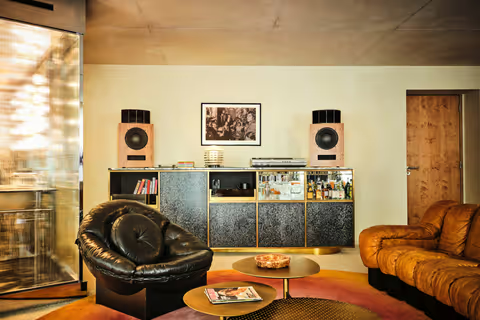
The idea of creating a hotel took root as early as 2016 and came to fruition after meeting with architects Karl Fournier and Olivier Marty of Studio KO, followed by Nicolas Saltiel of the Chapitre Six hotel group. Thirty-five rooms, including one suite, a restaurant, a bar, and—as always—a club and concert hall rebuilt almost identically in the basement, with the idea that the Bus comes alive 24 hours a day—even if it means staying there an entire weekend without ever getting bored. “One of the key priorities for us is having full control over the space,” says Valentin Brietz, the general manager. The feeling of stepping into a cocoon takes hold the moment you walk through the doors, which are finished in a reflective midnight blue. The thoughtful use of materials is a common thread throughout these spaces, which exude—through the subtle, amber-scented fragrance, the thick velvet, and the tanned leather—an indefinable chic that’s both cool and sexy, tinged with a ’70s vibe. In the rooms, the exposed concrete ceiling, the thick, pop-style powder-pink carpet, and the enveloping cork walls create a space full of contrasts, bringing it to life. On the walls hang black-and-white photos and modern-inspired paintings, along with Ojas wooden speakers, specially designed for the project.

With a delightfully vintage style and unparalleled sound quality, they let you listen to four playlists curated by Caroline de Maigret, model, music producer, and artistic director of the Bus Palladium. Whether it’s full-on rock with the Talking Heads, Can, or Baxter Dury; soul with Bootsy Collins, Christine Perfect, or Yellow Days; or jazz with Julie London, Donald Byrd, or Chet Baker, the music infuses every moment of the day and invites you to make the room your own, curl up on the sofas, and daydream in this timeless bubble, which also plays with light and shadow in the bathroom with its grooved glass walls—where silhouettes are revealed or concealed through a system of sheer curtains. The spotlights around the mirror create the feeling of being in an artist’s dressing room, the doorknobs resemble old-school microphones, and the mustard-yellow bathrobes cast their soft silhouettes against Klein blue tiles.
The languid atmosphere takes on an exhilarating edge at the bar corner, which is anything but “mini,” given its fine selection of bottles—both alcoholic and non-alcoholic. Whether vintage or not, each piece of furniture has the potential to spark a story or a memory—like the audio cassettes stacked in clear blocks at the head of the beds, or the art objects you can purchase by scanning the “L’œil de KO” QR code, the architectural firm’s gallery of objects, to take a little of the hotel’s spirit home with you. This spirit finds its quintessence in the Dalí suite on the first floor, with a balcony overlooking the red sign, a fold-away bed, a upholstered alcove, a wall of mirrors, and a 1970s modular sofa—a nod to the Spanish artist who once called the Bus a “jewel of kitsch art” and hosted a party where his guests mingled with the club’s regular beatniks.
Connecting Threads
In the hallways, Persian-inspired patterned carpets unfurl their colors between the raw concrete walls all the way down to the ground floor, into the reception area topped by a lighted marquee reminiscent of old-fashioned movie theaters, and in front of a fireplace, adorned with gold, ready to receive its first logs. The bar, at the center of an intimate space, cultivates a subdued atmosphere, with the outside light taking on a blue hue as it filters through the windows and latticework of the facade. This blue is echoed in the large mirror covering one of the restaurant’s walls, where the tables wrap around a patio with lush vegetation. Serving as a link to the venue’s history, the record collection of James Arch, its founder, takes on the air of precious treasures in a bookshelf equipped with a speaker, where a DJ often takes his place to spin records during dinner.

On the plate, diners experience the full creativity of Chef Valentin Raffali, a former contestant on “Top Chef” who honed his skills under Louis-Philippe Vigilant when the current chef of La Côte d’Or — Le Relais Bernard Loiseau in Saulieu—was still atL’Oustau deBaumanière in Les Baux-de-Provence. The menu draws inspiration from Valentin Raffali’s travels, prioritizing locally sourced ingredients and homemade preparations, such as Banka trout smoked on-site. That evening, it was served in a broth with rhubarb water, aloe vera, verjus, and nasturtium flowers. The young chef also enjoys putting a new spin on classics that have fallen out of favor, such as pig’s trotters, which he serves crispy, Thai-style, accompanied by a bouquet of aromatic herbs. The desserts, classic on paper, are served in bowls by an enthusiastic and attentive dining room staff.
As the hours pass, the lights dim, the volume rises, and the atmosphere becomes electric. It’s time to party in the club, with its disco ball, lamé curtains, and Persian-inspired carpet stretching from floor to wall. Contrasts, as always… Josy, one of the Bus’s iconic figures, is certainly no longer at the door, nor is DJ Jean-Charles, who spent over 20 years behind the turntables spinning soul, funk, and Californian sounds you couldn’t hear anywhere else. Concerts, cabarets, performances, screenings, DJ sets… the lineup aims to be eclectic and inspiring, in keeping with the spirit of Le Bus.
This article is excerpted from the Paris-Île-de-France guide. It is available in bookstores and on the Gault&Millau e-shop.