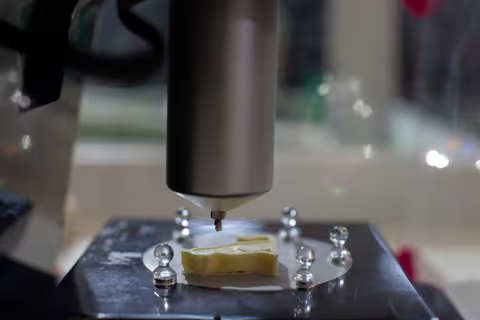
From artificial intelligence in every dish: managing stocks, reducing food waste, making menus more appealing with gourmet photos. Even the restaurant industry is affected by this technological revolution. However, they did not wait for AI to draw from the best of new technologies to serve their establishments. The use of so-called connected or smart devices is not new. Yesterday, sous-vide cooking... Take the Thermomix for example. Indispensable in most professional kitchens today, it was originally intended for domestic use since its launch in 1961 by the German brand Vorwek. In terms of cooking techniques, one cannot fail to mention sous-vide cooking, now a non-issue in the gastronomic sphere, although this cooking technique developed by George Pralus in the 1970s had to wait a long time to overcome criticism. After developing his technique in the kitchens of the Troisgros brothers by using a foie gras terrine as a guinea pig, the Roanne chef taught his know-how to future greats like Michel Bras or Alain Ducasse. "Last night, it was midnight when I started sous-vide cooking ducks," says Arnaud Viel, the chef of the gourmet restaurant Arnaud Viel, La Renaissance. And to emphasize "the sous-vide technique allows for a real concentration of flavors and a very interesting texture retention. It is used for cooking but also for preparing infusions." The advantage is not only gustatory. The use of sous-vide cooking is also part of a broader reflection now engaging professional kitchens to better value raw materials and reduce energy costs. "In this way, we optimize energy consumption," says the three-toque chef. In his Norman kitchen, Arnaud Viel also acquired a Robotcoupe C40 which allows him to extract the essence of products that usually end up in the trash: pea pods, scallop beards. "I make consommés and gels with this raw material that contains a lot of flavor," says the Argentan chef. By his own admission, it was his son, Arthur, currently a member of Yannick Alléno's brigade at the 1947 at Cheval Blanc in Courchevel, who shared the discovery with him. "With this robot, the work becomes faster and more consistent," he acknowledges, confident that discoveries of new technological innovations are shared among chefs. But before turning the button on his C40, Arnaud Viel performs a maneuver that his peers would probably never have imagined: cryogenics. Understand: passing a culinary preparation through liquid nitrogen to subject them to an extremely low temperature. At the chef of La Renaissance, this technique generally associated with molecular cuisine allows him to recover the liquid loaded with flavor. Unknown in the kitchens of great restaurants in the 70s and 80s, cryogenics appeared under the impetus of the famous Spanish chef Ferran Adria, in his mythical Catalan restaurant El Bulli. Mousses that disappear in the mouth, airy ice creams, smoke spheres that impress... Cryogenics has helped make gastronomy an instant spectacle. ...and now 3D printing "The whole goal is to make a dish memorable. A plate must be of quality, that's logical. But for customers to remember it, the visual must be impactful," analyzes Sylvain Renzetti, the Bordeaux chef with a unique universe. In his restaurant Son’Restaurant, the winner of the Young Talent Nouvelle-Aquitaine 2022 award diverts objects he makes with a 3D printer: a cocotte (like the paper one we made as children), a Lego brick, a bookmark integrating edible ink. "I use technology to support my message," insists this former rocker. The musician turned chef deliberately signs a playful culinary score and thus assumes integrating material that some might consider superfluous, like this "flavor blaster gun" that Sylvain Renzetti uses to create a cotton candy smoke around his dessert imagined on the theme of The Little Prince. "The whole challenge is to serve a food that customers have never eaten in this form," acknowledges the young chef. This openness to technological innovations, Sylvain Renzetti integrated it during confinement by reading Charles Spence's book entitled "Gastrophysics: a new science to enlighten our food choices." "I understood that not everything had been explored yet and that today's gastronomy was ultimately a new art dating from the 90s," sums up the Bordeaux toque. Are technological innovations in the kitchen really limitless? Chemical, tasteless, lacking emotion. We already hear the criticisms of those who would oppose this insurrection of new technologies within professional kitchens. "Our job is to seek out taste. These innovations simplify tasks for us. But, we must not rely on them to believe that we are creating 'new cuisine,'" tempers Arnaud Viel, who defends himself from being a fan of molecular cuisine just because he uses the cryogenics process. In Bordeaux, Sylvain Renzetti even considers that it would be a mistake to view cooking as a technological demonstration. "The limit is that it should not be chemical!" he concludes. Anne-Sophie Pic's point of view (4 toques) Are cutting-edge equipment and high-tech tools now indispensable to support gastronomic creation? Anne-Sophie Pic: Being in tune with your time does not mean becoming totally dependent on technology, but knowing how to integrate it intelligently to facilitate the work of kitchen teams. New technologies are a valuable asset in the kitchen. We thus need to combine choice technologies to help us push the limits of culinary creativity. In my laboratory in Valence, the Pic Lab, I chose Swiss brand VZug equipment for their great precision and aesthetics. This includes notably ventilated and steam ovens offering unique temperature precisions. These are tools that allow us to precisely control cooking, preserve flavors, and explore different textures. Should new technologies be integrated, just like sous-vide cooking and cryogenics even though they were not initially consensual? A-S P: It is above all the process that is interesting. Regarding sous-vide cooking, I only retained the aspects that seemed relevant to the cooking profession. I diverted certain uses so that this technique integrates harmoniously with the personality of my cuisine. Cooking, like any art, evolves with its time and, as a chef, it is important to adapt to modern tools and know-how. They should not be adopted because they are trendy, but because they enrich the culinary experience. New technologies do not replace work and gestures, but complement them. In my reflection around sauces for example, I use the ROTOVAP, a low-temperature distiller, which allows me to obtain lighter compositions, and more concentrated in aroma. It is a mechanical tool that allows me to distill, and thus not burn the flavors. It reveals the aromatic depth of ingredients while preserving their properties. Distillation allows for purer and lighter concentrates, which is particularly interesting for plant-based dishes. The use is double: one can exploit the concentrate of a vegetable juice while using the distillate for a drink. Isn't there a danger of serving dishes that are too technical, preventing emotion? A-S P: yes, there is a risk if the tool becomes exclusive and if one relies solely on it. However, it remains beneficial when used sparingly, for part of the dish and not in its entirety. 3D printing allows us to push the visual of a dish even further by bringing coherence between intention, visual, and taste. They contribute to enriching the sensory experience, to multiplying the emotion felt.