This Breton fish farm has found the successor everyone is looking for
A leading figure in the Breton fish farming industry, Robert Le Coat is now handing over his farm to the young and passionate Amaury Guet. Amid technical demands and environmental challenges, this smooth transition also highlights the uncertain future of an industry seeking to pass on its legacy.
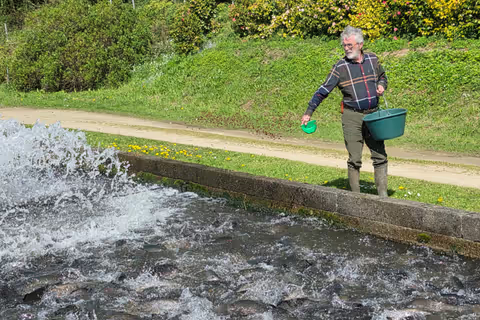
In Plougoulm, on the banks of the Guillec—a coastal river in Finistère that flows into the English Channel—the clear water flows continuously between the ponds, its gentle murmur accompanying the daily work. All around, the orderly paths and unobtrusive buildings create a setting that is as peaceful as it is demanding for Robert Le Coat, who watches over his trout with vigilance. Nothing escapes the notice of this 68-year-old fish farmer—with his full beard and mischievous gaze—who has been officially retired since January 1, 2026, but is still very much present. At his side is Amaury Guet, 29, the new manager of the Dourduff fish farm. This is a rare handover in an industry where farms struggle to find successors.
Born in 1957 to farming parents, Robert Le Coat first worked for fifteen years in the pork industry. His encounter with a friend who was a fish farmer changed everything. He decided to take up the trade and set up his own operation in 1992, without “any prior knowledge,” learning simply by watching.“The most important quality for a fish farmer is a keen eye,” says the man nicknamed “Bob the Trout.” In the ponds, nearly 200,000 rainbow trout grow from fry to three-kilo specimens. It requires constant patience.“Fish are the hardest to raise. ” Careful attention to diet and water quality ensures consistent fish, prized both fresh and for processing. Temperature, oxygenation, acidity, carbon dioxide—no antibiotics, but vaccination… “Here, it’s 24 hours a day, 365 days a year.”
This expertise, which has shaped the reputation of Le Coat—former president of the French Aquaculture Federation—is reflected on the plate. The rainbow trout raised here are distinguished by their firm, slightly pink flesh and delicate flavor, a far cry from the sometimes overgeneralized image of the product. They supply the Breton aquaculture cooperative as well as the kitchens of chefs, such as at the Nicolas Carro restaurant at the Hôtel de Carantec (15.5/20 – 3 toques). The farm also produces trout caviar—those orange-colored eggs with a delicate texture.
This exemplary journey, however, has been anything but smooth sailing. In 2010, pesticide pollution devastated the farm.“Everything was dead.” A catastrophe that serves as a reminder of the fragility of this profession, which depends on an environment it cannot fully control.“We’re the catchment area for the watershed,” sums up the young retiree, who has a wealth of knowledge about fish farming. “
The Next Generation Is Assured
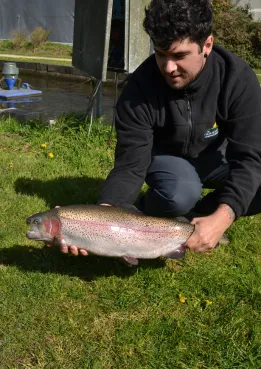
After studying aquaculture at the Olivier Guichard High School in Guérande, Amaury Guet discovered a unique workplace here eight years ago.“The farm is beautiful and functional. That’s a significant advantage,” says the young man, who has always been“drawn to living things.”A relationship of trust quickly developed. Robert Le Coat, who has had only five employees in thirty-five years, sees him as much more than just an employee.“Amaury is just as passionate as I am,”he says happily. The idea of letting go and gradually stepping back began to take hold. “You only live once. You have to know when to stop,” says the man who still owns the property. The handover becomes both obvious and necessary
For behind this individual handover lies a broader issue. In the world of agriculture and aquaculture, farmers are aging, and candidates to take over are few and far between. Here, the passing of the torch is part of the continuity of expertise patiently built up, often outside of academic settings. “I learned by observing nature, by constantly seeking solutions,” insists Robert Le Coat, who drew up the plans for his farm himself. The future remains to be seen—it looks as bright as it is unpredictable. Climate change, among other things, is a cause for concern.“When the water warms up, the fish eat less, grow less, and the entire economic balance is thrown off,” acknowledges Amaury Guet, who, despite the challenges he’ll face, truly has trout in his blood—so much so that he’s even had it tattooed on his arms.
▶ This article is excerpted from the *Bretagne 2026* guide. Find this guide in bookstores or on our online store.