






Rare citrus fruits that chefs are snapping up
The sweet-sour and tangy notes of citrus fruit are (g)astronomically popular. Many varieties, still unknown in France only 15 years ago, owe their fame to passionate chefs and orchards, many of which are located in the south of France.
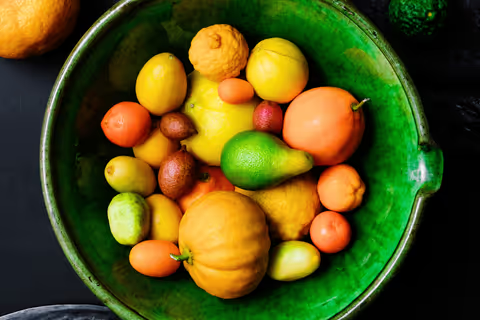
The world's most widely traded fruit, citrus fruits come in a multitude of varieties. While the classic oranges, clementines and mandarins, yellow and green lemons, pomelos and grapefruits provide a healthy dose of vitamins in winter at our latitudes, other, more confidential varieties of the botanical genus citrus and its relatives have been brought to the fore by chefs with a passion for acidity. After the sweet Meyer lemon, in vogue in the 1970s, and the IGP Menton lemon, it's now the turn of the highly aromatic kumquat, calamansi (or calamondin), cédrat, Buddha's hand, yuzu, combava and caviar lemon to bring originality to plates, from starters to desserts. Produced mainly in northeast India, China, Japan, Southeast Asia and Oceania, most of these varieties have been cultivated for several hundred years, but new crosses appear regularly and are even becoming acclimatized in France.
History of crossbreeding
From the popular Latin acrumen, derived from acer (sour), citrus fruits are thought to have originated in the hot, humid mountainous areas of Asia six to eight million years ago. The first known Mediterranean citrus fruit, a citron, originated in the Himalayas around 300 BC. This large, irregular fruit is, along with the grapefruit and mandarin, one of the three primitive citrus fruits. The others arose through natural hybridization, such as the orange and sour orange, a cross between grapefruit and mandarin, or the lemon, a hybrid of sour orange and citron. at the end of the XVIIIᵉ century, the clementine is said to have been discovered in Algeria in a mandarin orchard by a monk named Clément. Today, it enjoys a Protected Geographical Indication (PGI) in Corsica.
Developed in France from the XVIᵉ century onwards, under the generic name of orange, citrus fruits shot to fame with the Versailles orangery, quickly imitated throughout Europe. Since then, genetics has made it possible to establish the citrus family tree, even if there are still some grey areas. from the XXᵉ century onwards, botanists succeeded in intermarrying species to give birth, for example, in the 1940s, to the clemenvilla, a cross between a clementine and a tangelo, which itself is a hybrid between a mandarin and a pomelo.
France, its new home
Today in France, citrus growers are expanding from year to year in the south-east, mainly in Alpes-Maritimes and Pyrénées-Orientales, and in the south-west, notably in Landes and Corsica. In addition to the Inrae estate in San Giuliano (Corsica), home to one of the world's richest collections of citrus fruits, independent growers have contributed to the growth of national production. Among them is Agrumes Schaller, in Eus (Pyrénées-Orientales): former owner Michel Bachès got into the citrus game after a request for bergamots from Alain Ducasse - who, like Claire Heitzler, now has plants named after him. Taken over in 2017 by Perrine and Étienne Schaller, a couple of agricultural engineers, this organic orchard supplies 300 restaurants in Europe, with a few exclusives, such as the New Zealand pomelo reserved for César Troisgros. Étienne Schaller believes that"the tangy calamansi, the herbaceous sudachi and the very sweet dekopon are emerging" and points out that "the more chefs use citrus, the less they transform it!"
This article is taken from nᵒ 12 magazine. It is available in bookshops or on theGault&Millau e-shop.