






What You Don't Know About Glenn Viel's Cuisine at Baumanière
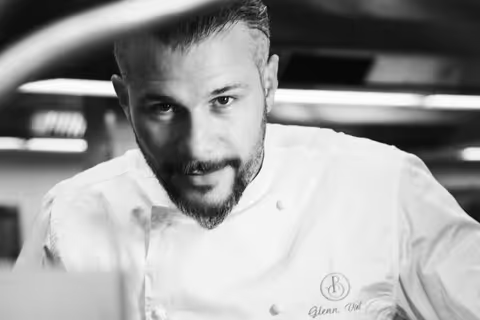
At the Oustau de Baumanière in Les Baux-de-Provence, Glenn Viel creates a cuisine that eschews showmanship to better capture what truly matters: flavor and emotion.

At Glenn Viel’s restaurant, L’Oustau de Baumanière (5 toques) in Les Baux-de-Provence, cooking is never just a performance. It takes shape in the moment, through a kind of intuitive interpretation of the meal and the person experiencing it. ““Psychology is part of my cooking,” he confides. It’s a way of acknowledging that the guest—their mood and energy on any given day—is an integral part of the equation.“The main ingredient in my dishes that I can’t control is the guest and how they feel.”
In his restaurant, it’s all about precision rather than showmanship.“My signature dish is the one I haven’t created yet,” he jokes. And while Glenn Viel’s cuisine is impressive, it seeks above all to convey something simple: a flavor, a memory, a perfect moment. Here are five dishes, ideas, or cooking techniques explained by the chef to help you understand his culinary world.
Potatoes cooked in pork fat: a return to the basics
This is one of the foundational techniques of Glenn Viel’s cuisine. A simple, almost obvious idea, born from a traditional cooking technique: wrapping potatoes in a pork caul, like a roast that’s sewn up and slowly roasted in the oven.“The potatoes cooked in the pork fat. There were no gimmicks or over-the-top flourishes. It was the right idea, more than a show,” recalls the chef of L’Oustau de Baumanière. This dish, essential to his culinary philosophy, illustrates this pursuit of simplicity rather than spectacle.
Pairing Dishes with Bread: A Simple Idea That Became a Signature
For a long time, bread was merely a side dish. At Glenn Viel’s restaurant, it has become a true element of the meal. Introduced about eight years ago, the pairing of dishes with bread now sets the pace of the dining experience. Different flours, varied textures, precise baking: bread is conceived as a product in its own right. But above all, it must not disrupt the start of the meal.“We never put bread on the table before the dishes arrive. Otherwise, guests will stuff themselves, and that’s counterproductive.” It’s the chef’s way of preserving the desire to eat and keeping the appetite intact! And while the breads served initially were beautifully presented and portioned into individual slices, they are now made in larger quantities and sliced to order.“Bread needs to be substantial to develop its aromas. Beauty comes after taste.”

A very, very charming periwinkle: taste comes before appearance
In this dish, everything is deliberately unsettling, starting with the presentation, which isn’t meant to be immediately appealing.“It’s a dish that’s a little ugly,” Glenn Viel readily admits. Set against a sauce of persimmon-colored periwinkles, the carrot stands out in a play of contrasts. Simple, almost unassuming ingredients that“don’t make you want to get up in the middle of the night”… and yet.“When you taste this dish, there’s a real ‘wow’ factor,” assures the chef, who hails from Brittany. This dish is based on a principle dear to Glenn Viel: surprise, like a poorly wrapped gift.
Pigeon cooked by thermal inertia: a true exploration of cooking
This dish is the result of an almost scientific approach to cooking. For a long time, the team searched for the perfect point without necessarily taking into account one essential parameter: thermal inertia. Previously, the chef would remove his pigeon from the oven when the bird’s internal temperature reached 52 degrees.“The problem is that once the pigeon is out of the oven, the temperature continues to rise, and the cooking process continues,” explains Glenn Viel. After running some calculations, the teams at L’Oustau de Baumanière realized it was better to remove the pigeon from the oven when its core temperature reached 37 degrees, after just 11 minutes of cooking.“The temperature continues to rise for 22 minutes, reaching 52 degrees,” the chef explains. The result: meat that’s always at the right temperature and never overcooked.
The Abalone: A Childhood Memory and 15 Years of Reflection
An intimate dish if ever there was one, the abalone says as much about the chef—who spent much of his childhood in Brittany—as it does about his cuisine.“When I was little, we used to go abalone fishing, and I remember my grandfather pounding them so hard to tenderize them that they didn’t look like anything anymore,” says the Top Chef judge with a smile.

“After 15 years of thinking it over, I found a way to tenderize it properly while preserving its natural character,” he explains, keeping the secret of his discovery to himself. Now, the abalone is presented simply, accompanied by seaweed and placed on a piece of pink granite—a nod to the fishing grounds of his childhood.