This man from Lille bet on kombucha before anyone else did
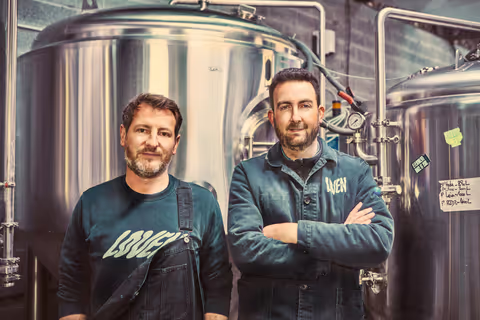
Just a stone's throw from Lille, a brewery unlike any other in the land of beer. Charles Dumeignil and Guillaume Limousin brew modern, creative, delicious, organic, and natural kombuchas under the brand name Loven—a portmanteau of “love” and “levend,” which means “alive” in Flemish.

When Charles Dumeignil founded his kombucha brewery in 2019 in Phalempin, south of Lille, he was the first in the Hauts-de-France region to venture into this market. With low sugar content, a high concentration of probiotics, and a short, reassuring list of ingredients, kombucha is winning over a broad audience and offering brewers the prospect of significant market share to capture.
Canadian Pioneers
In Wambrechies, as soon as the brewery door opens, a powerful scent of mint fills the air:“We received the packages this morning; we use the leaves to make an infusion for one of our kombuchas, ” explains Guillaume Limousin. The space, which serves as a shop, office, kitchen, and even a testing lab, opens onto the brewing room where the tanks await filling.
Although the duo moved into this former rope factory in 2022, the story really began in 2016, and Charles was the one who started it all. While living abroad in Canada, he discovered kombucha and an unprecedented craze for it. Intrigued, hetried his hand at making it in his kitchen, then trained in cafés and under Sébastien Bureau, the “fermentation druid” and co-author of the book *Révolution kombucha*(Les Éditions de l’Homme). Upon his return to France, Charles left his job as a marketing manager in the IT sector to launch his kombucha production business. He partnered with Euralimentaire, an incubator that supports food-related projects in the Hauts-de-France region, moved in with his parents in Phalempin, and, in late 2019, his first bottles, even though he was aware that the drink was still unknown to the general public. The road to making it more widely accessible is long, but Charles is fully committed to it.
AChance Encounter
Meanwhile, Guillaume, after fifteen years in the brewing industry, wanted a change of pace and to devote himself to a more personal project. He reached out toEuralimentaire and met Charles. It’s only a short step from kombucha to beer. One has knowledge of the product; the other, expertise in fermentation. In September 2020, they shared the ambition of making kombucha a truly enjoyable beverage. Initially, they limited themselves to three recipes sold in local restaurants and bars: a first one called “original,” a second with hops, and a gingerbeer in which the kombucha culture, combined with the native yeasts found on the skin of the ginger, naturally kickstarted the fermentation process. Charles and Guillaume then expanded their recipe lineup and gave them a gourmet twist with original flavorings such as bergamot, mint, and Espelette pepper, or ginger and cardamom.
Modern Druids
For the production process, which lasts about three weeks, two types of tea are used: a Chinese green tea and an Indian black tea, steeped together for just one hour at 60°C to prevent bitterness from developing. The blend is then sweetened and placed in a tank to ferment: “We don’t use a kombucha mother, because that acidifies the product, but rather a kombucha culture—also known as Soby[an acronym for‘symbioticculture of bacteria and yeast’ ”— in French, “symbiotic culture of bacteria and yeast”—which is maintained regularly and will gradually recreate the kombucha mother.”
For about ten days, two fermentation processes occur simultaneously: one alcoholic—converting sugars into alcohol through the action of yeast—and the other acetic—converting alcohol into organic acids through the action of bacteria. When the kombucha is ready, fermentation is halted by cooling it in conical fermenters, which put yeastactivity to sleep . Before bottling, the kombucha is flavored: fruits, spices, or herbs—whether in the form of purees, juices, or infusions—anything goes as long as the flavoring agents are rich in flavor. “We work a lot with spices; they add flavor without adding sugar.”
To create new flavors, the duo flips through cookbooks and studies pastry trends before starting with two liters:“Then we scale up to 200. We have people taste-test here and there, and then we go for 2,000 liters.” ” While some flavors are obvious choices, others spark debate—such as elderflower, which Charles would like to use. Guillaume, skeptical, confides: “ We have an organic producer in Cassel [Nord], but the harvest only lasts two to three weeks, so you have to be ready.” Charles adds with a smile: “ He’s hard to convince, but I’ll get there eventually!”
Sustainably Produced Beverages
Grocery stores, organic shops, and specialty retailers like Otera and Le Fourgon have been won over by their kombuchas, which contain no added sugar and are unpasteurized. The proximity between the retail locations and the brewery allows them to recover 70% of the returnable bottles, which can be reused. The appeal is also due to the fact that the duo has proven they can use a variety of local ingredients, such as beet sugar, which is gradually replacing cane sugar—even if this requires some adjustments to the yeast cultures. A day will come when they’ll work with chicory and local flowers, and when the tea will be French, as domestic production is on the rise.
The main hurdle , for now, remains the purchase price. In the meantime, the product line evolves with the seasons, as the beverage has a shelf life of only five to nine months. Clémentina, in particular, has become a classic—a blend of tonka bean and Corsican clementine, using every part of the fruit, from leaf to peel, in both infusion and juice form. At the same time, the duo has been working on “clean sodas, ” a healthy alternative to industrial sodas. Three basic ingredients: water, sugar, and kombucha, which serves as a natural alternative to citric acid. Low in sugar and free of preservatives, this drink is a source of pride for the two friends—and with good reason! The summer version, featuring raspberry, hibiscus, mint, and cucumber, offers complexity and balanced flavors. “It’s red on the outside, but green on the inside,” Guillaume points out.
In Search of New Flavors
In a fermenter, a new recipe featuring fig leaves. Intended to be paired with yuzu, it’s biding its time because the citrus season ended too early, just as the kombucha wasn’t ready. That’s kind of the Lovenspirit : try, fail, try again. An unapologetic rock ’n’ roll attitude and boundless creativity, as exemplified by the challenge of craftinga nettle-based kombucha, sourced fromFlorent Layden at the Auberge du Vert-Mont in Flandersto create a limited-edition blend pairing the wild plant with melon. A challenge successfully met by a rapidly expanding company that will soon move into larger facilities to produce 1,200 hectoliters under better working conditions; and to provide space for developing new recipes and printing labels that are as funky as ever—a key factor in helping the duo stand out in a market where new competitors have emerged to challenge them.