





This everyday vegetable hasn't always had the color we know today..
Although it's the second most widely consumed vegetable in France, it has a special, centuries-old history that's not all that obvious.

Colorful and popular, the carrot has made its way onto our plates. However, behind its apparent simplicity lies a surprising history, made up of journeys through centuries and countries. It has changed appearance, taste and even role several times, before becoming the essential vegetable we know today.
The origins of the carrot
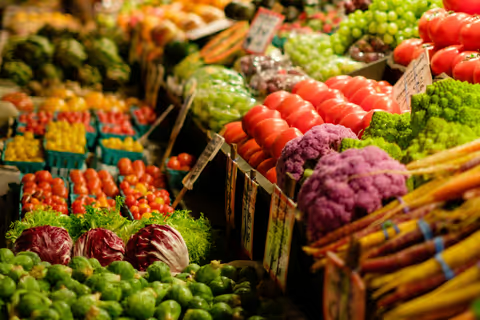
The carrot is widely recognized on market stalls, not least for its shape and emblematic orange color. Those in the know will know that there are multi-colored carrots, but do you know why?
The first carrots, cultivated several millennia ago in Asia, were white and stringy. But because of their low cost, they were widely consumed. Later, it was used more as an aromatic plant. The leaves and seeds are removed in the same way as fennel.
The root then became edible, after several crosses. Carrots come in many shades, from pale yellow to deep purple.
The story behind its orange color
This vegetable was then chosen by the Dutch to pay tribute to the House of Orange-Nassau in the early 19ᵉ century, which then ruled the Netherlands. After much selection work, the carrot became as we know it today: long, sweet-tasting, and with a high concentration of beta-carotene.
With this widespread variety, the old colors have been eclipsed. Nevertheless, they are making a comeback on market stalls and restaurant tables, not least thanks to their often-appreciated aesthetic appeal.
Carrots become a classic of French gastronomy
Carrots owe a large part of their benefits to their vitamin A content, which plays an essential role in slowing cell ageing, tissue regeneration and skin health.
In the kitchen, too, the carrot is an indispensable ally. With its distinctive flavor and texture that can range from crunchy to melting, it has become an indispensable ingredient in many French gastronomic dishes, and as a side dish.