






Everything You Need to Know About Olive Oil Terminology
Learn and understand olive oil terminology, from fatty acids, green fruitiness, and black fruitiness to cold-press and alicoque extraction.
Learn and understand olive oil terminology—from fatty acids, green fruitiness, and black fruitiness to cold-press and alicoque extraction. To make sense of the vocabulary from the olive grove to the bottle, check out the glossary.
Oleic Acidity
A parameter that measures, on a precise scale, the percentage of free fatty acids contained in olive oil. It is determined primarily by the conditions under which the olives are harvested and stored. The more damaged the fruit is, the higher the oleic acidity will be. Regulations require that extra virgin olive oil have an acidity level of 0.8% or less, and virgin olive oil, 2% or less.
Alicoque
The name formerly used in the Drôme region for the evening meal eaten by mill workers and farmers after a day’s labor. The meal consisted of a crouton rubbed with garlic and seasoned with freshly pressed oil. Today, it is the name of a festival celebrating the end of the harvest in Nyons, famous for its olive oil—the first to receive, in 1994, a Protected Designation of Origin (PDO).
Bitterness
In olive oil, bitterness is a criterion of quality in terms of both organoleptic properties and health. It is linked, on the one hand, to the variety and, on the other, to the early harvest—and thus to the amount of polyphenols present in the oil. It diminishes as the olives ripen and as the oil ages.
Pungency
This is the tingling sensation in the throat when tasting the oil. Pungency varies from one variety to another: it is more pronounced in oils produced early in the season from olives that are still green and decreases over time.
International Olive Council (IOC)
An intergovernmental organization based in Madrid, founded in 1959 under the auspices of the United Nations, the COI is dedicated to olive oil and table olives and serves as a forum for discussion on olive cultivation. Its mission is to encourage international cooperation, support scientific research and technical innovation, and contribute to the sustainable management of olive resources worldwide, particularly in the face of climate change. Its responsibilities also include the adoption of a number of regulatory and standard-setting measures. Finally, it accredits sensory analysis laboratories authorized to conduct olive oil tastings.
Cold Extraction
Contrary to popular belief, olive oil is not pressed but extracted from olives. In fact, traditional pressing has been largely replaced by centrifugation. The oil is extracted using mechanical processes under controlled temperature conditions that must not exceed 27°C, in accordance with regulations. At higher temperatures, yields are higher, but the trace elements in olive oil—particularly polyphenols—degrade, as do its organoleptic qualities. The term “first cold-pressed” refers to the fact that, in the past, there was a second hot-pressing process. Since this is no longer practiced, there is no longer any need to label it as such.
Fruity
A classification of the olfactory sensations that characterize the aromatic profile—and part of the organoleptic value—of an olive oil. It is determined based on the ripeness of the harvest.
Green fruitiness
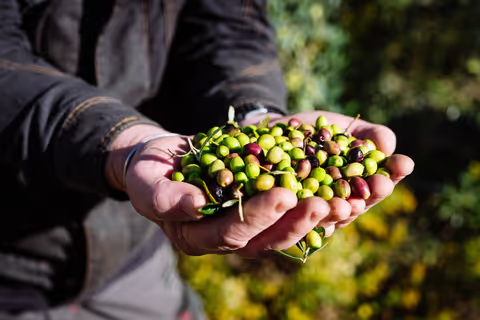
Produced from olives harvested green or just turning green at the start of the season. Its aromas are reminiscent of freshly cut herbs, artichokes, or even green fruits. On tasting, it may develop a certain pungency before revealing its full roundness and complexity on the palate.
Ripe fruitiness
This oil comes from olives harvested at full ripeness. Its aromas evoke ripe fruit, almonds, and hazelnuts. This type of fruitiness offers a certain sweetness and a delicate roundness on the palate.
Dark Fruity
Also known as the “traditional flavor,” it results from a deliberately late harvest. The olives are fermented in palox containers, sealed off from the air, revealing intense, almost candied aromas of nuts, cocoa, and mushrooms. The dark fruit profile has little bitterness and little pungency—an organoleptic characteristic long considered a flaw that prevents it from qualifying for the “extra virgin” classification. Nevertheless, this traditional method has its devotees. Certain designations of origin, such as that of Les Baux-de-Provence, have rehabilitated the dark fruit profile by marketing, with the approval of the National Institute of Origin and Quality (INAO), a “ripened olives” version.
Olive pomace
A byproduct of olive oil production consisting of skins, pulp residues, and fragments of pits. During extraction, the centrifuge separates the solids from the liquids—oil on one side and olive pomace on the other. The pomace is then pressed to extract oil, which is subsequently refined, blended with virgin olive oil, and marketed under the name “olive pomace oil.” Olive pomace is also used as a soil amendment for agricultural land, as fuel, or to make Marseille soap.
Oxidation
An active process that begins when olive oil comes into contact with air or is exposed to heat and light. As a result, the antioxidants beneficial to health gradually disappear. However, modern techniques prevent this oxidation process. “Olive oil is one of the few food products where mechanization—from crushing to extraction—has been harnessed to enhance quality,” notes biophysicist Christophe Lavelle of the CNRS.
Flavor Profile
The taste of olive oil is defined by three major characteristics: the type of fruitiness, the intensity of its bitterness, and the intensity of its pungency.
Xylella fastidiosa
For more than ten years, this bacterium has been ravaging olive trees in Puglia in southern Italy. Carried from tree to tree by insects, it attacks a wide variety of plants, including grapevines, olive trees, coffee trees, and more. First detected in France in 2019 on two olive trees in Menton and Antibes, it is a major concern for French olive growers.
This article is excerpted from Gault&Millau magazine,issue no. 14. It is available at the Gault&Millau online store.