






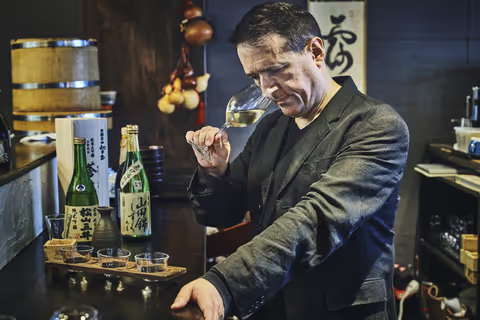
Sylvain Huet, the sake dancer
Between dance, aikido and sake tastings, Sylvain Huet transforms each experience into a path of excellence and sharing, becoming a veritable living bridge between France and Japan, between body and culture.

On October 4, 2012, Sylvain Huet made history by becoming a "Sake Samurai" on the recommendation and co-optation of three sake producers who considered thathis commitment and exceptional knowledge of how the beverage is made and its history, as well as his passion for defending it, deserved this distinction usually awarded to Japanese. A title that Sylvain accepted with great humility, as it echoes one of the thoughts that dictates his life: " Not to be attracted by social status, but by sensations to be lived to the full. "
From stage to dojo
As he admits himself, he's a bit annoyed with calendars and the memories that go with them. His life is made up of so many passions that dates end up overlapping, intermingling and colliding. What is certain is that it all began in 1970 in Poissy [Yvelines], where Sylvain was born, before growing up in Saint-Germain-en-Laye and the nearby village of Maule. He was a good student, or rather a brilliant student, at the Lycée Hoche in Versailles, but without the slightest competitive spirit. By his own admission, competition "bored" him, but he was aware that, at the time, everything he did was relatively easy. He dabbled in everything - piano, maths, theater - and was interested in sound and lighting.he was interested in sound and lighting, but stumbled upon a subject that a sports teacher decided to introduce to his pupils - dance.
Sylvain is in his early teens and his body is as stiff as justice. For the first time, he understands that he will have to fight and work to master an art that resists him. While attending the twenty or so hours a week of mathematics, physics and computer science classes at Orsay University, he gets involved and puts his now supple body through twice as many hours. A Stakhanovist of the inward turn, the balancé, the chassé, the dégagé, the gambade and the sissonne. With sound and lighting back at the forefront of his mind, he also wanted to enter the ENS Louis-Lumière. He took the competitive entrance exam and finished second, but at the last minute, just as the doors of the school were opening to him, the call of dance was stronger. He gave in to the suggestions of a choreographer who encouraged him to make a living from his passion. He would devote ten years to it, but remained highly dependent on subsidies and fees from right and left. Serenity, level zero.
An encounter slowly led him to Japan: Pierre Doussaint, dancer and choreographer, is also an aikidoka.sylvain took an interest in this martial art and, as with everything he undertook, gave his all to the point of becoming a third dan within a few years. This new passion, which he indulges while pursuing a career he describes as a "computer geek", takes him to Japan, where new adventures and discoveries begin, and his life opens up in a new direction.
"You're more Japanese than we are
In 1999 or 2000 - the damned calendar plays tricks on him - Sylvain lands in Japan for the first time. As far as his bank account was concerned, things were looking up. As an IT and marketing strategy consultant, he charges a fair price for his knowledge and can afford to travel to a country renowned for its high cost of living. On the spot, he wants to know more about aikido, which has definitely taken over from dance, and about the budoka, the warrior in the noble sense of the word, the expert martial arts fighter, the heir of the samurai.
From the very first meetings, the Japanese spoke to him in their mother tongue, convinced that he was one of them by the way he moved, his stature, his presence, the way Sylvain held his body. The years of dance and aikido can be read on his physique. To make himself understood, he decides to learn Japanese and, as with dance and aikido..., to the full. He stayed a while, went back, came back, read a lot between two trips to learn more about the traditions and ceremonies, such as the tea ceremony. he fell in love with it to the point of studying calligraphy, wooden objects, ceramics, architecture and garden design.the "way of tea" or tea ceremony takes time to master. Considered a social practice, it is both a bubble in time and a moment of purification that he lives to the full.

© Guillaume Czrew
Encounter with sake
During one of his trips to Japan to deepen his mastery of aikido, he discovered sake at dinner. That evening, he had no desire for wine, unlike his aikido comrades who were accompanying him. For his palate, it was a shock, a revelation.he tried one variety after another and, like the tea ceremony, understood that he was bringing a piece of Japanese culture into his body. As with his previous passions, he set out to learn more, to learn, to master, by taking courses and professional training courses, notably those of John Gauntner, the world's leading sake expert. and visiting producers during the long winter months of production, his hands immersed in the hot, barely steamed rice.
Unformatted by wine and the words associated with tasting, he developed his own language to define his sensations, creating a vocabulary that he adapted according to the person in front of him. As the months go by, the Japanese see him as an expert on sake, able to define the market with a scientific, marketing and taste approach; in fact, he is better known in Japan than in France.to stay above the fray, he refuses to become an importer or to associate himself with prefectures or sagakura (production companies). His credo is to share his knowledge. He multiplies tastings, visits to producers - 300 in ten years out of a potential 1,000 - conferences, workshops, consulting with Europe,he approached chefs, sommeliers and wine merchants, founded the Sake Academy, put journalists in touch with Japanese institutions and producers, and created the Salon du Sake in Paris.all to achieve the mission he has set himself: to educate and train the general public and professionals alike, while remaining independent.
This righteousness, combined with his culture, led him to earn the title of "Sake Samurai" in 2012. Since then, water (from a spring) has flowed into the sagakura and, in thirteen years, his notoriety has only grown, to the point that his master, John Gauntner, says he's "very proud" of him.his master, John Gauntner, calls him " a brilliant man, in constant activity (...) who has reached full maturity in his field ".enough to sketch out a few dance steps of joy or pride.