






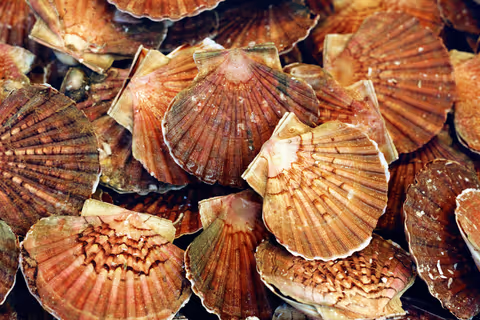
Scallops, the queen of shells
Chance: the scallop is both a gourmet delicacy and a preserved resource in France's main shellfish beds. From October to mid-May, you'll have no hesitation in feasting on this melting, pearly muscle, which lends itself to the simplest as well as the most sophisticated preparations.
"Scallops: record abundance again in the Seine and Saint-Brieuc bays" For several years now, press releases from the French Research Institute for Exploitation of the Sea (Ifremer) have been invariably positive. The 2025-2026 season should follow the same trend. So, unlike other endangered seafoods, this bivalve mollusc, with its red-brown shell, can be enjoyed without a guilty conscience. And to taste its tender nuts in raw or cooked versions, in carpaccio, pan-fried, grilled, poached or in creamy, soya-flavoredwith soy, citrus or truffles, with or without its colored coral, whole or mixed in sauce.
Pilgrimage
This abundance at sea is all the more comforting given that it hasn't always been this way. With a history stretching back thousands of years, the mythological birthplace of Venus in Botticelli's famous painting, and Galicia's traditional emblem for pilgrims returning from Santiago de Compostela, was in danger at the end of the last century.the ransom of success due to the classic chain of events: after centuries of haphazard harvesting, dredging with motorboats in the mid-twentieth century facilitated catches (too much), to the detriment of the species' renewal.
The alarm was sounded in time. Regulations and strict self-discipline on the part of French fishermen were applied to conserve resources in Normandy and Brittany, the country's leading fishing regions.the plan was ambitious: limited number and size of boats, minimum catch sizes set at 10.2, 10.5 and 11 cm depending on the sector, and above all a fishing season restricted to October1 to May 14.thus preserved, fish stocks, estimated at over 94,000 tonnes by 2023, are once again sufficient in quality and quantity. Nevertheless, fishermen of the "largest combs", Pecten maximus, the scientific name given in 1758 by the Swedish naturalist Carl von Linné, are still battling on several fronts. On the one hand, natural predators such as starfish and octopus lie in ambush. On the other hand, commercially, they have to differentiate themselves from other pectinids, such as the common scallops, which are also allowed to bear the name "saint-jacques".
Labels certify the best qualities of Pecten Maximus. In Brittany, where the nuts are naturally coral-free during the fishing season, certain shells from the Côtes d'Armor region have been awarded an IGP, while those from the Bay of Saint-Brieuc have been awarded a Label Rouge.
As for scallops from Normandy, led by Port-en-Bessin-Huppain and Grandcamp-Maisy, slightly larger and recognizable by their two-tone iodized coral, some can boast a Label rouge, while awaiting an IGP hoped for around 2027. But long before that, Normandy shellfish should be awarded the MSC Ecolabel, which recognizes sustainable fishing. A formality, given the conditions now required, even if they don't match the must in terms of sustainability, the manual harvesting of the exceptional diving shell.