






Roquefort: the age-old secret of the "king of cheeses" finally revealed?
The undisputed star of the Occitanie region, enjoyed the world over, Roquefort cheese often has a place on a platter. Made since the dawn of time, it is the pride of a village made famous by a landslide.

Driving along the country roads of Aude, Aveyron, Gard, Hérault, Lozère or Tarn, you're sure to come face-to-face with a flock of Lacaune ewes.to come face to face with a flock of Lacaune ewes, grazing in the distance or gathered around a lavogne to drink.lacaune is at home here, in what is known as the"Roquefort radius", and takes its name from the eponymous mountains shared by Tarn and Aveyron.with its white fleece, pink muzzle and fine, hornless head, the Lacaune is the only breed in the appellation d'origine to supply milk for the production of Roquefort, which recently celebrated the centenary of its appellation following a law passed by Parliament in 1925.
A millennium rather than a century
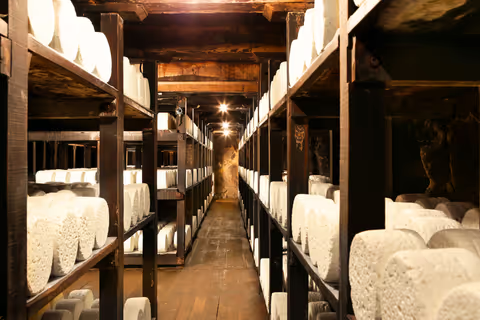
While the year 1925 is still the pride of the entire industry, Roquefort is obviously much older. Can we really date its creation? As with any good story, there's legend and there's fact. Legend has it that a shepherd forgot his snack of bread and cheese on the Combalou rock - which today houses the maturing cellars - to join his beloved. on his return, he discovered his cheese riddled with mold transmitted by the aging of the bread. In fact, the first written mention of the existence of a blue cheese was found in the cartulary of the Abbey of Conques in Aveyron. Four centuries later, King Charles VI (1368-1422) granted the inhabitants of the village of Roquefort, by royal privilege, exclusive rights to mature the cheese in the famous natural caves. This time, the facts are geological.millions of years ago, part of the causse du Combalou collapsed, leaving natural cavities and fleurines, a fissure in the rock that acts as a natural air duct, ensuring constant ventilation and a temperature that fluctuates between 8 and 10°C, summer and winter. It's in these cellars, sometimes tiered over several levels, that Roquefort cheese makers refine the cheese that Diderot dubbed the " king of cheeses".

Back to the sheep
In the village of Roquefort-sur-Soulzon, at the foot of the Combalou, only seven companies make this blue-veined cheese: Carles, Papillon, Société, Gabriel Coulet, Vernières, Maison Combes and La Pastourelle. These seven companies source their milk from 1,334 dairy farmers and their 630,000 ewes in the famous "Roquefort radius". Once collected, the milk is brought to the cheese dairy, poured into stainless steel vats and analyzed before being treated with rennet, which causes the milk to coagulate and turn into curds. A few hours later, the curd is sliced into small cubes, stirred to separate the congealed cheese from the whey, and finally molded into "loaves" - 12 liters of milk are needed for a 3-kilo Roquefort.before being sprinkled with Penicillium roqueforti, extracted for some manufacturers from the crumb of rye bread, while others cultivate very specific strains that give a unique signature to each cheese. Turned over, salted, brushed and then pierced to allow the Penicillium to develop and create those famous blue-green veins, the breads finally head for the village of Roquefort-sur-Soulzon to take up residence in the cellars nestled in a network of underground galleries. Here, they will mature for a minimum of 14 days before being packed, but the maturing process does not stop; it continues slowly - some say in slow motion - away from the light.

Special pairings
Smooth, intense, creamy, persistent, more or less moist, more or less marbled, more or less salty, each Roquefort has its own personality. While they differ from one manufacturer to the next, and from one maturing process to the next, Roqueforts have one thing in common: they can be paired with wines you might not think of. Served on its own, it needs a companion to counterbalance its power. The first can be a maury, a banyuls, a port or a rivesaltes, which will bring roundness and sweetness to face the salinity. The second, whether sweet or syrupy, can be found in most French vineyards, from Alsace to Sauternes and Anjou. The most iconic pairings include a late-harvest Gewurztraminer, a Bonnezeaux, a Coteaux-du-Layon, a Quart-de-Chaume Grand Cru, and further south, in addition to Sauternes, its neighbors Barsac, Monbazillac, Bergerac and the little-known Rosette, which can't help but be moved to be recognized in this way.
This article is taken from the Occitanie-Andorre guide. It is available on the Gault&Millau e-shop.