Without the work of this little-known woodworker, Mont d’Or would not have the same flavor. Summer and winter alike, he cuts thin strips of soft wood from the spruce trees of the Jura Mountains, which are then used to wrap the cheeses before they are placed in their molds.
Stéphanie Bouvet
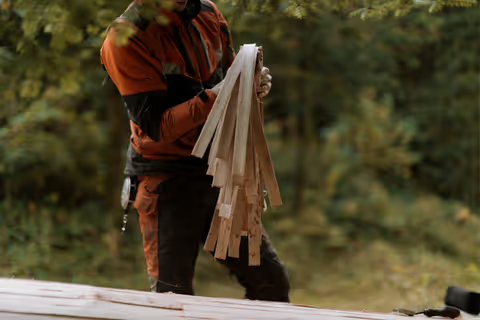
The air is crisp on this foggy November morning in Champagnole, in the Haut-Doubs region. While autumn is still lingering elsewhere, here, in the heart of the Jura Mountains, winter is already setting in. It takes more than that to stop a wild boar. We’re not talking here about the wild boar, but about its namesake, whose job is to cut straps from freshly felled spruce logs. Why cut these strips? To wrap them around the Mont d’Or, of course, and give this star of winter cheese platters its signature woody flavor. Come rain, wind, or snow, the artisan is hard at work. Only freezing temperatures stop him from working, as they make the wood too hard.
The Straps: A How-To Guide
To find Romain Dubat, one of the thirty “wild boars” of Franche-Comté, there’s no address—just a GPS coordinate at the entrance to a private estate. For a day, this land, exuding the scent of humus and resin, will be his playground and that of his partner, Alexandre Verjus, who taught him the trade. The location wasn’t chosen at random. A lumberjack has just cut down some spruce trees there. The wild boar steps in before the tree is cut into sections—to make “mont d’or” boxes, for example. He selects his tree: a minimum size, healthy wood, without too many knots. The work can begin. The movements seem simple, but mastering them takes several months. First, the tree is debarked using a “plumette,” a long-handled scraper. Then, using an articulated tracer with two adjustable blades or a template with a curved knife, the lengths of the future straps are marked, depending on the size of the cheeses. Next, using a spoon—a small, sharp tool he makes himself—Romain Dubat cuts the strips from the bast, the softest part of the wood that forms each year just beneath the bark. On average, five to six trees pass through his expert hands each day, each yielding nearly 800 strips. Finally, he heads to the workshop to use a splitting machine to adjust the thickness of the strips—when necessary—to about 2 mm. The final step involves bundling the strips in sets of twenty-five and arranging them on racks in the drying room, where the temperature rises to 55 °C to eliminate any pests. Once the moisture content drops below 20%, the straps are ready for storage, sometimes for several months. In fact, while Mont d’Or production is seasonal—from August 15 to March 15—the wild boars work year-round. When the time comes, at the cheese factory, the straps will be immersed for 30 minutes in water at 90 °C to restore their flexibility. According to the Mont d’Or AOP specifications, once removed from the mold, “the curd is wrapped in a spruce strap. This strapping is done by hand and must take place immediately following the production process, which includes removing the cheese from the mold. ” Spruce is the only wood species permitted. Fir would be too rigid.
History and Outlook
The first written mention of a banded cheese in the region dates back to 1280. For a long time, the harsh climate made the journey to the Comté cheese dairy too perilous in winter. To avoid wasting their animals’ milk, the herdsmen made small cheeses on the farm for their own consumption. They stored these “vacherins” in straps made of spruce, a wood that grows in abundance in the nearby forests. Much later, with the granting of AOC status in 1981 and then AOP status in 1996, the criteria regarding the straps were included in the specifications, proof of their essential role in the cheese-making process. Like Romain Dubat, the “sangliers” are often men and women deeply attached to nature, and to the forest in particular. It is a peaceful, open-air workplace where one might just spot a doe or a stag. But it’s not all rosy. Even though the Mont d’Or industry is thriving today, thanks to sustained consumer enthusiasm, several threats loom over this physically demanding trade. The first is competition from Eastern European countries. While the PDO specifications require locally sourced milk, the same does not apply to the wood used for the straps. The second stems from the poor health of the forest, which jeopardizes the resource itself. Naturally present in the ecosystem, the bark beetle—a wood-boring insect—is gaining ground year after year, fueled by repeated droughts. Will the efforts of ONF foresters be enough to stem the tide?
▶ This article is excerpted from the Bourgogne-Franche-Comté 2027 guide. Find this guide in bookstores or in ouronline store.