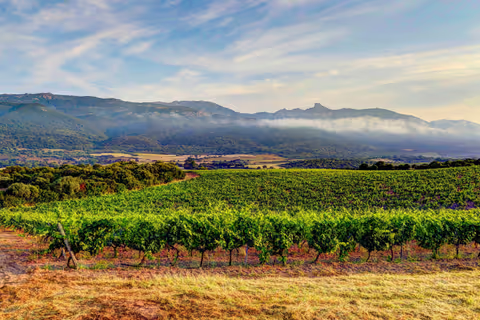
In Corsica, viticulture is a historic economic pillar. Just under 6,000 hectares of vines (half of them PDO) are cultivated all along its coasts. In the department of Corse-du-Sud, Figari and Porto-Vecchio, two geographical denominations within the regional Corsican PDO, are located in the extreme southeast of the island. These small-scale appellations reflect the island's identity, thanks to traditional grape varieties and passionate winemakers.
The Corsican Porto-Vecchio appellation stretches along the entire eastern coast, from Sari-Solenzara in the north to Bonifacio in the south. The vines are planted on a diversity of soils, between sea and scrub, dominated by granite and siliceous arenes. These draining soils force the vines to draw their resources from deep within the soil. High temperatures are regulated by sea spray and rainfall from the mountains, which benefits four estates cultivating 85 hectares of vines. near Bonifacio, the Corsican Figari appellation is the island's most southerly vineyard, and historically one of its oldest. The first vines appeared as early as the 5th century BC on this granite plateau, enclosed by a mountainous arc and open to the influences of the sea. Swept by powerful winds, the environment is arid and rocky. Across three communes with 159 hectares of vines, nine winegrowers endure these harsh climatic conditions, where berry concentration is natural.
Native grape varieties
in Figari as in Porto-Vecchio, sciacarellu and niellucciu lead the way in the production of red and rosé wines, accompanied by grenache. Secondary grape varieties are divided between continental varieties - carignan, cinsault, mourvèdre, syrah - and autochthonous varieties, such as barbarossa, aleaticu, carcaghjolu neru and minustellu. Porto-Vecchio's reds are distinguished by their roundness and elegance, with notes of ripe red fruit and spices. Pale rosés are fresh and lively. in Figari, red wines are often considered the most robust in Corsica, offering a tannic structure and natural aromas of maquis, leather and black fruit, while maintaining great finesse. like the reds, the rosés are full-bodied and spicy, making them true gourmet wines. Vermentinu (also known as malvoisie in Corsica or rolle in Provence) reigns supreme among white wines. It is the only obligatory grape variety, but can also be blended with other heritage varieties such as biancu gentile, codivarta and genevose. in Porto-Vecchio, the whites express a saline minerality accompanied by fruity and floral notes of hawthorn and almond. in Figari, they are full-bodied and rich, with the floral aromas typical of vermentinu and a fine bitterness on the finish, expressing the granite terroir.
Corsican wines in figures
5,955 hectares of vines planted in Corsica
295 producers
54 million bottles produced each year
1% of national production
68% of wine production is rosé
9 PDO
1 GI
This article is taken from the Provence-Alpes-Côte d'Azurguide . It is available on the Gault&Millau e-shop.