






Why the rest of France has abandoned salted butter
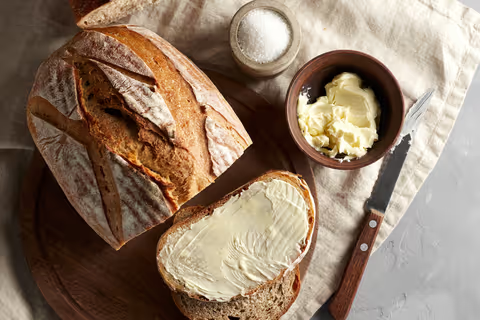
Team sweet butter or team salted butter? Today, the boundaries are pretty blurred, but there's an unusual story that explains the differences between sweet and salted butter consumption in different regions.

In Brittany, salted butter is sacred. But Normandy and the Pays de la Loire are not to be outdone. But why is salted butter so popular in the West? A brief tour through French history is in order to understand why.
Gabelle, the salt tax
The creation of semi-salted butter originally had a preservation function: by adding a few grams of salt to the butter, it could be kept longer and better resist heat.
It was the gabelle, a tax on salt created in 1342 by Philip VI of Valois to finance the war, that redefined history. To save money, many regions in France stopped salting their butter. But not in Brittany! The region was exempt, as it was then a largely autonomous duchy. What's more, it was a major producer of salt, notably in the renowned town of Guérande and in southern Brittany.
some regions, such as Flanders, western Normandy and the Pays de la Loire, paid only a low rate of this tax, and thus retained this habit as well.
The turning point came in 1532, when Brittany joined the kingdom of France, but negotiated hard to maintain its exemption from gabelle. Salted butter thus became a marker of the region's identity.
A symbol for the region
Today, semi-salted butter plays an important role in French cuisine. But first and foremost, it is the pride of Breton plates, and remains a symbol of the region. Salted butter is used to make many gastronomic specialties: salted butter caramel, crêpes, palets bretons, kouign-amann...
This is in stark contrast to the south of France, where the proximity of the Mediterranean basin has led to the use of an entirely different fat: olive oil.