






Why This Château in Bordeaux Grows an Artichoke Variety That's Almost Extinct
The Dutch Albada Jelgersma family, owners of Château Giscours—a third grand cru classé in Margaux—has set out to save Macau camus, the Médoc’s former flagship wine. It’s a somewhat crazy project, fully in line with their commitment to protecting biodiversity.
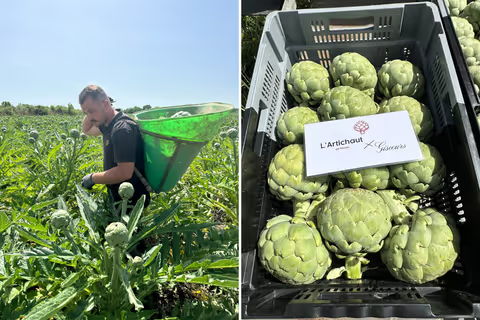
During Bordeaux’s Primeurs week in mid-April, wine enthusiasts from around the world—whether American or Taiwanese—head to Giscours, an estate renowned for its Margaux appellation wines, to get a sneak peek at the 2025 vintage. Alexander van Beek, who has managed the estate since 1995, steps away for an afternoon to check on the day’s other event: the artichoke harvest. This is the very first harvest of Macau artichokes at the château, an unexpected savior of this disappearing delicacy.
Breton Ancestors
This variety is said to have been developed by Toussaint-Yves Catros, a botanist born in Saint-Brieuc in 1757. Appointed at the age of 28 as director of the royal nurseries of Guyenne in Bordeaux, he settled in the Bordeaux region and is credited with landscaping the grounds of Château Margaux. Recognizing the qualities of the Macau terroir, enriched by alluvial deposits from the Gironde estuary, he imported artichokes of the “Camus” variety from his native Brittany. After several rounds of selection, a new local specialty was born: the Macau artichoke (aptly named), with its round, fleshy head, which brought prosperity to generations of local market gardeners. Packed among wine barrels and protected by layers of salt, it was exported “by the barrel” to the American colonies as early as the late 18th century. At the height of its pre-war production, it covered 400 hectares, stretching from the left bank of the Gironde to the outskirts of Bordeaux and across the river’s islands; the volume produced at that time placed it ahead of the Camus varieties from Brittany and the Var. Today, prominently featured between two bunches of grapes on Macau’s coat of arms—despite having nearly disappeared— it lends the town of 5,000 residents a cheerful flavor at the Artichoke Race (not the shallot race), held every fall.

Best-seller
The Macau was long the star of Bordeaux’s markets, sold shelled on the stalls of the “quatre-saisons.” But its cultivation is labor-intensive—particularly during the thinning period—and its mechanized Breton cousin has gained the upper hand. Only one producer remained—Joël Lacroix—to keep the tradition alive on six hectares. This son and grandson of artichoke farmers passed away this year, but not before passing the torch—and some seedlings—on to Giscours.
In a field whose location is kept secret along the estuary—since the tender-hearted artichoke is all too coveted—six hundred plants have thus become the last representatives of the local variety, aside from a few specimens pampered in private gardens. Already involved in preserving the Bordeaux cattle breed at their farm—which also raises Landes sheep and Gascon pigs, a project carried out in collaboration with the Aquitaine Breed Conservatory—the estate’s owners were committed to preserving this botanical, cultural, and gastronomic heritage, which has been designated by Slow Food. The hope is that, through its growing reputation, this initiative will help revive the crop and sustainably protect the Macau variety. The town’s mayor, Chrystel Colmont, also plans to launch a guild.“We need about ten producers to aim for AOC status,” she explains.
Under the Giscours Sun
On a glorious day, in the Médoc with its mild and temperate climate, Pierre-Louis and Maxime Boschetti, market gardeners from father to son commissioned by the château, harvest the plump (and organic) heads of the domesticated thistle, ripe to perfection, which they place in harvest crates borrowed from the estate. The bushy plant, with leaves cut like witch’s fingers but without any prickles, holds up its fruits like raised fists. They must be cut before they open. Each plant bears a “master artichoke”—the first to be harvested—two “offspring” cut a week later, and half a dozen “grandchildren” that won’t have time to grow large but are best enjoyed raw, with a sprinkle of salt. As for the artichoke heart—the receptacle of the unopened flowers that form the silky “fuzz”—it has many benefits beyond the tenderness of its grayish flesh: it’s low in calories, very rich in antioxidants, and good for the liver.
Part of the harvest is sent to La Table de Giscours, where Chef Benjamin Laurent cooks the Macau à barigoule in a white poultry stock. From the cooking broth, he prepares a jelly and an espuma. The finishing touch: chips made from raw hearts, sliced into strips and deep-fried. But“be sure to wear gloves when peeling them,”he reminds us: these tough thistles, which were once planted in vegetable gardens to attract aphids and stink bugs, leave a black sap and a lingering bitterness on your fingers. The blanched stems can be braised or stuffed, while the leaves, when steeped or macerated, are excellent for flavoring broth or oil. Alexander van Beek, the estate’s director, also enjoys them steamed—simply eaten leaf by leaf—but also with hollandaise sauce… given his Dutch roots!
This article is excerpted from the Nouvelle-Aquitaine 2026 guide. It is available in bookstores and onthe Gault&Millau e-shop.